


How to Start Homeschooling: A Step-by-Step Guide for New Families

You’ve made the decision, or you’re close to it.
Homeschooling feels right for your family. But now comes the part that stops a lot of parents in their tracks: actually starting.
Where do you begin? What do you need? How do you know if you’re doing it right?
Here’s the good news: starting is simpler than it looks.
You don’t need to have everything figured out. You don’t need a teaching degree or a Pinterest-perfect classroom.
You need a clear enough sense of direction to take the first step, and then the next one.
This guide will walk you through that process. Not the theory of homeschooling (we cover that elsewhere), but the practical path from “I’m thinking about this” to “we’re doing this.”
Before we talk about curriculum or schedules, though, there’s a fundamental question to answer: what role do you want to play?
- Some parents want to teach: to lead every lesson, set every pace, be directly involved in their child’s learning.
- Others want to guide: to oversee their child’s progress while the child works independently (or more independently).
- And others want a partner: live teachers who handle instruction while the parent provides support at home.
These are all valid desires. And your choice shapes everything that follows: your daily rhythm, your time investment, what you need to buy, and what support looks like. So as you read, keep that question in the back of your mind. We’ll come back to it.
Is Homeschooling Right for Your Family?
Before diving into logistics, it’s worth pausing on the decision itself. Homeschooling is a significant commitment. Not because it’s impossibly hard, but because it reshapes your family’s life in meaningful ways.
Families come to homeschooling for different reasons. Some want to integrate their Christ-centered worldview throughout their children’s education rather than compartmentalizing it. Some have a child who wasn’t thriving in a traditional classroom: too advanced, too behind, too anxious, too bored. Some want more rigorous academics than their local schools provide. And others simply want more time together as a family, more flexibility in their schedule, or more control over what and how their children learn.
All of these are legitimate reasons. But homeschooling works best when you’re moving toward something, not just running away from something. A clear sense of purpose will sustain you through the hard days.
Ask yourself:
What kind of education do I want for my child, not just academically, but formationally?
What kind of person do I hope they’ll become?
Am I prepared to take responsibility for my child’s education, even if I bring in help for certain subjects or stages?
Does my spouse (if applicable) share this vision, or at least support it?
What does our family’s life look like right now, and how might homeschooling fit into it or reshape it?
You don’t need perfect answers. But you need honest ones. There’s no shame in deciding it’s not for you. It’s better to make that call now than to start, burn out, and quit in frustration.
If you’re still reading, you’re probably ready, or close to it. Let’s talk about what comes next.
Know Your State’s Requirements
Yes, homeschooling is legal in all fifty states. That question is settled. But how you homeschool, what you’re required to do, document, or report, varies depending on where you live.
Some states require almost nothing: you simply homeschool. Others ask for notification, attendance records, standardized testing, or curriculum approval. A few require regular assessments or interaction with local school officials.
None of this should scare you. Even in high-regulation states, thousands of families navigate the requirements successfully every year. But you do need to know what applies to you.
For a deeper dive into the legal landscape, including what each category of regulation looks like in practice, see our complete guide: How Does Homeschooling Work?
Start with the End in Mind
Before you choose a curriculum, before you even think about curriculum, answer this question: What kind of person do I hope my child will become?
Not what career they’ll pursue. Not what college they’ll attend. What kind of character will they have? How will they think? What will they love? What will they be able to do?
This isn’t a detour from the practical work of getting started. This is the practical work. Education is formation. Education is preparation for life. Every choice you make, from what to teach to how to teach it to what to emphasize and what to skip, shapes your child. If you don’t know where you’re headed, you can’t evaluate whether a particular curriculum, method, or approach will get you there.
Try this exercise: write a short paragraph describing your vision for your child’s education.
What do you want them to know?
What skills do you want them to have?
What kind of thinker, what kind of person, do you want them to be when they graduate?
Keep that paragraph somewhere you can return to it.
On the hard days, and there will be hard days, it will remind you why you started.
Choose Your Role: Three Ways to Homeschool
Before you choose what to teach, you need to decide how you want to teach it. Specifically, what role do you want to play in your child’s education?
There are three basic approaches. They’re not quality tiers but different fits for different families.
You Want to Teach
You want to lead instruction. You want to be directly involved in every lesson, setting the pace and guiding the learning. You’re not looking for someone else to teach your child. You want to do it yourself, with excellent materials to support you.
This is the You-Teach model. You’re the teacher. The curriculum provides the plan, the content, and the guidance, but you’re the one in front of your child, day by day. This requires more preparation time and direct involvement, but it gives you maximum control and connection.
- Best for: Parents who love teaching, want full control over pacing and emphasis, or have strong convictions about being directly involved in instruction. Also well-suited for children who thrive with hands-on parental involvement.
You Want to Guide
You want your child to take more ownership of their learning. They work through material more independently: video lessons, self-directed assignments, built-in assessments. Meanwhile, you provide accountability, support, and encouragement. You’re the coach, not the primary instructor.
This is the Self-Paced model. Your preparation time is lower, but your role shifts to oversight: checking progress, answering questions, and keeping your child on track. The curriculum does the teaching. You make sure the learning happens.
- Best for: Self-motivated learners, families with demanding schedules, parents who don’t feel confident teaching certain subjects themselves, or households where flexibility is essential.
You Want a Partner
You want your child in a real classroom: live classes with experienced teachers and engaged peers. But you still want them to learn from home. You want structure, accountability, and expert instruction, with your role shifting to oversight. You’ll oversee homework, reinforce lessons, and stay involved without having to teach every subject yourself.
This is the Veritas Scholars Academy model. Students attend live online classes with set schedules, receive real grades and transcripts, and become part of a genuine academic community. You’re still the one responsible for your child’s education, but you have partners in the work.
- Best for: Families who want the rigor and community of a classroom, parents who can’t teach certain subjects (or don’t want to), students who thrive with external structure and real-time interaction, or households preparing for college-level work.
You Can Mix
You don’t have to pick just one approach. A family might teach grammar themselves, use self-paced materials for history, and enroll their high schooler in a live literature class. The foundation stays consistent; the delivery adapts to each subject, each child, and each season of life.
Start with the approach that fits your family right now. You can always adjust.
What You Need to Start (Based on Your Path)
The minimum viable homeschool looks different depending on which role you’ve chosen. Here’s what each path requires to get started.
If You’re Teaching (You-Teach)
You’ll need curriculum with strong teacher guides: materials that tell you what to teach, how to teach it, and what to look for. You’ll need time carved out for preparation (reviewing lessons before you teach them) and time for instruction itself. Plan to be more hands-on, especially in the early weeks as you find your rhythm.
- The tradeoff: more time investment, but maximum involvement.
If You’re Guiding (Self-Paced)
You’ll need curriculum with built-in instruction: video lessons, clear explanations, and assessments that don’t require you to grade everything manually. Your preparation time is lower, but you’ll need a system for tracking progress and checking in regularly. Your child will need a workspace and the self-discipline to work through material without constant supervision.
- The tradeoff: less direct involvement, but more flexibility and independence.
If You’re Partnering (Veritas Scholars Academy)
You’ll need a reliable internet connection, a computer with a webcam and microphone, and a quiet space for live classes. You’ll need to work around set class schedules, which can mean less flexibility in when learning happens but more structure built in. Your role shifts to supporting homework, staying engaged with what your child is learning, and communicating with teachers as needed.
- The tradeoff: less scheduling flexibility, but expert instruction and built-in accountability.
For Every Path
Regardless of which approach you choose, you’ll need a few basics: a designated learning space (it doesn’t have to be a dedicated room; a kitchen table works fine), basic supplies, and realistic expectations for the first month.
Set a Start Date, Then Actually Start
At some point, research becomes procrastination.
You will never feel completely ready. There will always be one more blog post to read, one more curriculum to compare, one more family to ask for advice. That’s fine for a season, but eventually you have to stop gathering information and start putting it into practice.
Pick a start date. Put it on the calendar. Make it real.
If you’re pulling children out of traditional school, especially if they were struggling, consider building in a transition period first. Some families call this “deschooling.” It’s a few weeks of decompression: reading for pleasure, playing outside, rediscovering curiosity without assignments or grades. It helps everyone reset expectations about what learning can look like.
Then begin. Your first week doesn’t have to be impressive. It doesn’t have to go smoothly. It just has to happen.
Start with just two or three subjects. Keep the first month light. You’re building a foundation, not running a marathon on day one.
Build Rhythms, Not Rigidity
The first month of homeschooling is for learning, and not just for your kids. You’re learning what works for your family: what time of day is best for math, how long your children can focus, when to push through and when to take a break.
What daily rhythms look like depends on your approach:
- If you’re teaching: Your day will have more structured blocks. Time for you to teach, time for independent practice, time for review. You’ll be actively involved throughout, which means building in breaks for yourself too.
- If you’re guiding: Your child may work more independently in the morning while you check in periodically. Your role is rhythmic oversight: starting the day together, touching base at key points, reviewing work in the afternoon.
- If you’re partnering: Class times become the anchors of your day. You’ll build family rhythms around those fixed points. Homework around class times, review in the evening, weekends for rest.
Whatever your approach, expect to adjust. Your September won’t look like your January. The schedule that works in fall may need to shift in spring. Flexibility is the point.
And resist the temptation to compare your beginning to someone else’s year five. The families who seem to have it all figured out were once exactly where you are now.
Find Your People
Homeschooling doesn’t mean going it alone. One of the most important things you can do in your first year is find community: other families who understand what you’re doing and can offer support, encouragement, and practical advice.
That community can take different forms. Look for other homeschool families in your area. Join online groups where you can ask questions and learn from those further down the road. And consider what your curriculum provider offers. The best ones don’t just sell you materials and disappear.
At Veritas Press, for example, community is woven into the experience. For those families using Veritas Scholars Academy, it’s built into the model: students interact with classmates and teachers in live classes throughout the week. But it goes beyond academics. VSA offers clubs (chess, photography, computer programming, creative writing, and more) where students connect around shared interests. Student government gives older students leadership opportunities. Regular “Student Connections” gatherings bring students together by grade level for play, conversation, prayer, and relationship-building.
Beyond the weekly rhythms, mission trips take students to places like Ecuador and Washington D.C. for hands-on service learning. And each year, over a thousand students, parents, and teachers gather for the End of Year Gathering: five days of games, fellowship, field trips, and a graduation ceremony that families describe as the highlight of their year.
Even if you’re using Self-Paced or You-Teach materials and doing most of the work at home, many of these opportunities are still available to you. You’re joining a community of families walking the same path.
When to Reassess (and When to Stay the Course)
Not every hard day means something is wrong. Homeschooling has a learning curve, and the first year especially will have bumps. Resistance from kids, exhaustion, lessons that don’t go as planned: these are normal.
The question isn’t whether you’ll face challenges. The question is whether you can distinguish between normal friction and signs that something needs to change.
Give your approach time before making big pivots. A few rough weeks don’t mean your curriculum is wrong or homeschooling isn’t for you. But if months go by and you’re consistently miserable, or your child is, it’s worth asking some diagnostic questions:
- Is this a curriculum problem? Maybe the materials aren’t a good fit for your child’s learning style, or they’re too advanced, or not challenging enough.
- Is this a schedule problem? Maybe you’re trying to do too much, or at the wrong time of day, or without enough breaks.
- Is this a fit problem? Maybe you chose to teach yourself but you’d thrive with a partner. Maybe you started with self-paced but your child needs more structure and live interaction.
Changing your approach isn’t failure. A family might start You-Teach and realize they need the structure of Veritas Scholars Academy, or vice versa. That’s not quitting. That’s learning what works. The goal is your child’s formation, not loyalty to a method.
And, by the way, if you’re a Veritas family reading this, remember that you can always speak with your Family Consultant or Academic Advisor for help.
The Best Time to Start Is Now
You don’t need all the answers on day one. No one does.
The path forward is simpler than it feels:
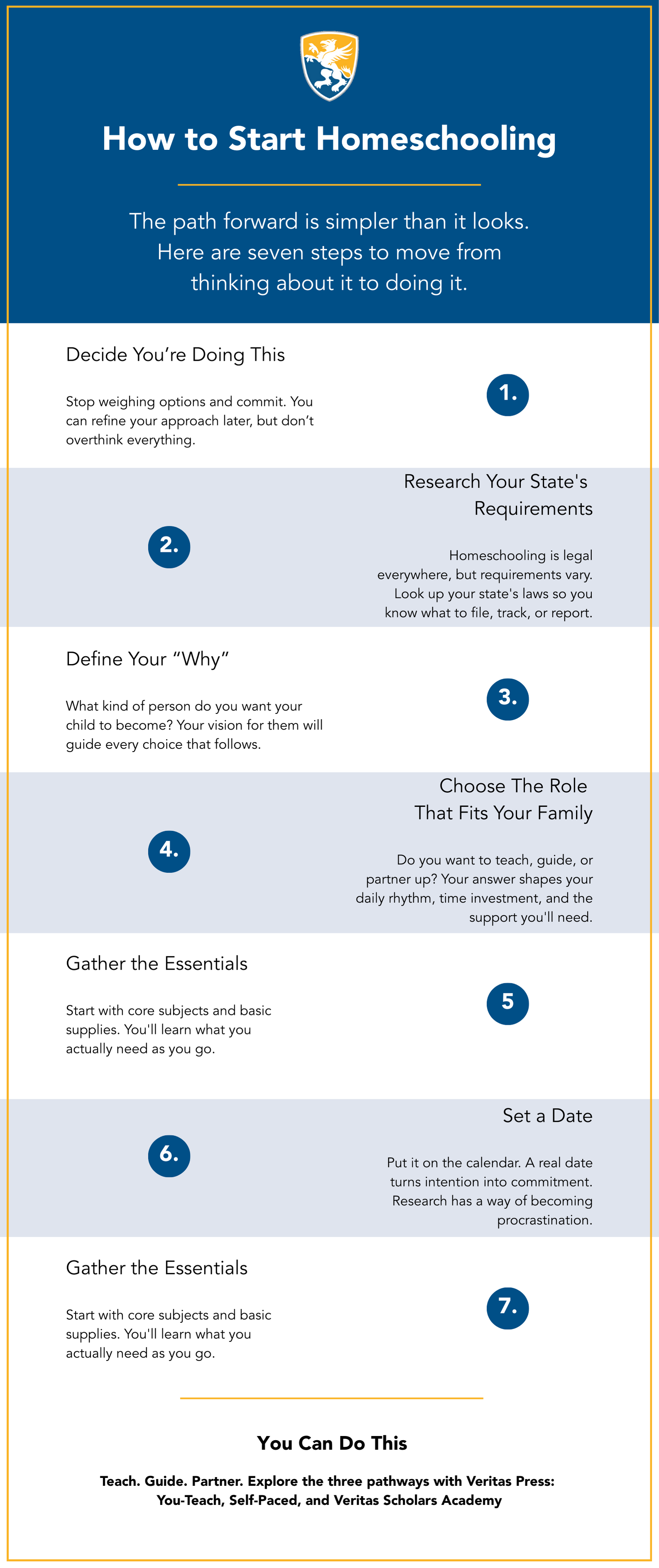
Decide that you’re doing this.
Research your state’s requirements.
Define your “why.”
Choose the role that fits your family.
Gather the essentials, and only the essentials.
Set a date.
Begin.
Then adjust as you go. Learn alongside your children. Find your people. Fine-tune as needed.
Millions of families have walked this path before you. They’ve faced the same doubts, the same overwhelm, the same hard days, and they’ve found that homeschooling, for all its challenges, is one of the most rewarding things they’ve ever done.
Remember: You’re investing in your children’s formation. You’re building something that matters.
And you can do this.
When you’re ready to take the next step, explore our three pathways, You-Teach, Self-Paced, and Veritas Scholars Academy, and find the one that fits your family.