

Classical Education vs. Modern Education: What’s the Difference?
When parents start researching education options, they usually begin with practical questions. What’s the schedule? What does it cost? What are the test scores?
These questions matter. But they’re not the most important ones.
Beneath the logistics lies a deeper question. What is education actually for?
Modern education has an answer: prepare students for college and career, shape engaged citizens, equip young people to participate in the economy and transform society.
But classical education has a different answer. Formation is the purpose of a classical education. Cultivate wisdom, virtue, and the capacity to think clearly about what matters most. Prepare students to live well, to pursue truth, and to know God. And here’s the ironic part: in forming the student’s whole character, classical education prepares students for life, for college, for career, for citizenship better than modern education.
These aren’t two paths to the same summit. They’re different summits entirely. They rest on different beliefs about what human beings are, how we learn, and what makes a life meaningful.
When comparing classical education and modern education, it’s tempting to focus on methods, techniques, and outcomes. But the philosophy is the point. Get that wrong, and no amount of pedagogical technique will set it right.
At Veritas Press, we believe classical education answers the deepest questions correctly. This article will explain why and show you how it works in practice. We’ll also describe modern education fairly—what it actually believes and how those beliefs shape the classroom—because understanding the contrast helps clarify what’s really at stake.
For a comprehensive overview of classical education on its own terms, see our complete guide to classical education. This post focuses specifically on the comparison.
The philosophy is the point. Get that wrong, and no amount of pedagogical technique will set it right.
What Modern Education Believes
The Philosophical Roots
Modern education isn’t a single philosophy but a family of related approaches that emerged over the past 150 years, each with different emphases but common roots.
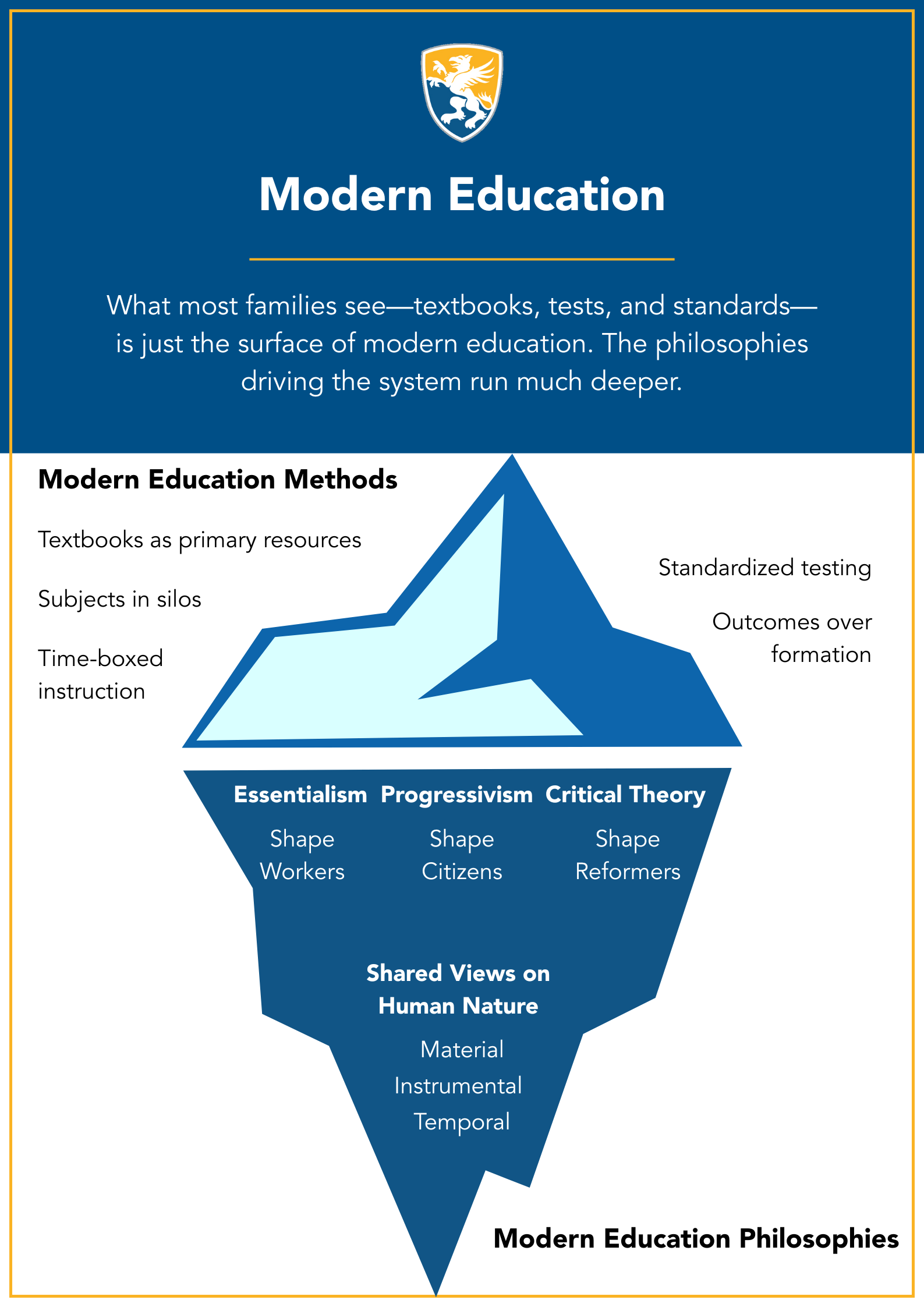
Progressivism, most associated with John Dewey, sees education as preparation for democratic citizenship. Learning should be experiential, inquiry-driven, and relevant to students’ lives. Dewey established his Laboratory School at the University of Chicago in 1896 to test these ideas, and his influence shaped American education for generations
Essentialism emerged partly as a correction to Progressivism’s perceived softness, as thinkers like William Bagley strongly argued for core knowledge, academic rigor, and direct instruction. Have you ever heard someone place the Three R’s (Reading, Writing, and ‘Rithmetic) at the center of education? That’s Essentialism. But Essentialism’s goals remain instrumental: knowledge serves economic mobility and civic participation.
Critical Pedagogy, drawing from Paulo Freire and others, sees education primarily as a tool for social transformation. Students should become conscious of power structures and equipped to challenge injustice. The goal is liberation and systemic change. Again, the goal is instrumental. Students are agents of reform and revolution, first and foremost.
These philosophies argue with each other, sometimes even fiercely, but they also share foundational assumptions:
A functional view of human nature. Students are understood primarily as future citizens, workers, or agents of social change. The soul, if acknowledged at all, plays no central role. Human beings are social, economic, and political actors.
An instrumental view of education. Education serves socio-political ends beyond the students: a healthy democracy, a productive economy, a more just society. The student is shaped for something.
A temporal horizon. The “real world” these philosophies prepare students for is economic, political, and social. Questions of ultimate meaning, transcendence, and the proper ordering of the soul fall outside the scope.
There’s also a strand worth naming that isn’t quite philosophy but profoundly shaped the structure of modern schooling: the scientific efficiency movement. Influenced by Frederick Taylor’s industrial management principles and Edward Thorndike’s educational psychology, this approach optimized schools for standardization and scale. This is why we have age-graded classrooms, 50-minute periods, standardized tests, and Carnegie units. One historian has even argued that Thorndike’s vision largely won even as Dewey’s rhetoric remained.
The result in most schools today is a hybrid: progressive language layered over an efficiency-minded structure, with critical pedagogy increasingly influential in teacher preparation programs.
Progressivism wants to shape citizens. Essentialism wants to shape workers. Critical Pedagogy wants to shape reformers. All three treat the child as a means to an end.
How Modern Education Works
Philosophy shapes practice. The beliefs underlying modern education produce predictable methods.
Textbooks as a primary resource. When the goal is efficient knowledge transfer, textbooks make perfect sense. They standardize content, enable broad coverage, and pair well with assessments. But they flatten complexity. Students encounter summaries and excerpts rather than original texts.
Subjects in silos. English, math, science, history: each occupies its own period, its own teacher, its own mental compartment. This makes scheduling easier and specialization possible. But it fragments knowledge. A student might study the American Revolution in history class and American literature in English class without ever connecting the two. Modern educators have to make a special effort to connect material through interdisciplinary lessons.
Hands-on learning. Progressive influence emphasizes “learning by doing.” Essentialist influence promotes core proficiencies to meet minimum standards. For the critical educator, learning is primarily a social event that takes place in a sociopolitical context. In each case, the emphasis is on the acquisition of skills deemed valuable by that philosophy.
Standards and assessments. The efficiency model demands measurable outcomes. Standards define what students should know; tests determine whether they know it. This creates accountability but also narrows the curriculum to what can be measured.
Age-graded, time-boxed instruction. Students move through school in cohorts, spending fixed amounts of time on each subject regardless of mastery. The Carnegie unit (120 hours of instruction = one credit) was designed for industrial-era standardization, and we still use it.
These methods aren’t arbitrary. They follow logically from the underlying philosophy: if education is about producing citizens, workers, or reformers at scale, you need systems optimized for efficiency and measurability.
The question is whether that philosophy is correct.
What Classical Education Believes
A Different View of the Child
Classical education begins with different assumptions about what a human being is.
Classical education starts from the premise that a child is a person with a soul. Capable of reason. Capable of virtue. Capable of apprehending truth and beauty.
What you believe about human nature determines everything downstream.
If a child’s primarily a future worker, you train them for productivity.
If a child is primarily a future citizen, you train them for civic participation.
If a child is primarily a future activist, you train them to challenge systems.
But if a child is a soul with transcendent dignity and eternal significance, education takes on a different character entirely. The goal becomes formation: shaping the whole person toward their fullest flourishing.
The ancient Greeks understood this. They called it paideia, the comprehensive formation of mind, character, and spirit toward excellence. Education wasn’t information transfer. It was the cultivation of a certain kind of human being.
A Different Goal
The goal of classical education is wisdom. The capacity to know what is true, love what is good, and live accordingly.
The Greeks called this flourishing eudaimonia, translated “happiness,” but meaning something richer: living in accordance with virtue, fulfilling one’s proper end as a human being. A life well-lived, measured by more than wealth or status or social impact.
In the Christian classical tradition, this vision is completed and corrected by revelation. Flourishing finds its ultimate expression in knowing God and being formed into the image of Christ. The Trivium, the Great Books, the Socratic method—all serve this end point. Every subject points toward ultimate truth. Every text becomes an occasion for formation.
That’s why classical Christian education integrates faith across the curriculum rather than compartmentalizing it into chapel or Bible class. That’s why theology isn’t one subject among many; it’s the queen of the sciences, the discipline that orders all other knowledge toward its proper end.
If a child is a soul with transcendent dignity and eternal significance, education takes on a different character entirely.
How Classical Education Works
Philosophy produces method. The beliefs underlying classical education generate distinctive practices.
The Trivium
The trivium is the backbone of classical methodology: three stages of learning aligned with how children naturally develop.
Grammar stage (roughly elementary years): Young children excel at absorbing information. Facts, vocabulary, rules, timelines, poems—they memorize readily and joyfully. Classical education leans into this rather than fighting it. Students build a rich foundation of knowledge that later stages will draw upon.
Logic stage (roughly middle school): As children mature, they become argumentative. They want to know why. Classical education channels this developmental shift into formal training in logic, reasoning, and analysis. Students learn to construct valid arguments, identify fallacies, and think systematically.
Rhetoric stage (roughly high school): Adolescents care about identity, expression, and persuasion. The rhetoric stage trains them to articulate their ideas with clarity, eloquence, and conviction. They learn to synthesize what they know and communicate it compellingly.
At Veritas Scholars Academy, we follow this developmental progression. Grammar students memorize and recite. Logic students analyze and debate. Rhetoric students write, speak, and defend their ideas before teachers and peers.
Primary Sources and Great Books
Classical education puts students in direct contact with the greatest minds in history. Homer, Plato, Virgil, Augustine, Dante, Shakespeare, the American Founders—these aren’t names in a textbook. They’re authors students actually read.
Why does this matter?
Reading original sources develops intellectual muscles that summaries cannot. Grappling with difficult texts builds comprehension, patience, and the capacity for complex thought. And encountering great ideas directly, rather than filtered through a textbook author’s interpretation, forms students who can think for themselves.
The Great Books also connect students to an ongoing conversation across centuries. Ideas build on ideas. Arguments respond to arguments. A student who has read Plato understands Aristotle differently. A student who has read both understands Augustine differently. The tradition becomes a living inheritance rather than a list of dead authors.
Veritas Press offers multiple ways to engage this tradition: Self-Paced courses for independent learners, You-Teach materials for parent-led instruction, and Veritas Scholars Academy for families who want expert teachers guiding the conversation.
Socratic Discussion
Socratic dialogue takes its name from the ancient Greek philosopher who taught by asking questions rather than lecturing. The teacher poses a question. Students must think, articulate, and defend their responses. Other students challenge, refine, and build on those responses. The conversation leads somewhere—toward truth, ideally—but the path matters as much as the destination.
This method does something lectures cannot: it forms students who think rather than simply absorb. Research supports its effectiveness. Studies have found statistically significant correlations between Socratic instruction and improved reasoning performance, and scholars consider it an effective intervention for developing critical thinking.
At Veritas Scholars Academy, Socratic discussion happens in live classes with small student-to-teacher ratios. Students don’t hide behind screens. They engage, argue, and learn to articulate their convictions.
Integration of Subjects
In most schools, subjects exist in silos. Classical education integrates them.
A student studying ancient Rome might simultaneously read Virgil’s Aeneid in literature, study the Punic Wars in history, learn Latin grammar, explore Roman philosophy, and examine how Roman thought influenced Western civilization. The connections illuminate each subject. History makes literature richer. Literature makes history vivid. Latin unlocks both.
This integration reflects a belief about knowledge itself: truth is unified. Subjects aren’t arbitrary divisions; they’re different windows onto the same reality. A fragmented curriculum produces fragmented thinking. An integrated curriculum helps students see the whole.
Language and Logic
Many classical schools teach Latin. But why?
Latin develops linguistic precision like no modern language. Its inflected grammar forces careful attention to how words work. And because 60% of English words derive from Latin (rising to 90% for words of two syllables or more), Latin study accelerates vocabulary acquisition and reading comprehension.
The research bears this out. According to one study, students taking the Latin Achievement Test scored 144 points higher on SAT Verbal and 122 points higher on SAT Math than the average. The rigorous study of Latin develops analytical thinking that transfers to other domains. And according to the ETS Research Institute, students of classical languages score the highest of any group on the Verbal Reasoning section of the GRE while outperforming most other majors in Analytical Writing and performing well above average in Quantitative Reasoning.
Of course, these outcomes aren’t the goal of classical education, but there’s also something to be said about knowing something by its fruits.
Classical education also teaches formal logic as a dedicated subject, usually in middle school. Students learn the structure of valid arguments, common fallacies, and the discipline of careful reasoning. This makes explicit what other educational approaches leave implicit—and hope students pick up on their own.
Latin students scored 144 points higher on SAT Verbal and 122 points higher on SAT Math than the national average.
Character Formation
Classical education treats virtue as an educational goal, not a side effect.
Students study moral exemplars in history and literature. They discuss wisdom and folly, courage and cowardice, justice and injustice. They encounter heroes worth admiring and cautionary tales worth heeding.
This isn’t moralism or indoctrination. It’s the recognition that students become what they practice and what they admire. Education shapes character whether we intend it to or not. Classical education is intentional about it.
In Christian classical education, character formation is discipleship. The goal is genuine virtue rooted in faith, Christ-shaped character that persists beyond graduation.
How Veritas Press Makes This Accessible
Classical education has a reputation problem: people assume it’s only for wealthy families who can afford elite private academies.
That assumption is increasingly wrong.
Veritas Press has spent over 25 years making rigorous classical Christian education accessible to families regardless of geography or income. Our online format means families anywhere can access what was once available only in select cities. And our pricing structure, combined with growing support for educational choice, puts classical education within reach for more families than ever.
This isn’t a humble brag on our part. The point is that classical education has become increasingly accessible in the modern world.
Education Savings Accounts (ESAs)
Veritas Press accepts ESAs in states where they’re available, including Arizona, Florida, North Carolina, West Virginia, and others. These accounts allow families to direct education funding toward the options that best serve their children. We’re actively working with leaders across the country to expand ESA access, because we believe every family deserves educational options aligned with their convictions.
(For more on using ESAs with Veritas, see our page on School Choice.)
Flexible Options for Different Families
Every family is different. Some parents want to teach their children directly. Others want expert instruction and external accountability. Many want something in between.
Self-Paced courses give students the flexibility to work through rigorous classical content on their own schedule. Ideal for independent learners or families with irregular schedules.
You-Teach materials equip parents to be the primary instructor, using Veritas curriculum as the backbone. You’re the teacher. We give you the tools.
Live Online classes taught by expert teachers through Veritas Scholars Academy. Real discussion. Real accountability. Real community. Our teachers become partners in your child’s formation.
These options can be mixed and matched. A family might use You-Teach for grammar-stage children, Self-Paced for an independent middle schooler, and VSA for high school courses requiring specialized instruction.
Community, Not Isolation
Online education can be isolating. Veritas is designed to be the opposite.
VSA students attend live classes with real teachers and real peers. They discuss, debate, and build relationships across geography. End-of-Year Gatherings bring families together in person. Parent communities provide support and encouragement for the homeschool journey.
Classical Christian education has always been communal. Veritas brings that community into the digital age.
The Results
Philosophy sounds abstract until you see its fruit.
The University of Notre Dame conducted a major study using data from the Cardus Education Survey, comparing alumni (ages 24-42) from classical Christian schools with graduates of other schools outside the classical Christian tradition.
The findings:
Classical Christian alumni ranked highest in all seven life outcome profiles: college and career preparedness, outlook on life, Christian commitment, Christian lifestyle, traditional values, independent thinking, and cultural influence.
84% of classical Christian alumni reported being well-prepared for college and career.
55% earned mostly A’s in college, compared to roughly 35% of public school graduates.
Nearly 90% reported more close friends than the median; 86% described themselves as goal-oriented versus 65% at evangelical schools.
Classical education is also growing rapidly. Between 2019 and 2023, 264 new classical schools opened across the United States, with a 4.8% average annual growth rate. Enrollment now exceeds 677,500 students across more than 1,500 schools, and projections estimate 1.4 million students in classical schools by 2035 (per RealClearEducation).
This growth is happening while conventional education struggles.
The 2022 National Assessment of Educational Progress (NAEP) showed the largest drop in math scores for 4th and 8th graders since testing began in 1990 and the largest reading score decline.
About one-third of students in both grades can’t read at even the “basic” achievement level. Thirteen-year-olds’ reading scores are now comparable to 1971, when the test was first administered (per Chalkbeat).
Parents sense something is wrong. The data confirms it.
And families are increasingly choosing a different path.
The Choice
Classical and modern education rest on different foundations. They aim at different goals. They produce different results.
Modern education asks: What skills does my child need for college and career?
Classical education asks: What kind of person should my child become?
We believe the second question is more important. Career skills matter, but wisdom matters more. Economic participation matters, but virtue matters more. Preparing students for the workforce matters, but forming souls for eternity matters most of all.
And in preparing students for eternity, they are prepared for life. The ends of modern education are achieved in classical education without ever losing sight of the most important goals.
If that vision resonates—if you want an education that forms the whole person, engages the greatest ideas, and grounds everything in a Christian understanding of truth and purpose—classical education may be exactly what you’re looking for.
And Veritas Press can help you get there.
Have questions? Talk to an expert for free!
Our Family Consultants are here to help! Fill out the form below to schedule a quick call for free.