

What is Christian Nationalism? | R.R. Reno | Veritas Vox
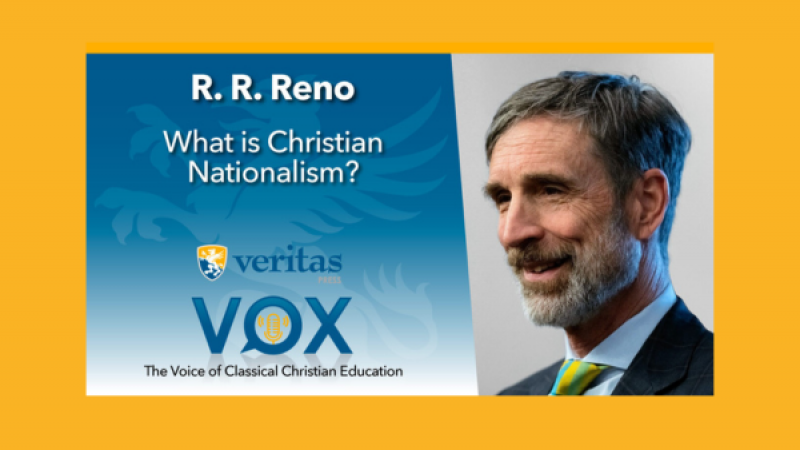
Theologian and editor of First Things Magazine, R.R. Reno joins us from New York City to discuss a topic that has given rise to many questions in recent years: the idea of Christian nationalism.
What is Christian nationalism, what could it look like in practice, and would it be beneficial for America to make a return to having Christian principles at the forefront of how we live and govern ourselves? We’ll discuss all this and more in today’s episode!
Episode Transcription
Note: This transcription may vary from the words used in the original episode.
Introduction
Marlin Detweiler:
Hello again and welcome to another episode of Veritas Vox, the voice of classical Christian education. Today we have with us Rusty Reno. Rusty, welcome.
R.R. Reno:
Great to be on your podcast.
Marlin Detweiler:
Joining us from New York City and is the editor of First Things Magazine. How would you describe first things quickly? Won't go there too long but just…
R.R. Reno:
Well, we're we have a magazine, website, podcast. We're the voice of religiously conservative people who are engaged in a kind of contest if you will for the future of our country and the future of Western culture.
Marlin Detweiler:
Good. Thank you. But before we go more deeply that direction, tell us a little bit about yourself, your family, your education, your career, so that people will have some context for you.
R.R. Reno:
I was born and raised in Baltimore, Maryland, and I went to Havard College, which is a small liberal arts college north of Philadelphia.
Marlin Detweiler:
And I live in Lancaster, part of the year.
R.R. Reno:
All right. Yeah.
Marlin Detweiler:
Beautiful. You know those different –
R.R. Reno:
Yeah, yeah. And I was raised as a Episcopalian, you know kind of liberal Protestantism kind of. But I was in that sort of spiritual, not religious camp probably when I was an 18, 19 years old as a college student. But I had a very influential teacher who assigned Carl Bart famous Protestant theologian from the 20th century. And Carl Bart really challenged me spiritually.
It wasn't a question of whether Jesus is meaningful. The question is is he the Son of God? And I realized I had to actually make up my mind about whether I thought that was true. And that sent me down a path of a deeper faith and eventually graduating. And then I decided I wanted to do a PhD in theology which I did at Yale University in the late 1980s and then taught as a theology professor at Creighton University in Omaha, Nebraska.
And I won't go into all the details but eventually I kind of was unable to persevere as an Anglican and entered the Catholic Church in 2004. And maybe I could say I was unable to persevere as a golfer, and wound up as editor of First Things magazine about 15 years ago.
What is First Things Magazine?
Marlin Detweiler:
Okay. Very good. Well, tell us a little bit about First Things. And a kind of a bit more comprehensively than you're mentioned earlier or a moment ago.
R.R. Reno:
It was founded by Richard John Neuhaus who was a Lutheran pastor who also entered the Catholic Church and became a Catholic priest in the early 90s. So we were founded in 1990 and he had a vision of I mean he recognized that Christianity had played a very fundamental role in the shaping of the American project and that in the as we've reached a kind of secular mentality in the latter part of the 20th century it was really urgent to renew the Christian foundations of the American Democratic Project.
And so First Things was founded to be a forum in which religiously serious people could intervene in matters of public debate in our society. And I think we've stayed very true to our mission over the last 35 years.
Marlin Detweiler:
Very good. And you've been in the leadership position of that for about 15 now?
R.R. Reno:
Yes. I started about yeah almost exactly 15 years now.
Marlin Detweiler:
So as to not ignore the topic but make sure that it's understood that we're not covering it. We are, at Veritas Press, a distinctly reformed Protestant organization. Our statement of faith is clearly that. And I'm sure we can have some interesting conversation about the differences there between that and Roman Catholicism. But we're here to talk about those things that I think we're very much aligned on.
And I want to hear you talk a little bit about what problem you were hoping to solve or what idea you were hoping to bring to the forefront when you wrote the article resurrecting the idea of a Christian society. This was written in 2016. We're recording in 2026. So that's ten years ago. And that was before the conversation had really hit the main in the way I would say it has in the last 3 or 4 years.
Why Resurrect a Christian Society?
R.R. Reno:
Yeah. I mean that's resurrecting the idea of a Christian society. A friend of mine's a book publisher. Regnery. And he had read things that I had written in First Things magazine and thought I should gathered them together and knocked them into shape as a book. And so it came out as a book in 2016, Resurrecting the Idea of a Christian Society.
And it's an argument that I was making about the way in which you know people think oh you know Christianity, dogmatism, God's authority and so on. It's contrary to freedom. But the argument of the book is is that the that faith is actually the foundation of a free society that I look at back to the book of Acts, and I think one of the greatest a declaration of Independence far more significant than our own declaration which is of course very important in its own right.
And that declaration is what Peter says Peter and his colleagues say to the high priests in Jerusalem we're trying to prevent them from proclaiming the gospel. They say we obey God, not men. And that is at the foundation of any free society is it's the fact that we're loyal to power's higher than the power of men that give us the strength and courage to resist oppression.
That was what I was driving at in that book. And other themes as well such as concern for the weak and ability to see that the purposes of life are greater than the endless struggle to get get get in the marketplace.
Marlin Detweiler:
Going back to the foundation of America, how would you describe the founders and the founding ideology in that context? Is it accurate to say that that's what they had in mind? Or is that a hasty generalization? That might be true of some but maybe not. Most or all. What would you say about that time 250 years ago.
R.R. Reno:
The founders were a mixed bunch, right? Some were Orthodox Christians, others were unorthodox. I mean Thomas Jefferson famously kind of composed his own version of the Gospels and in much of the composite.
Marlin Detweiler:
It was more of a cutting out of things that it was an adding of things. It was just the chopping.
R.R. Reno:
Yeah. He cut out you know anything that seemed too supernatural you know but nevertheless I think it's fair that the founders had a consensus that they were establishing a society on the basis of truths that were ultimately rooted in as the declaration says nature and nature's God. So there's a theistic horizon that's in under if we can not doubt that at all a theistic horizon that is important for us to sustain our culture of freedom.
But I would say that our founding has many stages so to speak. And the Second Great Awakening played a very important role in shaping the American project and the Second Great Awakening.
Marlin Detweiler:
You don't mean this Great Awakening.
R.R. Reno:
No. The second because it comes hard on the heels of the Revolution. Nathan Hatch's book on the democratization of Christianity it's called was really helped me understand the extent to which our hostility to institutional authority our populist sentiments as a nation have their roots in the low church you know Stone Campbell oriented kind of revivalism.
That's a very important part of our national culture. And so Ralph Waldo Emerson it was by no means a orthodox Christian Unitarian at best. Yeah. Nevertheless his essay on self-reliance and his egalitarianism is clearly connected to this kind of Protestant press for an unmediated a a relation to God. And I think that our individualism these are all aspects of our society that of course can become excessive and destructive.
But nevertheless I think they're part of our national genius. And I cherish them and I think it's crucial for us to recognize the Christian roots of the many aspects of our society which many people wrongly think are hostile to to Christianity. On the contrary they have their birth in very passionate forms of Christianity.
Marlin Detweiler:
Bringing with there's a lot we could talk about in the historic context of those Christian religious efforts around the founding with the First Great Awakening. Of course you're talking about the Second Great Awakening how that kind of establishes how we operate in some sense individualism and other things that have shaped us.
What is Christian Nationalism?
Marlin Detweiler:
But I wanted to talk mostly here on the recent interest and I should say interest the recent elevation of the discussion of Christian nationalism. Let's define it first as you think of Christian nationalism what is it that you would say we should understand it to mean?
R.R. Reno:
Well I think Christian nationalism we have to look at the two sides of it. The first probably think the question about nationalism why should we even be bandying that word around? And I think I am in favor of nationalism because we've been through a long season of what I would call a kind of globalist ideology. It's really had a very powerful influence and that the effect of that ideology has been to weaken our sense of national unity and purpose as Americans.
So we live in a season of our national history where we have to lean into re consolidating our country reuniting our country. Putting the needs and the interests of our fellow citizens first and foremost. And that by any definition is a nationalist kind of project. Well once you say that say okay I agree with you, Rusty.
You're right. We do need to kind of lean into this more national American national interest side of things where you unite the country and so on. Well then what kind of nationalism do you want? Secular nationalism. Do we want do we want Jewish nationalism? Do we want? And I just think that anybody whether you're religious or not you ought to want the Christian dimension of our society to have a powerful influence on this nationalist project partly because nationalism can go off the rails as we know from the history of the 20th century and Germany and Italy and elsewhere with fascist movements.
Sure. And would that Christianity had had a greater influence on German politics in the 1930s? Perhaps some terrible evils would not have transpired.
Marlin Detweiler:
Yeah I think you're right. Well.
R.R. Reno:
The it's kind of a lot of people and I explain it that way. They think that's kind of cheap. I mean isn't Christian nationalism theocracy? And au contraire Christianity invented secular politics. Christianity is the world religion that separated the two swords the doctrine of the two swords the spiritual sword of the church the secular sword of the magistrate. And so I think a Christian nationalism is a guard against what I would call ideological politics.
You know progressives have their own kind of theocracy where they want to kind of be we were going to be governed by the by the if you will the secular saints for whatever progressive ideology and very little sense of the fullness of man and the need to always guard against our own self deceptions to be aware of the fallible and always imperfect outcomes of our political projects. This is one of the great contributions that Christianity makes to any political culture.
Marlin Detweiler:
You know there you know it's interesting you use the term some people think that's a little cheap. I assume that when you use the term cheap but you mean is it leaves a lot unexplained.
R.R. Reno:
You know or they like I say you say Christian nationalism. And if the sort of secular reader of the New York Times recoils in horror like oh my gosh he's really he wants you know I don't know Jesus to be installed as the president of the United States or more likely his his self-appointed representatives. But I but you know Protestant traditions and certainly the Catholic tradition are very wary about religious authorities exercising secular power because there's a recognition that that this can corrupt the church and that you know the the minister of the gospel is you know has to proclaim Christ crucified and risen and the magistrate has
to order the affairs of the temporal world which will ultimately pass away when Jesus returns in glory. And when we when again Christianity recognizes this distinction between the secular and the sacred and therefore and when it's properly ordered. And you know the problem is if you have if you have only the secular and none of the sacred the secular winds up becoming potentially tyrannical.
So that that you know that's my I mean and then the second argument here is that Christian nationalism because that's always how it has been in our our society you know whether it's the abolition movement the Christian Christianity has provided not only Christianity but Christianity is one of the major sources of renewal and reform in our society over our 250 year history.
And so part of what we need to do is we need to recover the if you will the transcendent sources of our common life. Christianity offers the I think the most trustworthy guide for doing that.
Marlin Detweiler:
Yeah.
R.R. Reno:
It and then also has the advantage of being true. I mean you know if you're if you're a Christian it seems really strange to me that you would believe in the truth of Christianity and then balk at the notion that it should have a preponderant influence on our common life as a nation.
What Would Christian Nationalism Look in Life and Education?
Marlin Detweiler:
I couldn't agree more there. But as we think in terms of interacting with other citizens with the same rights the question becomes by what standard? And that's what you mentioned earlier and what we see in at least something defined as Judeo-Christian values we see an ethic that has foundation in the Scripture. I think it has some foundation in natural law as well.
We know at some very basic level it's a wrong thing for me to injure or kill my neighbor. It's the wrong thing for me to steal from. But how do we know that? Isn't that ultimately an early step into Christian nationalism?
R.R. Reno:
The. You know Thomas Aquinas observes that God's revelation. It reveals to us things that we could never know when you know our salvation in Christ is not something we can deduce from reason. Right? It's you know foolishness to the Greeks and scandal to the Jew. As Saint Paul says however God also reveals truths to remind us of the things that's the wounds of sin have darkened our minds and remind us of truths that we should be able to know by virtue of natural reason.
But we often fail to acknowledge. And the example you give us is a clear one theft murder adultery and other things. You know the Ten Commandments are or even a duty of worship. I mean so I think a country inspired by Christian nationalism that civil authority will encourage religiosity the virtue of piety in citizens. That doesn't mean compelling people to go to church.
That's absurd. Christianity's always rejected for instance coercion of causing people to get baptized. Baptism is always an act of freedom. But we could have Sabbath laws. I mean a good example. Some of my pastor friends say that one of the great threats to church attendance these days are these travel sports leagues and games scheduled on Sunday morning.
And I think it's well within our long tradition as a nation to be religiously neutral. That is to say we don't preference this Protestant sect over that one or the Catholics over the Protestants or Protestants over Jews but that we make we have general purpose laws to protect the Sabbath. And then we you know depending on where you live if you're live in New York City where you have a very substantial Jewish population you make accommodations and adjustments accordingly.
And that's a matter of prudence on the part of our the magistrate. But but I do think this there is a it's it's available to a natural reason that there is a creator and we have a duty to acknowledge and honor our creator. That's a very controversial and it wasn't controversial two or three generations ago.
I grew up with blue laws in Maryland. And they weren't absolute prohibitions against commerce but significant curtailment of commerce on the Sabbath. And that cannot help but encourage people to acknowledge even if they're not going to church it's a special set apart day. It has an effect and a positive effect.
I'm also in favor of restoration. We just published an article arguing for the legitimacy of school prayer according to our best constitutional principles. And I think acknowledging a supreme being. A lot of my friends that. Well that's not really prayer. That's a kind of anodyne you know one that you know and I say well yes but it would be a good thing for young people to recognize that there is a transcendent source.
Yeah. And then that disposes. It doesn't guarantee that they'll become Christian, and it's not the job of the public school to to try to make young people Christian but it should dispose them towards this proper stance of the transcendent. And you can foresee that this will make the work of evangelization it'll prepare the soil.
On Keeping the Nation’s Moral Health
Marlin Detweiler:
I have clear recollections. Growing up in Lancaster Pennsylvania not far from you growing up in the Baltimore area of what Sundays the Christian Sabbath were like. Most businesses were closed when I was very young. As I got a little bit older high school age restaurants started to be open. And as we all know the greatest supporter of lunch or on Sundays at restaurants as people leave going somewhere after church but when I think of Christian nationalism sometimes I think of it in terms of a post millennial eschatology and something that we are growing to be more and more of a Christian nation.
I've heard it said by people who embrace that eschatology that they believe there will be a time where it'll be hard to find somebody in the world who isn't a Christian. That's the nature of how God will take how God will advance history. And I look at where we are today of course we've gone a different direction than that.
And the short term in the long term believing that the short term is still within the definition of 50 years or more. But that I wonder what what does Christian nationalism look like to you? Is that what you're embracing or is that taking it further than you would and then related maybe not related to that question.
Another question. So that I can get two of them out there and let you talk. One of the things that's happened is not just the soccer mom going to a soccer field on a Sunday with a soccer dad. At that point probably. But we have football golf tournaments and on Sundays almost in every instance that are televised lots of Sunday baseball Sunday basketball those things are all very much a part of our life.
The big business of sports television sees to it. How does all that play out in the context of the Sabbath and Christian nationalism?
R.R. Reno:
Well let's I'll go backwards with your questions. Okay. Let's start with the second one. This requires prudence. I mean the magistrate our legislators need to not let the perfect be the enemy of the good. And it could be very modest efforts. You know the juggernaut of big sports which is such a passion for so many Americans it's going to be difficult to curtail.
But you can like I say you could you the state you know the state legislation it's a collective action problem in many parents would like to go to church but the leagues are scheduling it so it it would not be that heavy a lift to say that youth sports leagues cannot have games until after noon on Sunday and that would be meaningful.
It would seem to me. Are we going to go back to the kind of cessation of commerce that you and I experiences as as kids? Unlikely at least in the near term or the medium term. But that's okay. We have to live in the world we've inherited and try to make it a little bit more in accord with what natural law indicates and what our own tradition encourages as best we can with respect to you know I'm not a post-mellinialist myself.
I am much more I mean I think that we should think of politics as its own domain rather than something that is charged with theological significance in an immediate and direct way. And so you know typically I like I think make these arguments on kind of natural law grounds. And so I think the goal of a Christian nationalist is to restore a decent society and not a righteous society.
And there's a great peril in trying to create a righteous society because that can so easily flip into a kind of tyranny. Yeah I can see that.
But we’re still a long way from a decent society.
Marlin Detweiler:
Well we certainly have. I mean bad direction in many respects.
R.R. Reno:
Legalization of marijuana, sports gambling, addictive sports gambling apps, this kind of cascade of unregulated pornography on the internet. It's just shocking to me that the people leading our country are so indifferent to the moral health of their fellow citizens.
Marlin Detweiler:
Is that a significant issue a first thing or not an issue? Is that a significant initiative? First things do you expose and combat that? Do you argue with it?
R.R. Reno:
Oh very much so. Part of our I mean we want to nurture the spiritual lives of our readers. We have articles that kind of delve into the truth of the faith on their own terms and we want to renew the cultural memory of Western civilization. We do that too. But the third prong of our work is to combat what we think are the cancers that are so harmful to the body politic.
So I think we're the I would put us in a kind of mainstream conservative publication. We've been around for a long time we're influential and we're the only mainstream conservative publication that's adamantly opposed to the sexual revolution. We we we combat the rainbow agenda at every turn. Yeah. And and we publish articles more recently about really a deep critique of feminism.
You know we don't have a party line on male headship at First Things I mean this is a contested question among Christians of good faith but we certainly give voice to that position which I think needs to be seriously thought about by Christians about how disordered the male female dance has become how broken the male female has become and we need to be have the courage to think heretical thoughts.
I mean I'm heretical with respect to progressive ideology right? Because the problems are are are fundamental. I mean the collapse in fertility rates. Yeah. Is is sort of.
Marlin Detweiler:
Or something that wasn't given much consideration to know.
R.R. Reno:
In this tsunami. I fear soon to break on our shores of in vitro fertilization and artificial means of producing children. And that's related also to assisted suicide. And you know these are all aspects of our effort as human beings to take kind of complete control over or so. Life is not a gift to be both relished but also the burdens of life are their own gift, as we have to I mean we that's how we grow spiritually.
And in God's providence. He gives us crosses to bear and we reject the crosses. We both we both are unable to accept life as a gift and we're unable to accept life sufferings as an opportunity for spiritual growth and renewal. Yeah. And I think this reflects it's one reason our fellow citizens are unhappy and anxious.
They're not given the spiritual tools to deal with life as it really is. So we live in these illusions that we can kind of end up when we want gender assigned at birth and mortality assigned to death. Okay? They're related. Those two perversions are related to each other.
Advice to Parents and Educators
Marlin Detweiler:
I believe then but we are out of time. But I really want to ask one more question. As you think of your initiatives and what you think we need to be focused on the important aspects of culture and civility in some sense is a substantial aspect of what you're seeking to recover. How would you advise the Christian educator of a K-12 student or the parent who is also the educator of a K-12 student?
What initiatives would you encourage them? What cautions or suggestions would you offer them as they think about training the next generation to take up the mantle in a way that might be successful in causing these changes?
R.R. Reno:
In the Christian classical school movement is I think tremendously important for the future of our society. It will not be a majority movement. Not likely but it will be a very powerful leaven going forward. So the parents and they should be aware that they're preparing their children for leadership of our society. And and I think that that's something that needs to be encouraged.
These young people they need to be reminded that they're going to carry a burden of responsibility for a very disoriented and dysfunctional society and that they've been given a great gift in an education that is rooted in timeless truths. So I think that's really important for for us. And then just at a practical level you know the digitization of everything and that you know you should pursue education to the exclusion of all as many screens as possible.
And then finally because of the dysfunction that's so deep as talked about the male female thing how do how do we in classical education both shape the mind of our young people and their souls? But also how can we teach boys to become men and girls to become women? That's that's a every classical school should be asking the leadership of every classical school should be asking itself what are we doing as a school to help boys become men and girls become women?
Marlin Detweiler:
That's very good. That's that's very good. Thank you so much for us here. Appreciate you joining us today.
R.R. Reno:
Thank you. Okay. Was great to be on the podcast. And thanks for your mission and everything you're doing to promote classical education. As I said it's a hugely important for the future of our country.
Marlin Detweiler:
And folks thank you for joining us on this episode of Veritas Vox the voice of Classical Christian Education. We hope to see you next time.
Have questions? Talk to an expert for free!
Our Family Consultants are here to help! Fill out the form below to schedule a quick call for free.