

Christian Parents and the Sexual Revolution | Mary Eberstadt | Veritas Vox
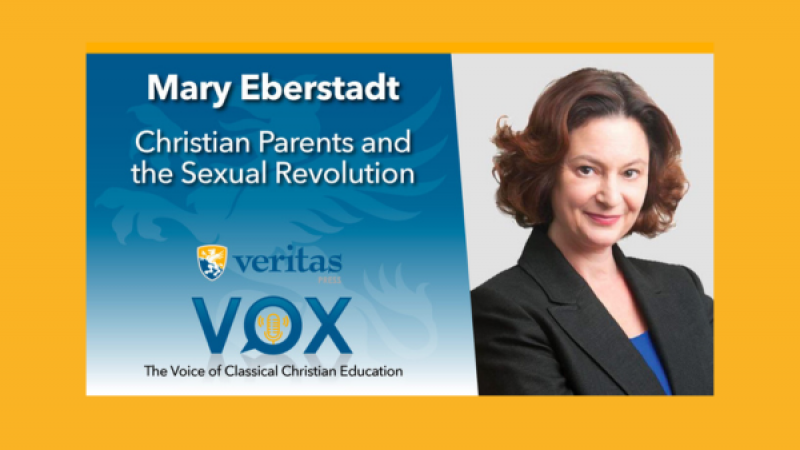
In this episode, we examine the far-reaching consequences of the sexual revolution on families, faith, and human flourishing with Mary Eberstatdt, author of Adam and Eve After the Pill and Primal Screams.
Tune in to gain a deeper understanding of today’s cultural challenges and walk away with practical, grounded ways to strengthen your family and live faithfully in an increasingly countercultural way.
Introduction
Marlin Detweiler:
Hello again and welcome to another episode of Veritas Vox, the voice of classical Christian education. Today, we have with us Mary Eberstadt. Mary, welcome.
Mary Eberstadt:
Thank you. Marlin.
Marlin Detweiler:
Mary is joining us from Washington D.C. where she works as a senior research fellow at the Faith and Reason Institute in Washington. And she'll talk a little bit about that work in just a moment. But first Mary, tell us about yourself your family, your education, and then of course your career, which will lead us into our discussion.
Mary Eberstadt:
Thank you. Marlin. Well as I always say my vocation is as a wife and mother mother of four grown children. And my vocation in life has been writing. I've worked as a speechwriter. I've worked as an essayist. I have written several books. I have had one of my books turned into a stage play. So writing is really my passion on the side of being a wife and mom.
Marlin Detweiler:
Oh that's great, that's great. Where'd you go to school?
Mary Eberstadt:
I went to a series of public schools in upstate New York. I'm from rural America and I went to college at Cornell University where I double majored in philosophy and government.
Marlin Detweiler:
Very good, very good. And you've been in this position of Washington for how long?
Mary Eberstadt:
Oh for some years. And I've also been writing for a number of different places for a long time now. Longer than I might want to add up.
Marlin Detweiler:
We don't need anything that will help us know how old we are to be said. We're good with that. That's great. Well for the audience, I want to point out that Mary comes from a Roman Catholic background and I from a reformed Protestant background, but the topics that we're here to talk about are clearly topics where we expect Christians of all ilks to be co-belligerent and probably far more certainly far more in common than we have indifference.
And those are the things that we're going to focus on today. So Mary, I appreciate your willingness to be here. I've identified three books that you've written, and two of them are going to kind of group together. I think this is the first time we will have tackled the topic of sexuality on our podcast, and you have been doing that as a writer and a speaker, and I'm really looking forward to hearing some of the things you have to say.
The two books that I've identified that we'll talk about together are Adam and Eve After The Pill and Primal Screams: How the Sexual Revolution Created Identity Politics.
Tell me, how and or why the pill has had the impact that it has, what that impact has been, timing, and how it affects us today.
The Impact of the Birth Control Pill and Separation from Family
Mary Eberstadt:
Well so Marlin, we are quickly reaching a moment where no one will remember life before the sexual revolution. By sexual revolution I mean the technological shock of the birth control pill. Beginning in the early 1960s and its widespread adoption during all the decades since. And I came at this not from a religious perspective but as a researcher because the more I researched the clearer it was that this revolution has had bad consequences for humanity.
And that is what Adam and Eve after the Pill is about in that book which was published in 2012. I looked at what had happened to romance to men to women to children and to families after the 1960s. And the answer is nothing good basically, apart from the countercultural embrace of the family that we see in religious communities.
And so the reason I have focused on this, Marlin, is that although there are other problems in the world and other things that make us miserable like our smartphones and things like that the sexual revolution is the place where we see denial. People do not want to talk about what it has done because we might have to rethink a lot about the way we have come to live.
And so in focusing on that as one of the generators of our current problems, I'm not saying it's the only such source of our problems, but I am saying it's the one that people most don't want to look at. And I'm encouraged that now, for the first time during the last few years, we've also had secular voices looking at some of the things that I described years ago like for example, the increasing unhappiness of women.
There's a lot of social science data in my book about this. The modern woman is not happy. A modern woman is often likely to be on psychotropic medication, for example. And this is not only true in the United States but across the West. According to social science is registering unhappier than she used to be. So what's going on with that?
Those are the kinds of questions that I look at in the book. And what I conclude Marlin, is that we are living in a way that is unnatural for our kind, for our species even. We are living in atomized situations like households of one. We are living without family. In many cases, we were living without extended family in most cases.
And this I think, is the source of many of our contemporary problems.
Marlin Detweiler:
Can you be more specific when you talk about many of our contemporary problems and what has changed? It seems obvious, but let's state the obvious anyway. The idea of the pervasive one-night stand, the use of I'm engaged as a tool of living together without any real expectation of being married, the lack of virginity or the low percentages of virginity when married.
All of those kinds of things I assume are what you're talking about. But let's really be clear here because I think we've got an opportunity to address a problem that is far deeper as you've pointed out and far broader than we realize.
Mary Eberstadt:
Well so let's talk about for example what happens on secular campuses these days and not just these days. This has been going on for a long time. There's a very good book written by a psychiatrist named Miriam Grossman called Unprotected. She was a psychiatrist on a major campus in California and she was seeing young people come in mainly young women in dire straits really unhappy talking about self-harm talking about their problems.
And invariably these traced back to early sexual activity, sometimes abuse, on campus. That's an example of how the sexual revolution has left people unprotected and put them in harm's way. So that's the kind of evidence I'm talking about. It's not theological evidence. It's evidence from social science. Or let's look at it from another direction. What has happened to children since the 1960s, and in saying the 1960s, I don't have some romantic idea about the 1950s.
I didn't live then. I'm just observing that there have been changes in for example psychiatric diagnoses among kids. There's been a rise in anxiety and depression among children and adolescents and this has been going on for a long time. I've been writing about this for at least 25 years, and psychiatrists agree that it's real.
It's not some artifact. Well, we know that there are strong correlations between for example fatherlessness and psychiatric diagnosis, and truancy and behavioral problems. These are very well documented. Again, the dots have been connected for us, but people don't want to have to look back and say maybe we're living in the wrong way. And so that's what I'm trying to chip away at, is that resistance to the evidence out there.
Is that specific enough?
Marlin Detweiler:
Yeah. Well, I'll keep pressing you. Tell me if I press too hard. It has been a grave concern of mine to see where sexuality and promiscuity have moved in my lifetime. I graduated from high school in 1974 during my high school years, Roe v Wade became the law.
The pill became a reality in my lifetime and sex without physical consequence of pregnancy and other complications.
The ability to have a sexual relationship without those consequences changed things dramatically. You've written on that. But what we see today is that kind of sexuality now being minimized in our understanding of what Scripture teaches because it doesn't have those same physical consequences. And I'm curious about what you've seen happen there.
The Impact of the Sexual Revolution on the Christian Church
Marlin Detweiler:
Broadly speaking, in the Christian church, on how it impacts a pastor or a priest's ability to deal with things that were clearly understood to be sin and immorality at one point that now have very broad acceptance and in my observation even a creep into the church in ways that well it may not be called acceptable in the most conservative aspects of Christianity, sometimes gets winked at.
Mary Eberstadt:
Yes I think it's very simple in a way. Marlin, I think that the sexual revolution is locked in mortal combat with the church and I mean the church broadly. I mean those ancient teachings that were developed in distinction to the Romans and the pagans those strict teachings about marriage about family about sex about not getting to do beastiality and infanticide and other practices that were common among the Romans.
So what we are seeing is that Christianity is shining like a sign of contradiction in a way that it hasn't since I think pagan times, and in a way, that's a beautiful thing of course but it also means that Christianity in every denomination is being divided from within. There are two camps out there.
There's the one that says the church can accommodate the sexual revolution without ceasing to be the church. And then there's the camp that says no. If we throw out these ancient teachings, we will cease to be Christians. I stand firmly in that second camp and I am thinking that you do too.
Marlin Detweiler:
I join that absolutely.
Mary Eberstadt:
I don't mean to oversimplify but I do think that that's what's going on. When churches are fighting among themselves these days, they're not fighting about theological fine points like how many angels dance on the head of a pen. I'm not making fun of theology. I'm just observing that what is tearing the churches apart from within is this question of whether the sexual revolution can be accommodated or not.
And I believe that this experiment has been run, Marlin. I mean we have seen the collapse of parts of the Anglican Communion for example over exactly these questions. We have seen the African Anglicans move away from the Anglican Communion because they want to keep the traditional teachings. So in case after case this kind of ecclesiastical civil war is happening about one thing exactly. And it is whether we can live as Christians in the post-revolutionary order by adopting post-revolutionary mores or not.
How Should Christians Live in the Wake of the Sexual Revolution?
Marlin Detweiler:
What are our constituency the people that are going to watch this podcast episode are generally those people that are going to be in agreement with us about those things, but are also going to be people who say, okay, but what does that mean? How do I do it? How do I protect my children? How do I instruct them?
How do I live in a world where I have become a very very very significantly a minority? When my parents those people my age were not in that minority then even though they went through a transition from being the majority of the minority what are the parents do today? How do they help their children?
Mary Eberstadt:
Well Marlin, I speak with young people a lot including young parents. And I also as we were saying off camera, I plug the classical academies every chance that I get because it's such important work and I do this.
Marlin Detweiler:
I can tell you it is such a thrill to see what we're doing make a difference in these areas and I'm just trying to do more of the same in this conversation.
Mary Eberstadt:
Yes well the people who are being trained up in the counterculture whether it's classical academies or homeschooling or intentional Christian communities these people are going to be punching above their weight in the years to come in the best possible way. They're going to be overrepresented in business in government and everywhere else that matters in America. And that's a great thing.
So the first thing I would say to parents is know that you're doing the right thing and don't let anybody shake you off that path because you will be vindicated. You already are. The second thing I would say and this is something I have a couple of chapters about in various books is that I think the biggest problem we face when it comes to the safety of our children today is pornography.
It's lethal. It's absolutely lethal. We have no idea because we don't want to know how many children are addicted to this because of their smartphones. But pornography is obviously for example a major factor in divorce. Nowadays it is very often cited as a reason for divorce. It is also something that a lot of teenagers are addicted to. And I believe Marlin that it's part of why we're seeing this dramatic drop in romance this inability to find one another that young people in the secular world report routinely.
It's a barrier to human contact. And so my second piece of advice to parents is to be as careful as possible about that.
Marlin Detweiler:
Is it fair to say that we should not take anything for granted that any child has easy access any parent has easy access to pornography and putting ourselves in categories of accountability where others know what we're doing is a solution?
Mary Eberstadt:
The more transparency and accountability is better I would say. And also so as not to sound overly negative know that your example and I'm speaking directly to parents here who are purposely countercultural, purposely Christian. The example of you and the example of your family is going to fan out and touch others in ways that you can't imagine.
So I'm speaking here as someone who's usually a you know cast as a teacher but there's that saying from one of the popes that we need teachers and we need witnesses who are also teachers. You the parents of your constituency are witnesses. And the power of example is probably the most powerful thing that Christianity has in its quiver. So no again that you're doing the right thing.
Marlin Detweiler:
And be a good example.
Mary Eberstadt:
And be a good example. And let me be very specific about it. I mean I'm always remembering a story of a girl who came up a young woman who came up to talk to me after one of my speeches on a secular campus and she said that she had become a Christian. And I said wonderful. Well what did it?
Was it philosophy? Was it theology? Was it art? You know I named all these abstract things that are in the Christian patrimony. And she said no, she said it wasn't that at all. She said I was the only child of a single mom. I didn't know anything about church. But my best friend in high school came from a big Christian family and over time I found myself wanting to spend more and more time with them. And then she said Marlin, I wanted what they had.
And that's what's so bad about the self-sacrificing community that you are representing here is that every one of those families amounts to another set of witnesses for the kind of truth that that young woman was seeing.
Marlin Detweiler:
Let me ask you. Tell me what your Primal screams and how the sexual revolution created identity politics. What was the premise of that book? That to me probably because of it being a category that I'm a bit unstudied in is not immediately apparent what you were after there?
Mary Eberstadt:
Well here's how I connect the dots on that argument. The sexual revolution shattered the family and it shrunk the family and it shrunk the number of people we could count on for primal loyalty to us. Families are smaller. Families are ruptured. Not all families of course but these trends are widespread. And so what I argue in the book is that the rise of identity politics has to be understood as a consequence of the shattering of the family because in turning to these identitarian groups whether they're based on race or ethnicity or erotic inclinations or any of the other isms what people are doing is trying to find a primal community again.
And we see this very clearly in the ways that these bands of identitarians defend themselves. Right? If you cross them if you say the wrong thing about being trans you are cast out. You're canceled you're exiled you're never coming back. In other words people bring to these groups the kind of primal loyalty that we associate with the family.
And so that's the hypothesis of that book which I think is proven in the book. It's that identity politics is a consequence of the sexual revolution.
Practical Ways to Help Families and Be a Christian Witness
Marlin Detweiler:
What are the solutions? What are the ways out? What are the things that you're proposing? Obviously, establishing families having children and being faithful Christians is the most basic of that. But those are obvious and those are significant. And sometimes we focus on the fringe. And I don't want to do that too much but I do want to hear more than what's obviously on the obvious on the face of the solution.
Mary Eberstadt:
I don't sugarcoat things, Marlin. I don't think we can afford to at this point in the drama. So I think Christians need to be much more realistic, and I'm speaking of my own denomination as well as others, about what is required for a family to flourish. I think we need a lot more at the grassroots. So for example, what happens when a baby is born?
Well when a baby is born the household is in chaos. Mom is getting no sleep. Dad stressed. So we need things like meal trains. We need very basic stuff. We need donated diapers, and we need donated baby furniture. And we need as communities to do those things mindfully, as we say. And I'm not being abstract here. I think a lot of what needs to be done is right on the ground.
Marlin Detweiler:
Yeah those are very practical suggestions, and I hope and trust that people listening will say I can do that. I'll make that happen in my church or in my community.
Mary Eberstadt:
Yes.
Mary Eberstadt:
I mean, I'll give you an example of what I'm talking about. I made one trip to Israel and visited a pro-life center there and this center has saved some 88,000 babies. It was started by a Holocaust survivor. So a very dramatic place, but it was basically a warehouse Marlin. And they had everything in it that you would need for the first year of life for a baby, everything from canned goods to cribs and bassinets and baby clothes and diapers.
And they would drop these off once a month at the homes of the women who had come to them in need for a year. And I think that would be a fantastic model for our churches to try and get with it.
Marlin Detweiler:
Sure is.
Mary Eberstadt:
I mean don’t get me wrong there's a lot that needs doing on the intellectual end. Our intellectual class has gone far down a road that isn't helping anybody. There's a lot to be done with argument. There's a lot to be done with politics but there's also a lot to be done of a very practical nature I think.
Marlin Detweiler:
I think that's wonderful. Let's button it up there and move to another book. But the idea of practical biblical Christianity put in practice like that identifies where needs are. And meeting them has not only great practical benefit but great theological benefit as well. When Jesus asked what the greatest commandment was, he didn't answer with just one.
He answered that and then he said something else. And that is love your neighbor as yourself. And in doing so we demonstrate Christ's understanding of how we are to live.
Mary Eberstadt:
Excuse me, this was noted. This was noticed very early on. I think it is the historian Eusebius writing in the third century or so who said that.
Marlin Detweiler:
Our children our students read him.
Mary Eberstadt:
Well if I recall my history correctly he said that what distinguished the Christians was the way they took care of one another. And people even outside their tribe or group.
Marlin Detweiler:
Very good. Another book that you wrote is How the West Really Lost God A New Theory of Secularization. What aspects does that focus on? What do you theorize there that might be slightly different? I realize there's overlap but what were you focused on? What problem were you addressing there?
Mary Eberstadt:
So for years Marlin I was interested in the question of why Christianity was in decline in the West. In the Western world we know it's thriving in Africa it's thriving in parts of Asia. But something has happened in the world of the United States, Western, and increasingly central Europe. And I really wanted to figure out what that thing was.
There are a number of theories about what happened. And in the book How the West Really Lost God I walked through each of them and find each of them unpersuasive. So for example some people say the two world wars of the 20th century shattered people's sense of religiosity shattered their belief in a benevolent God. But this doesn't hold up because after the wars, there was actually a religious boom that went for about 15 years from 1945 up to 1960.
So similarly some people argue that the problem is that we got rich and well-educated and we didn't need God anymore because that's the opiate of the masses that's you know something that sophisticated people don't need. But this also doesn't hold up because if you look at examples from history, like Victorian England, like the Mormons in America, like America today in general the better off people are educationally, the more likely they are to practice faith.
And that is not an intuitive finding but it is one that social science underscores. So with one thing and another, it seemed as if the going explanations for secularization didn't work. What I finally landed on was the connection between the strength of the family and the strength of the church because the image I came up with was the double helix.
You know one side needs the other to reproduce. When you see that Christianity is weak, expect the family to be weak. This I think is what we're witnessing in the West. When you see that the family is strong. Expect Christianity to be strong. So let me give you an example from where we are now, the area of the world that is the least religious, according to survey information, is Scandinavia.
Scandinavia also pioneered the unmarried family, and Scandinavia is a place where a great many people, about half live in households of one person.
Marlin Detweiler:
Half of their population lives by themselves?
Mary Eberstadt:
Yes. And so here we see very clearly that not living in the community of the family makes it less likely that people will be Christian. And why is that? I wrote that whole book to try and figure out what the connection was there. But one thing for starters is that Christianity is unique. It begins with a holy family right?
It begins with a baby and a mother who subordinated herself to God and a loving adoptive father. And part of what I argue in the book is that in a time when many kids don't have dads at home for example, this model becomes harder to understand for them. How do you understand a benevolent God? The very idea of a benevolent God.
If your only experience of adult males is a series of mom's boyfriends, sometimes abusive? So I'm not saying that people in the post-revolutionary disorder can't become Christian. What I'm saying is that the sexual revolution put new obstacles into understanding the basics of Christianity. And that's just one example.
Marlin Detweiler:
Very well put. We could go on for hours, but I want to underscore to our listeners how important it is for us to know our place in time in history in order to learn from the past to live in the present in ways that recognize the principles that we buy into that we believe are timeless. And they don't, they're unchanging because God is unchanging.
You've really done some yeoman's work in helping to make these things known. Thank you for the research and for your articulation in the books that I haven't read.
And today in which you've been able to share with us. Thank you, Mary, very much for joining us.
Mary Eberstadt:
Thank you Marlin and I hope that we can give just a little encouragement to your listeners out there and those families out there because they're doing the most important work on Earth.
Marlin Detweiler:
Well it’s my hope that they are encouraged by this and motivated to learn more as a way of not only having confidence in what they're doing but also being more evangelical about what they're doing that others might be blessed by it as well. Thank you and thank you for joining us on this episode of Veritas Vox. We hope to see you next time.
Have questions? Talk to an expert for free!
Our Family Consultants are here to help! Fill out the form below to schedule a quick call for free.