

The Benefits of Homeschooling: What the Research Actually Shows
Something remarkable is happening in American education. Across the country, families are leaving traditional schools and teaching their children at home.
In 2024-2025, 36% of reporting states recorded their highest-ever homeschool enrollment, exceeding even the pandemic peaks that first drew national attention to this movement.
And the growth is accelerating.
According to researchers at Johns Hopkins, homeschooling is now expanding at 4.9% annually, nearly triple the pre-pandemic rate.
These families aren’t making the decision lightly. They’re weighing the evidence, talking to other homeschool parents, and asking hard questions about what’s best for their children. If you’re in that process right now, this article is for you. We’ve compiled the research on homeschooling outcomes: academic achievement, social development, family life, and what happens after graduation.
The findings may surprise you.
Academic Achievement: What the Numbers Say
The most common fear parents voice when considering homeschooling is academic.
Will my kids fall behind? Will they be able to get into college? Will I somehow ruin their futures by taking them out of a “real” school?
Homeschool vs. Public School Achievement
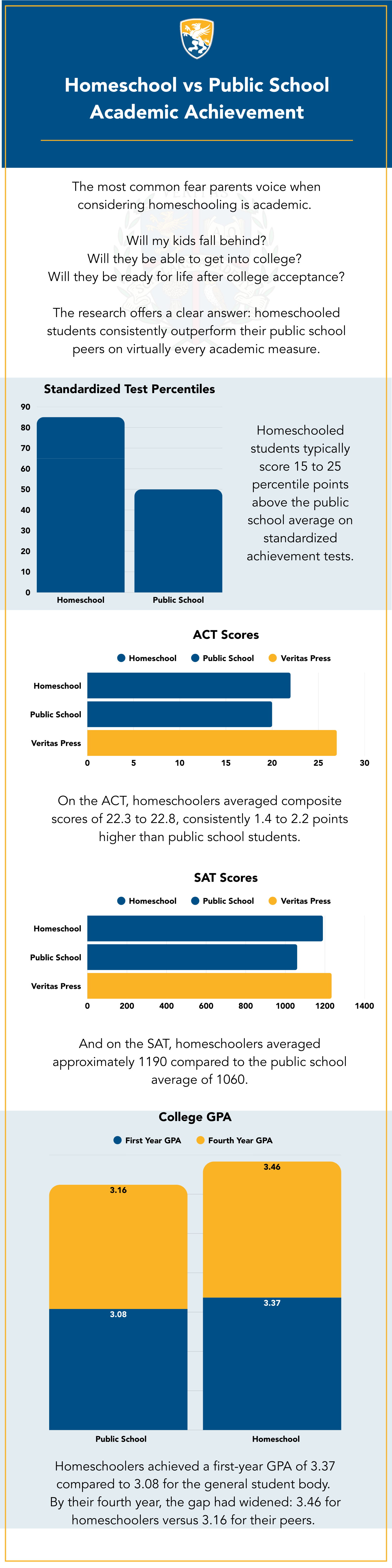
The research offers a clear answer: homeschooled students consistently outperform their public school peers on virtually every academic measure.
According to Dr. Brian Ray’s peer-reviewed research published in the Journal of School Choice, homeschooled students typically score 15 to 25 percentile points above the public school average on standardized achievement tests. While public school students average around the 50th percentile by definition, homeschoolers consistently place between the 65th and 80th percentile.
This isn’t a marginal difference. It’s a substantial and consistent gap that shows up across subjects and grade levels.
ACT and SAT Performance
Independent data from ACT, Inc. confirms the pattern. An ACT research brief analyzing data from 2001 to 2014 found that homeschoolers averaged composite scores of 22.3 to 22.8, consistently 1.4 to 2.2 points higher than public school students.
SAT data tells a similar story, with homeschoolers averaging approximately 1190 compared to the public school average of 1060. That’s a 130-point advantage.
But standardized tests only tell part of the story. What happens when homeschoolers get to college?
University Performance
A peer-reviewed study by Michael Cogan, published in the Journal of College Admission, tracked students at a midwestern doctoral university and found that homeschoolers achieved a first-year GPA of 3.37 compared to 3.08 for the general student body. By their fourth year, the gap had widened: 3.46 for homeschoolers versus 3.16 for their peers. Most tellingly, homeschoolers graduated at a rate of 66.7% compared to 57.5% for the overall cohort.
They were thriving in college.
The Socialization Question
If you’ve told anyone you’re considering homeschooling, you’ve probably already heard some variation of the question: “But what about socialization?” (More likely: “Aren’t you worried your kid will turn out to be some kind of weirdo?”)
It’s the concern that comes up more than any other, usually accompanied by visions of awkward, isolated children who don’t know how to interact with their peers.
The research tells a different story entirely.
Dr. Richard Medlin, a psychologist at Stetson University and the leading researcher on homeschool socialization, conducted a comprehensive review published in the Peabody Journal of Education. His conclusion: homeschooled children demonstrate higher quality friendships and better relationships with parents and other adults compared to conventionally schooled children).
They’re socially flourishing.
Positive Behavior
An older but still striking study comes from Larry Shyers at the University of Florida.
Shyers matched 70 homeschooled children with 70 traditionally schooled children, carefully controlling for age, race, gender, family size, socioeconomic status, and extracurricular activities. He then had trained observers, who didn’t know which children were homeschooled, watch them interact. The results were dramatic: homeschooled children exhibited over five to twelve times fewer problem behaviors than their public school counterparts.
Shyers described the homeschooled children as “acting in friendly, positive ways,” readily introducing themselves, initiating conversation, and cooperating with others. The public school children, by contrast, were more likely to be aggressive, loud, and competitive.
Extracurricular Activities
A 2023 study from Harvard Kennedy School adds qualitative depth to these findings. Researchers Daniel Hamlin and Albert Cheng interviewed 31 adults who had been homeschooled as children. Only 3 of the 31 described experiences that could be characterized as social isolation. The remaining 90% reported positive social experiences, with most citing extracurricular activities like scouting, martial arts, sports, theater, and church groups as their primary social outlets.
This shouldn’t be surprising when you look at the data on how homeschool families actually spend their time. Research indicates that 98% of homeschooled students participate in extracurricular activities, averaging five different activities per week. The typical homeschool family spends about 10 hours weekly on social and extracurricular activities.
Psychosocial Development
Across the research literature, most peer-reviewed studies on social, emotional, and psychological development show homeschool students performing statistically better than those in conventional schools.
The socialization concern, it turns out, has it backwards. The question isn’t whether homeschooled kids can learn to socialize. It’s whether the peer-dominated environment of public schools is actually the ideal place to learn healthy social skills in the first place.
Flexibility That Meets Your Child Where They Are
Every child learns differently.
Some devour books and need to be challenged constantly. Others need more time, more patience, more hands-on experience before concepts click. Some thrive with structure; others wilt under it.
Homeschooling changes the equation. Parents can adapt curriculum, pacing, and methodology to each child’s learning style, interests, and developmental pace. A child who’s ready for algebra in fifth grade doesn’t have to wait. A child who needs an extra year to master reading doesn’t have to feel like a failure. Learning can happen on the schedule that makes sense for your family.
How Many Gifted Students Are Homeschooled?
This flexibility proves particularly valuable for students at both ends of the ability spectrum. For gifted learners, the Johns Hopkins Institute for Education Policy estimates that 50,000 to 140,000 gifted students are homeschooled nationwide.
Why so many? Because only 10 states have funded mandates for gifted education, leaving many high-ability students underserved and understimulated in traditional classrooms. Homeschooling allows these students to move at their own pace, dive deep into subjects that fascinate them, and avoid the boredom that so often leads to disengagement.
Learning Disabilities as a Motivator for Homeschooling
For students with learning differences, homeschooling offers similar advantages.
About 34% of homeschooling parents report a child’s disability as one motivation for their decision. The one-on-one attention, the ability to adjust teaching methods, and the freedom from the social pressures of a classroom environment can make an enormous difference for children who struggle in traditional settings.
One common concern among parents considering homeschooling is whether they're qualified. The research is reassuring: what matters most is intentionality, not credentials. Engaged families succeed whether they’re teaching subjects themselves, using self-directed curriculum, or partnering with expert teachers. The traditional objection that “you’re not a teacher” doesn’t hold up.
The real question is which approach fits your family best.
Stronger Families, Healthier Kids
When you ask homeschooling families why they made the choice, academics often aren’t at the top of the list. According to data from the National Center for Education Statistics, 83% of homeschooling parents cite “concern about school environment, such as safety, drugs, or negative peer pressure” as a reason for their decision.
These concerns are not unfounded. School bullying has been climbing for years. A 2023 Boys and Girls Club survey found that 40% of youth ages 9 to 18 reported being bullied on school property in the past year, representing a 14% increase from 2019. For many families, removing their children from that environment is reason enough to homeschool, regardless of any academic benefits.
The mental health outcomes for homeschoolers are striking. The 2025 Cardus Education Survey, which used rigorous methodology to compare educational approaches, found that long-term homeschoolers (those homeschooled for eight or more years) showed the lowest depression and anxiety scores and the highest life satisfaction scores of all groups studied. They were also least likely to agree with the statement “I often feel helpless dealing with life’s problems,” with only 20% agreeing compared to 34% of those educated in other settings.
Research from Harvard’s Human Flourishing Program adds another dimension. In a study of over 12,000 individuals, researchers found that homeschoolers were 33% more likely to volunteer in young adulthood, 51% more likely to attend religious services regularly, and 31% more forgiving than their public school peers.
Perhaps most importantly, homeschooling strengthens family bonds. Studies show that homeschooled children are significantly less peer-dependent than public school children, exhibiting greater focus on family relationships rather than peer validation. The increased time together and shared experiences between parents and home-educated children builds what researchers call “social capital”: trust, emotional connection, and the kind of deep relationship that sustains families through difficult seasons.
What Happens After Graduation?
Parents naturally want to know: what kind of adults do homeschoolers become? The research here is encouraging.
We’ve already seen that homeschoolers outperform in college, with higher GPAs and better graduation rates. But the benefits extend beyond academic performance. On measures of civic engagement, long-term homeschoolers consistently lead. They’re most likely of all groups to have done unpaid volunteer work, donated to charity, and volunteered with religious organizations. They participate in local community service more frequently than the general population.
The Cardus survey found that long-term homeschoolers were the group least likely to feel helpless in the face of life’s challenges. They report high life satisfaction and demonstrate the kind of resilience and self-direction that comes from an education focused on formation rather than mere information transfer.
The goal of education, after all, isn’t just college admission. It’s forming adults who are intellectually confident, morally grounded, and equipped to engage the world with wisdom and purpose. The research suggests homeschooling delivers on all counts.
Is Homeschooling Right for Your Family?
The research tells us what’s possible. It doesn’t tell us what’s right for you.
Homeschooling works when families are committed, engaged, and realistic about what it requires. It’s not the easy path. It asks a lot of parents. But for families willing to make the investment, the evidence suggests the returns are substantial: children who excel academically, develop strong social skills, maintain close family bonds, and grow into engaged, resilient adults.
The good news is that you don’t have to do this alone. The homeschool landscape has changed dramatically over the past two decades. Rigorous curricula, live online classes, and hybrid models mean you can design an approach that fits your family’s needs, schedule, and goals. You can be as hands-on or as supported as you want to be.
The question isn’t really “Can I do this?” The research suggests most engaged parents can. The question is whether this is the right fit for your family, your values, and your vision for your children’s formation.
The Evidence and the Decision
The research from the past decade paints a consistent picture. Homeschooled students typically outperform their peers academically, scoring 15 to 25 percentile points higher on standardized tests and graduating from college at higher rates. They develop strong social skills, with the vast majority of studies showing superior social and emotional outcomes. They come from stronger families and report higher life satisfaction. They become engaged, contributing members of their communities.
To be fair, no study proves that homeschooling causes these outcomes. Homeschooling families tend to be intentional and engaged, and those qualities might produce similar results regardless of educational setting. But what the evidence does establish is that homeschooling, done well, produces excellent outcomes. At minimum, it does no harm. At best, it offers something that public schools often can’t: an education tailored to your child, rooted in your family’s values, and oriented toward genuine formation.
Millions of families have looked at this evidence and restructured their lives around it. The homeschool population has nearly tripled since before the pandemic, and growth shows no signs of slowing. These families are pursuing their vision for education with intention that prepares their children for life.
Will you be next?
Have questions? Talk to an expert for free!
Our Family Consultants are here to help! Fill out the form below to schedule a quick call for free.