


If you’ve found yourself typing this question into a search bar, you’re probably in the middle of looking at a lot of options. You’ve seen the programs, the comparisons, the cheerful landing pages. And what you’re looking for, underneath all of it, is someone who will take the question seriously.
That’s because most parents asking “Is online learning right for my child?” are really asking something more personal. Will my kid actually learn this way? Will they sit in front of a screen all day? Will they miss out on the kinds of relationships and experiences that matter? Am I setting them up or holding them back?
Those are real questions. They deserve real answers, not a sales pitch, not a dismissive “just trust the process.” So let’s walk through what online learning actually looks like today, who it tends to work well for, where the legitimate concerns are, and how families are using it in ways that might surprise you.
Types of Online Learning
For a lot of parents, the mental image of online learning was shaped by the pandemic. And honestly, that’s fair. What most families experienced in 2020 was emergency remote instruction: a traditional classroom hastily projected through a screen, often with disengaged teachers, muted students, and a chaos of technical problems.
It wasn’t great. For many families, it was genuinely awful.
Online education that’s been purpose-built (rather than thrown together in a crisis) looks meaningfully different.
And it’s worth understanding the main formats, because online learning is a spectrum.
Asynchronous or self-paced learning is probably what most people picture first. A student works through recorded lessons, readings, and assignments on their own schedule. There’s no set class time. The student moves at their own pace, which can mean faster in some areas and slower in others. This format works well for certain students and certain subjects, and it offers genuine flexibility. But it also places the most responsibility on the student (and often the parent) for structure and accountability.
Live synchronous online classes are closer to a traditional classroom experience, except the classroom is virtual. Students log in at a set time, a teacher leads instruction in real time, and there’s actual discussion, interaction, and accountability built into the format. The teacher knows the students by name. The students know each other. It’s a shared experience, not an isolated one.
Hybrid approaches combine elements of both. A student might take some courses live and work through others independently. Or a parent might teach certain subjects at home and enroll their student in live online classes for others. This kind of flexibility is one of the real strengths of online learning, and it’s often underappreciated.
The point is that the format matters. A lot. The difference between watching a pre-recorded lecture alone and participating in a live Socratic discussion with a teacher and sixteen classmates is enormous, even though both happen on a screen.
Online Learning Across Ages and Stages
One of the first things parents want to know is whether their child is old enough for online learning. It’s a smart question, and the answer depends partly on the format and partly on the child.
But it also depends on something more fundamental: where your child is developmentally.
Not just their age, but how they think, how they learn, and what they need from adults.
This is one of the reasons we find a classical framework so helpful, even in a conversation about online learning. Classical education is built around three stages of development called the trivium: the grammar stage, the logic stage, and the rhetoric stage.
Each one describes how children naturally engage with learning at different ages.
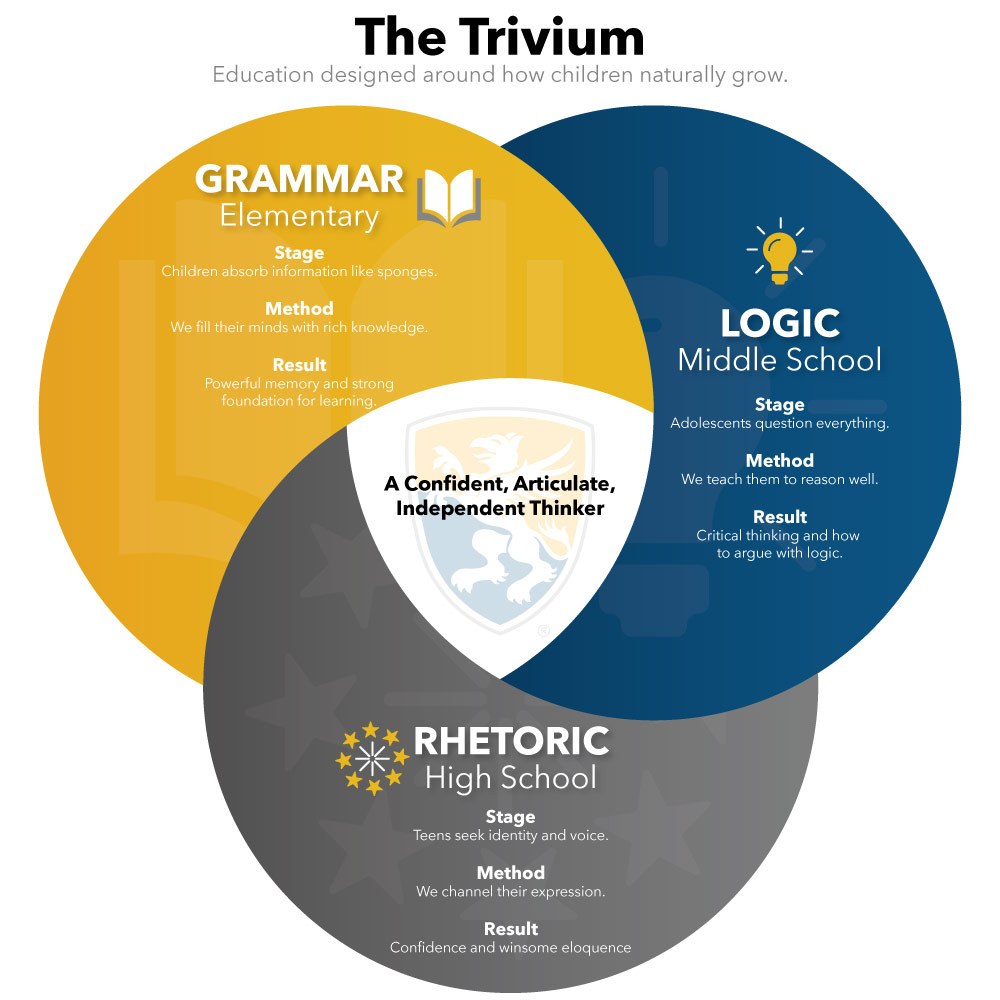
(If you want the complete picture, our parent’s guide to classical education goes even deeper. But for now, the short version is enough to make sense of what follows.)
Elementary and grammar-stage students (roughly K through 5th or 6th grade) are in the years when learning is deeply physical and relational. Children at this stage absorb information almost effortlessly: facts, stories, songs, rules, vocabulary. They learn through repetition, rhythm, and the presence of a caring adult. They need someone with them.
For most families, that means online learning plays a supporting role at this age. A parent teaching at home might use a structured curriculum with online components, or an older grammar-stage student might take a couple of live classes to supplement what’s happening at the kitchen table. Parents of younger children also tend to be more cautious about screen time, and rightly so.
That said, families come to this from different starting points. Some parents are eager to teach and just want good materials. Others want their child learning at home but aren’t in a position to lead instruction full-time, whether because of work, other children, or simply because teaching isn’t their gift. Both are legitimate reasons to explore what’s available. The question for grammar-stage families isn’t really “online or not” but “how much, and what kind?” A couple of live classes each week looks very different from a full day on a screen, and the right answer depends on your child and your family.
Middle school and logic-stage students (roughly 6th through 8th grade) are entering the years when they start to question, argue, and push back (as every parent of a twelve-year-old already knows all too well).
The name “logic stage” is apt: these students are beginning to ask why, to spot contradictions, and to test ideas against each other. They want to argue, and they should.
This is a natural entry point for live online learning. A student who’s beginning to think critically benefits enormously from a teacher who knows how to ask good questions and from peers who sharpen their thinking. The structure of a live class, with set meeting times, assignments, and a teacher who holds them accountable, also provides the kind of external scaffolding that many students this age genuinely need.
At this stage, many families begin adding two or more live online classes to their homeschool routine. A logic course, an upper-level math class, or a discussion-based humanities class can be a natural fit, giving the student a taste of what’s ahead while the parent continues to lead the rest.
High school and rhetoric-stage students are where online learning often comes into its own. The rhetoric stage is about synthesis and expression: students aren’t just absorbing information or analyzing arguments; they’re learning to build and articulate their own.
The subjects get harder. The thinking gets more sophisticated. The stakes feel higher.
Many homeschool parents, even experienced ones, reach a point where they’re no longer confident teaching advanced chemistry, calculus, or formal rhetoric. That’s a completely normal part of the journey. Live online classes at the high school level can offer the academic rigor, teacher expertise, and transcript credibility that families need, without requiring a move to a traditional school.
For students heading toward college, the experience of participating in a discussion-based class, writing papers for a teacher who gives real feedback, and being held to external deadlines is genuinely valuable preparation.
The general principle: The younger the student, the more they benefit from close adult involvement in their learning, whether that’s a parent teaching at home, a live class with a small group, or some combination. As students mature and move through these stages, they’re ready for more independence and more direct interaction with teachers and peers. Many families find that the balance shifts gradually, a class here, another there, adjusting as the child grows and the family’s needs evolve.
The Kinds of Students (and Families) Who Thrive Online
There’s no single profile of a student who does well with online learning. But there are patterns.
The self-directed learner. Some students are internally motivated. They want to move through material at their own pace, dig deeper into subjects that fascinate them, and work ahead when they can. Self-paced online learning gives them room to do that. Live online classes give them intellectual peers and teachers who can push their thinking further.
The student who needs a strong teacher but doesn’t have local options. This is more common than people realize. Many homeschooling families live in areas where co-ops are limited, private school options are few, and the local public school doesn’t offer what they’re looking for. Live online classes connect these students with expert teachers and engaged classmates regardless of geography.
The family with a non-traditional schedule. Military families. Families in ministry. Families with a child who competes seriously in a sport or pursues a performing art. Families who travel. For all of these, the fixed schedule of a brick-and-mortar school is a problem, not a feature. Online learning, in various configurations, gives them the flexibility to build education around their life rather than the other way around.
The parent hitting a wall with certain subjects. You might love teaching your children. You might be wonderful at it. And you might also be staring at an advanced math textbook thinking, “I have no idea how to teach this.” That’s an incredibly common experience, especially as students move into high school. Live online classes let a parent hand off specific subjects to a qualified teacher while remaining the primary educator in every other respect.
The student who thrives with external structure. Some kids do their best work when someone other than Mom or Dad is setting the expectations. A live class with a teacher, classmates, due dates, and real-time discussion provides accountability in a way that can be hard to replicate at the kitchen table. This isn’t about the student being undisciplined. It’s about knowing what environment brings out their best.
The common thread isn’t a personality type or a learning style. It’s intentionality. Online learning works best when a family chooses it deliberately, matching the format to the student and the season of life they’re in.
The Concerns Worth Taking Seriously
If you have reservations about online learning, you should. Not because online learning is bad, but because your reservations probably reflect the fact that you care deeply about your child’s education and you’re not willing to settle for “good enough.” That instinct is worth honoring.
Here are the concerns that come up most often, and they deserve honest treatment.
Screen Time
This is usually the first objection, and it makes sense. Most parents are already fighting a battle against passive screen consumption, and the idea of adding more screen time to the day feels counterproductive.
It’s worth stepping back for a moment here, though, because the comparison isn’t always what it seems.
Traditional schools are not screen-free. Most students spend significant portions of the school day on Chromebooks, iPads, or interactive whiteboards, and that’s before you factor in the time spent on screens during the commute, passing periods, and the hours after school. The assumption that brick-and-mortar schooling means less screen time doesn’t always hold up when you look closely at how a student actually spends their day.
Online learning can, in some ways, do the opposite of what parents fear. When a student’s school day happens at home, it eliminates the “buffer time” that tends to fill up with passive screen use: the bus ride, the passing periods, the thirty minutes of downtime between dismissal and an activity. A family with more control over the structure of the day often ends up with more space for the offline things that matter, reading, outdoor time, sports, hobbies, and unhurried family life.
That said, the specific concern about screen use is still worth holding onto. The distinction that matters is between passive and active screen use. Watching YouTube, scrolling social media, and playing video games are passive or semi-passive activities. The student is receiving, not producing. A live, discussion-based class is categorically different. The student is listening, thinking, responding, debating, and creating. The screen is the medium, but the activity is deeply engaged.
A student who takes a couple of live online classes doesn’t need to spend the rest of the day on a computer. Many families pair live online instruction with offline reading, writing, hands-on projects, and plenty of time outside. The screen is one tool in the day, not the whole day.
Research bears out this distinction. The American Academy of Pediatrics shifted away from blanket screen-time limits for older children years ago, emphasizing instead the quality of screen use and the importance of balancing it with other activities.
The question isn’t simply “How many hours?” but “What are those hours doing?”
Social Interaction
This is the big one. And it deserves more than a quick dismissal.
The fear is real: that a child learning online will be isolated and miss out on real friendships, social development, and the experience of being part of a community. For parents who value character formation, this concern runs deep. Education is more than content delivery. It’s about shaping a whole person, and people are shaped in relationship.
Online learning does look different socially from a traditional school. There are no hallways, no recess, no cafeteria. A student in a live online class will not have the same kind of ambient social exposure that comes from spending six hours a day in a building with other kids.
But “different” and “lesser” are not the same thing.
The relationships that form in a good live online program can be remarkably deep precisely because they’re built around something substantial. Students who discuss the Great Books together, debate ideas in a rhetoric class, work through hard material alongside the same cohort year after year, they aren’t just sharing space. They’re sharing an intellectual and moral formation. That’s a different kind of bond than the one formed in a hallway between classes.
At Veritas Scholars Academy, we’ve watched this play out in ways that continue to surprise even us. Students who have never met in person become close friends across state lines and time zones. They stay in touch after graduation. They meet up at the End of Year Gathering and pick up conversations they’ve been having in class for months. And occasionally, they end up building a life together. We’ve had students who first met in a VSA classroom years later get married. The community that forms in a live online classroom, when the program is designed with that in mind, isn’t a consolation prize for the “real thing.” For many students, it is the real thing.
It’s also worth remembering that homeschool families rarely rely on a single source for their child’s social life. Church, sports, neighborhood friendships, and family all contribute even as live online classes add to that ecosystem. The classes don’t need to be the whole thing.
One final note: most of the research mentioned in this article is about homeschooling specifically, but there’s significant crossover with online learning. And the research consistently shows that homeschoolers thrive socially.
Accountability and Structure
Some students are self-starters. Many are not, especially in the middle school and early high school years. Parents worry, reasonably, that a student learning from home will lack the external structure that keeps them on track.
Live online classes address this directly. The class meets at a set time. The teacher takes attendance, leads discussion, assigns homework, and gives grades. A student who doesn’t show up or doesn’t prepare will hear about it, just as they would in a physical classroom.
For many families, this combination of working from home while still being accountable to a teacher and a class is exactly the right balance.
“Is It Real School?”
Some parents worry about legitimacy. Will colleges accept this? Will it count? Is an online transcript taken seriously?
The short answer: yes.
Online education has been mainstream long enough that colleges and universities are well-accustomed to evaluating students from online programs. What matters to admissions offices is the rigor of the coursework, the quality of the transcript, and the student’s ability to perform, not whether the classroom had physical walls.
Accreditation matters here. Families should look for programs that are accredited by recognized bodies, which provides external validation of academic standards and makes the transcript portable and credible.
Both anecdotally and statistically, homeschooled students (including those educated partly or fully online) tend to perform well in college. A study from the National Home Education Research Institute found that homeschool students typically score above average on standardized tests and have higher college GPAs and graduation rates than their traditionally schooled peers. Online learning, when done well, is part of that track record.
It Doesn’t Have to Be All or Nothing
If you’re picturing online learning as an all-or-nothing decision, you’re not alone.
Most parents start there. The assumption makes sense: school has always been a single thing you’re either enrolled in or you’re not. It’s natural to bring that framing with you.
But one of the things families discover pretty quickly is that online learning is much more flexible than that. The options are more varied than you might expect, and most families end up building something that’s uniquely theirs.
A full course load of live online classes. Some families want a complete program: a set schedule, a full roster of teachers, a built-in community, a diploma track. The student attends live classes for all or most of their subjects. Structure and accountability are baked in. This is the closest equivalent to enrolling in a school, just without the commute.
A few live online classes alongside parent-led instruction. This is one of the most common approaches, especially for families who love homeschooling but want help with specific subjects. A parent might teach history, Bible, and literature at home while enrolling their student in live online classes for Latin, math, or science. The parent stays in the driver’s seat. The live classes fill specific gaps.
Live online classes combined with self-paced courses. For families who want a mix of structure and flexibility, this approach lets a student join live classes for discussion-heavy subjects (think humanities, rhetoric, or theology) while working through other subjects independently at their own pace. It’s a good fit for students who are self-motivated in some areas but benefit from a teacher’s guidance in others.
A mix that shifts over time. Many families adjust the ratio as their children grow. A younger student might start mostly parent-led, adding a live class or two in middle school. By high school, the balance might tip toward more live instruction as subjects get harder and the student’s independence grows. This kind of gradual transition is one of the great advantages of a flexible model.
The point isn’t to prescribe a single path. The point is that online learning is a tool, and thoughtful families use it in the way that best fits their child, their convictions, and their season of life.
What to Look for in an Online Learning Program
If you’re evaluating online learning options, here’s a framework. These are the things that separate programs that genuinely serve students from programs that simply deliver content.
Live interaction, not just pre-recorded content. There’s a meaningful difference between a student watching a video and a student participating in a class. Live instruction means real-time questions, discussion, and engagement. It means a teacher who can adjust based on how the students are responding. If a program is primarily pre-recorded, understand that you’re getting a very different experience.
Teacher quality and consistency. Who’s teaching, and how long have they been doing it? Great online learning depends on great teachers, people who know their subject, care about their students, and know how to lead a class through a screen. Look for programs where the teachers are consistent year to year, not rotating adjuncts.
Manageable class size. A live class with forty students is a lecture, not a discussion. Smaller class sizes allow the teacher to know each student, to call on them by name, to notice when they’re struggling, and to push them when they’re ready. Ask about class caps.
Curriculum philosophy and coherence. What’s the educational philosophy behind the program? Is there one? A program built around a clear pedagogical approach (classical, Charlotte Mason, or otherwise) will produce a more coherent educational experience than a program that’s simply aggregating courses. Look for something with a backbone.
Community beyond the classroom. Learning is relational. A good program offers more than isolated classes. Look for opportunities for students to build relationships with each other and with their teachers outside of formal instruction: events, gatherings, student groups, or other touchpoints that create a sense of belonging.
Flexibility to combine with other approaches. Not every family wants or needs a full-time program. The best online learning options allow you to enroll in individual courses, combine live instruction with self-paced work or parent-led teaching, and adjust as your family’s needs change. Rigidity is a red flag.
The Real Question
“Is online learning right for my child?” is a useful starting point. But the better question is this: What kind of learning does my child need, and how can we build an education that fits?
For some families, the answer will be entirely parent-led instruction at the kitchen table. For others, it will be a full schedule of live online classes. For many, it will be something in between, a thoughtful combination that uses the best tools available to give their child the formation they’re after.
The families who get the most out of online learning are the ones who approach it with clarity about what they’re looking for: academic rigor, a coherent worldview, real relationships, and the flexibility to educate in a way that fits their life. Those things aren’t mutually exclusive. And they’re more accessible than they’ve ever been.
If you’re curious about what live online classical Christian education looks like in practice, Veritas Scholars Academy is a great place to start. Explore the classes, talk to a Family Consultant, and see if the fit is right for your family.