

Making History Come Alive | Rob Shearer | Veritas Vox
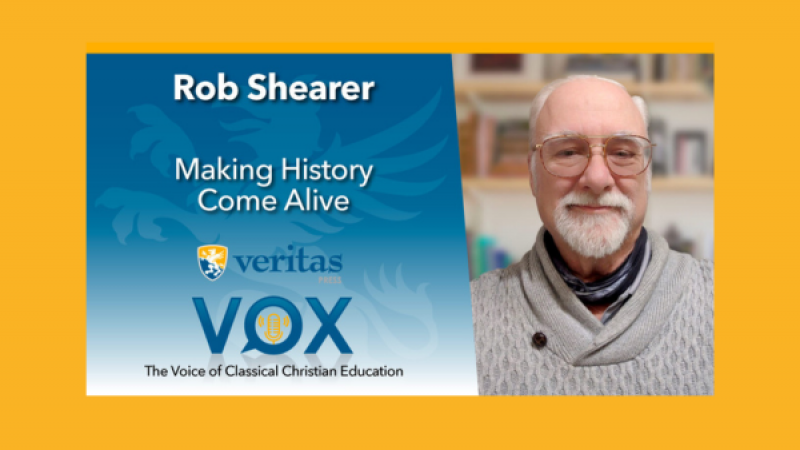
Rob Shearer has been teaching history and literature through the Omnibus courses at Veritas Scholars Academy for over a decade, and he has a passion for teaching like no other.
In today’s episode, you can get a preview of the engaging teaching style his students enjoy as he tells the story of how Pope John Paul II, Prime Minister Margaret Thatcher, and President Ronald Reagan completely turned around the 20th century and helped give the world hope and freedom.
Episode Transcription
Note: This transcription may vary from the words used in the original episode.
Marlin Detweiler:
Hello again and welcome to another episode of Veritas Vox, the voice of classical Christian education. Today, we have with us a familiar face for a couple of reasons. One, he's been on the podcast before, and two, because he is a beloved Veritas Scholars Academy teacher. Rob Shearer, welcome.
Rob Shearer:
Thank you. It's great to be here.
Marlin Detweiler:
Well, I know that you've been on before, but for those that may not have met you or may not know you, let's talk just briefly about your family, your education, your career. We like to start there, and I think it makes sense to do that with you again.
Rob Shearer:
All right. Well, as you mentioned, I've been teaching at Veritas, just finished my 12th year, and absolutely still loving it. It's just such a joy. It's such a great organization to be a part of. I give thanks for your leadership and our headmaster, Bob Cannon. The faculty continues to amaze me with all that they do.
Marlin Detweiler:
Even though I've got to say this, you have said something that merits repeating. I believe it was in your first episode, but I'm going to say it here again, and this is a statement that comes from Rob Shearer and other teachers have joined in, and that is, you say, Marlin, you don't have to pay me to teach.
Rob Shearer:
I will teach these classes for free. They are so much fun and so rewarding and so stimulating. I would absolutely teach for free. Now there's a second part to that stage.
Marlin Detweiler:
Well, I'll say the second part because I like the pencil line too, but you have to pay me to grade.
Rob Shearer:
Yep. You have to pay me to grade papers. Grading papers is just work. But teaching the classes is a true joy. And I am not unique in that. You know, I may be the one who has said it first, but the faculty I've talked to all feel that way, and they all approached their courses that way. They are all just passionate about their subject matter and they enjoy teaching.
Marlin Detweiler:
Very good. Well, tell us more about yourself now.
Rob Shearer:
So I wandered into the humanities, into history and Great Books program in my college days. I actually was a math science nerd. I was taking organic chem and calculus in high school. I went to Georgia Tech for a while, and then I got to my undergrad college, Davidson College in North Carolina. They offered a great books program, which I didn't really understand what that was, but I signed up because it got rid of most of my general education requirements, and it absolutely altered my trajectory academically and really career-wise.
It started with the Epic of Gilgamesh in the fall, and two years later you were reading modern 20th century existentialists. So all of a sudden I switched my major from math. I thought I was going to be an engineer to economics and then to history and German, and the rest is sort of what I've been doing for the rest of my life studying history.
I went to grad school at Stanford, came to find out when I arrived at Stanford, they had a two year Great Books program for their graduate students, more seminar style. But it started with the Epic of Gilgamesh, and it finished with the 20th century existentialists. And it gave you a joint degree. And I signed up for that as well.
And it really set the course. I've still got the syllabi over here on my desk from my undergraduate course. It was an early when you guys brought out the omnibus program. I just went, oh, yeah, you know, sign me up. This is great.
Marlin Detweiler:
How much of this is overlap?
Rob Shearer:
Oh, almost all of them, almost everything I read in college and grad school is in the Omnibus curriculum. And actually the curriculum is more complete. The college curriculum was broader.
Marlin Detweiler:
Well, it is six years. It's for younger students, but it is six years.
Rob Shearer:
Exactly. Yeah. Exactly. So and then, you know, I've done a little bit of this and that along the way. I've had a few different career paths. We were homeschooling our own children and we were looking for good history material. My wife and I found some things in a used bookstore. We decided to bring them back in print. We met Laurie and Marlin Detweiler in Florida, and they wanted to do flashcards to go with our books.
And so Veritas Press and Greenleaf Press had sort of a symbiotic relationship. Still do. Actually, sitting on my desk, here is a purchase order from Veritas Press for some of the books from Greenleaf Press. So we worked together to try and bring history to the homeschooling community in a way that made it alive and interesting and told the stories from a biblical perspective.
So I did that for ten years, and then you called me one day and said, hey, would you ever consider coming to teach for Veritas Scholars Academy online? And I said, I'm not sure online teaching really is a thing. I'm not sure that can work. So little did I know.
Marlin Detweiler:
Let's focus on that for just a moment, because it has been my experience that people that have not experienced online education are all doubters. And it's also my experience that everyone that does experience it all totally bought in. It is astounding to me how consistent that is.
Rob Shearer:
It is, although, in deference to the Veritas faculty, I have to say, I believe it's probably possible to do an online school badly. Veritas Press does it with excellence. Veritas Press doesn't. Outstanding job in a couple of ways. It's a great technology base, but it's also recruiting top notch teachers.
Marlin Detweiler:
Most important part of education is not the pedagogy. And we believe classical Christian education is the best. It's not the curriculum. And we believe that Veritas selections are the best. It is the teachers and the format, the venue, the environment is not prohibitive.
Rob Shearer:
Oh, not at all. And I will definitely testify that certainly in the way Veritas Scholars Academy conducts online schooling. It works. It works exceptionally well. It's a little different. The nuances are a little different than a brick and mortar classroom.
Marlin Detweiler:
That's right.
Rob Shearer:
But one of the interesting things, to paraphrase Jurassic Park, “community finds a way,” you know, people want to build community. Students want to get to know each other. Good teachers want to get to know the students and the technology. Actually, there's enough technology available that it's not a barrier. There is a way to build community, and Veritas has always held that part of the school up as something that's important.
It's not ancillary, it's central. And so there is a community. There's a community of faculty as they relate to each other. There's a community of students that relate to each other. And then there is, of course, our glorious five day in-person celebration every year, which, you know, you sort of go to the mountaintop and wish you could stay there forever, but it works.
And the relationships don't get built at End of Year Gathering. They get deepened. They're more richly experienced in some ways, but that's not where they're built. That's just another added little bit of icing on the cake.
Marlin Detweiler:
Yeah. Well, you have also, while you teach for us, you teach for a study center called the Francis Schaeffer Study Center. That's connected. Is it officially connected to the church?
Rob Shearer:
It is; the church sponsors it is a ministry. Abundant Life Church in Mount Juliet.
Marlin Detweiler:
In Mount Juliet, Tennessee. And you have started a podcast that the church has supported and sponsors your over a couple dozen episodes. Now you've focused it well, tell us what you focus on. I don't need to tell them. You tell us.
Rob Shearer:
Yeah. About two years ago, I sort of became aware because I was getting lots of questions from people in the church. They knew that I was a historian, that I was teaching online, that I was teaching in the classroom. And they said, hey, could we come to your classes or could you give some public lectures that we could come to and we could bring our friends to?
So at their urging, prompting, request, I started two years ago now to schedule a monthly lecture on a historical topic. And I did a couple of broad topics at first, but since then almost all of the other 25 lectures that I've given now have been focused on a single person. Because I know you know my litany. I've always said the best way to teach history is with biography.
The best way to teach children about history is to give them good biographies to read. Well, I think that principle extends even to adults. The things that adults are even most interested in is tell me a good story about somebody who made a difference, somebody who was important. So I've given 25 lectures now on selected key figures from across all of recorded history, from ancient to modern.
And yeah, they've been well attended, they've been recorded. We decided we would start putting them up on the internet. There's a YouTube channel now.
Marlin Detweiler:
Do you record them with a live audience?
Rob Shearer:
We do. We have a live audience. And so there is a little Q&A at the end. And yeah, I'm standing on stage. I work better when I've got people and I can see their faces and react to them, and I get good questions at the end. So that's part of each recording. It's not just me as a talking head, it's actually me giving the lecture to an audience.
Marlin Detweiler:
Okay. Who are some of the features?
Rob Shearer:
Well, I started when I began all of this with some people from the ancient world. I started with Constantine because he's often mentioned; he gets a paragraph in the textbook, and there's a whole lot more to his life than just that. I talked about Agustin because I've been teaching him for 12 years now with Omnibus, and more and more impressed and convinced that Augustine is probably the most important theologian in the history of the church.
I'm not really going out on a limb with that. A lot of people share that opinion. Then I did Dante because I've, you know, been teaching Dante every year. I've fallen in love with him. He's very important, very worthwhile. I've done Luther, I've done Bach, I've done Alexander the Great, Herod the Great, Charlemagne. I did a three-month series where I did three US presidents.
I did Washington, Lincoln and Teddy Roosevelt, three of my heroes. And right now I'm in the middle of doing three figures who changed the course of history in the 20th century. So I'm doing Pope John Paul II and Prime Minister Margaret Thatcher and President Ronald Reagan, because the course of the 20th century looked like it was going to end very badly.
If you looked at the period from 1900 to the mid 1970s, you could very well and reasonably draw the conclusion. This is a century that's gone badly so far. In the first 50 years, we've had the worst wars in the history of mankind and the Holocaust to boot. And it doesn't look like things are getting any better with the turmoil of the 60s and 70s.
And then things turned around, and the three people most responsible for the turnaround are Pope John Paul II, Margaret Thatcher, and Ronald Reagan.
Marlin Detweiler:
What are the issues that you would say they helped resolve?
Rob Shearer:
Pope John Paul II is the one I would mention first, and Pope John Paul II is a unique figure in church history, but also even in political in 20th century history, he had just a deep commitment to the dignity of every human being, the dignity and the natural rights of freedom and a sense that because of God's creation, God's created order, that every human being was worthy and had dignity and was not a means to an end, and that freedom was what mankind was created for.
So when he became pope and he had a long history, he had been a university student chaplain. He had been a teacher of ethics and philosophy. He had sponsored graduate students. He had been an advisor and a participant in the Vatican Council. In the early 1960s. I had to refresh my memory of that because I was alive when that was happening, and I knew a little bit about it, but I didn't realize that Vatican two was a summons to a conference of every Catholic bishop in the world, and over 2000 bishops attended.
Yeah, they met for three years now. They only met for about two months a year, and they met for three years in a row in the fall. But John Paul II was already bishop of Krakow, and he took part in those deliberations. That's how he became known to all the other bishops and to the previous pope, and was sort of his path to being elected.
So John Paul's emphasis on the absolute universal truths of Christianity, the centrality of the gospel and the saving work of Jesus Christ, and the value of every individual as a unique creation of God was at the core of pushing back on the communist socialist experiment that began in the Soviet Union, eventually enslaved half of Europe, and there was a longing for freedom.
He had grown up in that system. And actually he started university during the Nazi occupation. So he had experienced the Nazi occupation in Poland for six years and then had experienced the Communist domination and hostility to the church as he was ordained a priest and became a chaplain, he actually took students out into the countryside, took them on retreats, took them camping, took them kayaking, took them skiing.
Because he wasn't allowed to actually give religious instruction, it was illegal. So his cover story was, I'm not doing religious instruction. We're going on a hike, we're going on a camping trip, we're going skiing in the mountain. We're going on kayaking trip. But every evening he's sitting around the campfire and he's talking to students. He's talking to young married couples.
He's talking. He's just a pastor. It's a pastor's heart. But he has an academic’s breadth of knowledge and understanding of the gospel and the scriptures and how they apply to life.
Marlin Detweiler:
So as a as the pope, as someone who obviously came up in the Roman Catholic Church, what was it about politics and communism that really captured him? And how did that relate to the church? From his vantage point.
Rob Shearer:
He was never overtly political. He never made any direct political challenges himself. But one of the first things he did within a year of being elected pope, he contacted the government in Poland and said that he wanted to make an official apostolic visit as pope back to Poland. And of course, you know, that was almost unheard of.
Popes had not been allowed to travel behind the Iron Curtain. They were all officially atheistic and restricted church activity. But he was extremely popular. The Polish population majority were Catholic, still attending church, and they absolutely wanted to see him and welcome him and congratulate him. So the government really found themselves in an impossible position. They couldn't say no.
They allowed him to come for ten days. In 1979, he preached to over a million people in Warsaw and then over a million people in the south in Nova Huta, I think in an outdoor rally. But he didn't preach anything directly political, but he preached the worth of the individual. He preached the gospel. He preached the truth of Jesus Christ, and that salvation is through him.
But he encouraged the Polish people to renew their faith and to adopt a life of kindness and love and value and sort of quietly, silently maintain their religious identity and their appreciation for each other. One of the byproducts, I don't think he planned this, but one of the byproducts of that trip. When a million people gathered in Warsaw at an outdoor mass to hear him.
Lots and lots of people in later years have been interviewed and given the same answer. They were suddenly made aware. There are other people. It's not just me. And actually there's a lot of us, and actually there's more of us than there are of our communist over was the majority. All these other people feel like I do.
All of these other people are brothers and sisters in Christ. All of these other people long for freedom as well. Within a year of his visit to Poland, an electrician in Gdansk organized a trade union first trade union behind the Iron Curtain that wasn't controlled by a Soviet or a socialist government, and the shipyard tried to fire a worker, and they rallied around her and went on strike.
And they formed a trade union that they gave the name Solidarity to; that was inspired by John Paul. He didn't actually call for it. He didn't participate in the organization. But the experience that the people of Poland had when he went there and when he publicly proclaimed the gospel publicly was a defiance of the Polish government. They had never allowed any church service to be broadcast on TV, and they had to allow his visit to be televised.
They had to allow his public preaching to be broadcast. And so it changed the spirit of the people. They suddenly realized we are all still in this, and that government can be stood up to. And the gospel is stronger than those who are oppressing us.
Marlin Detweiler:
So that's John Paul the Second. Yeah. We also mentioned as part of this package of people, this collection of three that really kind of reformed the 20th century. Some of us are old enough to remember Margaret Thatcher and Ronald Reagan. Me too.
Rob Shearer:
Well, yeah.
Marlin Detweiler:
But some of us are not. I told somebody earlier today, I interviewed a teacher. She was a teacher candidate. She was born in 1984, I was gay. I said, I'm starting to hire. I'm hiring teachers now that are my kids age. Yeah. They don't have any recollection of Reagan being president. Tell us about I don't care. You take the one you want to take next, Margaret Thatcher or Ronald Reagan.
Rob Shearer:
Well, chronologically, Thatcher came to power next. So John Paul was elected pope in 78. Thatcher becomes prime minister in 79. And it's a reversal of 20 or 30 years of economic and political decline in Great Britain. Great Britain had gone to sort of a soft socialist. They had nationalized a large number of industries. The trade unions had enormous power and were blocking lots of innovation.
And economic inefficiency was something they fought to keep rather than to overcome. And so Thatcher comes to power and she champions the individual. She champions freedom. She champions the marketplace, the free market. She believes that we ought to, rather than sit back and just acquiesce to the Soviet empire, that we should actively resist it. She made the UK again a strong partner in NATO, and forced the Soviet Union to sort of rock back a little bit on their heels.
And she really did transform both the economic situation in Great Britain, but also the mood of the country. It was sort of a revival of patriotism in the United Kingdom. It became more fashionable to be proud of being British, to be proud of their history and their ancestry, and to be proud of all of the accomplishments.
So those two people were then in power. And then in 1980, Ronald Reagan is elected. Of course, you know, you have to know the details of the American electoral system. We have elections in even-numbered years. He's elected in 1980, but it's November of 1980, and he doesn't take office until January of 81.
Marlin Detweiler:
Sure.
Rob Shearer:
But Reagan was like Thatcher and like Pope John Paul II, not believing that we should acquiesce and accept as a fait accompli that the Soviet empire ruled half of Europe, that Yalta, the lines that were drawn, had to be accepted as sort of the permanent boundaries of Europe. Reagan, like Thatcher, like John Paul II, said, the Soviet Union is an evil empire, and we don't need to just tolerate it and contain it.
We need to roll it back. We need to work for the freedom of the people who have been enslaved. All three of them were agreed on that. They were approaching it from different perspectives and with different means. Pope John Paul was not calling for political movements, but he did, over and over again, reiterate the natural rights of people to live their lives freely.
And so Thatcher and Reagan supported that. And Reagan, of course, you know, famously goes to Berlin. There's a shift in leadership in the Soviet Union that went on to mention. So up until the mid 1980s, it was still the Khrushchev era, the generation followed by Brezhnev and a couple of other old, old guys who were World War Two veterans.
And then in the mid 80s, there's a generational change in the leadership of the Soviet Union. Gorbachev, who was the first Soviet leader, who had not been a soldier in the Great War, the first one born after World War two. And, of course, he's interested in glasnost and perestroika and is open to sort of, you know, he tries to put forward the communism with a human face, and Reagan picks up on that and says, okay, if you believe in that, here's what you should do.
You should demonstrate your commitment to glasnost and perestroika, to transparency, openness. And he gives the famous speech. He says, Mr. Gorbachev, if you really believe in those things, he's standing in Berlin with the Brandenburg Gate behind him and the wall behind him. Mr. Gorbachev, if you believe in those things, tear down this wall. And it didn't happen until after he left office.
I mean, it was true three years later, I think he gave that speech in 86 or 87. By the way, the US State Department really didn't want him to give the speech. They tried to take those lines out of the speech over and over again.
Marlin Detweiler:
Why?
Rob Shearer:
Well, they thought it was just too provocative. I mean, you know, it would upset the apple cart. It might make the Soviet Union upset with us, and Reagan said, I don't care.
Marlin Detweiler:
Reagan was very rhetorically effective. He brought his acting skills to the presidency. And I'm not suggesting at all by saying that that he was an actor as a president, but rather he was a remarkable communicator as a president.
Rob Shearer:
Oh, yeah. Absolutely. Yeah. It's a very good study in rhetoric. And, you know, the relationship between persuasive speech and political speech and dramatic speech. You know this because Veritas has one of the outstanding rhetoric programs, not just in the US, it's in the world. There's nobody who's doing rhetoric as well as effectively, as powerfully as Veritas.
It's not even a subject in most schools. And it ought to be. And my hat's off to you, because I see the results.
Marlin Detweiler:
Reagan was great for that, wasn’t he?
Rob Shearer:
Absolutely. Yeah, absolutely. You know, and the speechwriter for that speech, the one who actually helped Reagan do it is Peter Robinson from the Hoover Institute. He went on. He hosts his own podcast, his own TV series. He interviews people. Peter Robinson at the Hoover Institute is the author of The Berlin Speech.
Marlin Detweiler:
Interesting. I did not know that our friend and classical Christian education and former. I served on a board with him. George Grant was a speechwriter for Reagan at one point.
Rob Shearer:
Absolutely.
Marlin Detweiler:
Yeah. It was. I thought you might say that, but I figured I probably would have known that already.
Rob Shearer:
Yeah, well, I don't think. I don't think George had a hand in the Berlin speech, but yeah, I know, and George can't talk about all the speechwriting he's done, but he has. He has helped shape political rhetoric for a number of public figures, and he's not really at liberty to talk about it.
Marlin Detweiler:
Yeah. He has done just that. So these three people in our closing minutes. What did they accomplish that changed history?
Rob Shearer:
Yeah. Paul Johnson in his book, Modern Times, had to rewrite the ending of the book because he first published it in the late 70s, and it had a very somber, pessimistic ending. And after the events of the 80s, he had to rewrite the book, add a new chapter. The chapter he added, he gave the title The Recovery of Freedom.
Marlin Detweiler:
Wow.
Rob Shearer:
And he gives credit to Pope John Paul II and Margaret Thatcher and Ronald Reagan for the recovery of freedom. And if you had looked at the arc of the 20th century through the 1960s and 1970s, you would not have predicted it. You would not have predicted the events that would happen at the end of the 80s. The end of the 80s were a recovery of freedom.
That was an astonishing, for the most part, peaceful revolution, not just in one country, but in a dozen countries where freedom was recovered. And that's the single most important political event of the 20th century, is that freedom was recovered in Eastern Europe, in Germany, Poland, Czechoslovakia, Romania, Bulgaria, Lithuania, Latvia, Estonia. All of these countries that had been enslaved went from being slave colonies of the Soviet empire to being free and independent nations.
That was completely a surprise development. No one predicted it. No one saw it coming. And the responsibility for those. There are lots of people who contributed and lots of actors and all those various places. But I think the most important actors that set the stage and enabled those events are John Paul II and Margaret Thatcher and Ronald Reagan.
Marlin Detweiler:
Yeah. Well, I love to hear that because I lived it and I saw it happen from my American seat. I wasn't in the middle of it. And it really is an exciting time. I love your love of history. I love the way that you make history come alive. I want to encourage people to find your podcast and enjoy those talks. Tell us how we can find it.
Rob Shearer:
There are two YouTube channels you can go search on Abundant Life Church, Mount Juliet, Tennessee and all of the lectures are recorded in there along with the sermons from our church. But my lectures are there as well. And then there is a second YouTube channel for the Francis Schaeffer Study Center. If you go into YouTube and put those four words in Francis Schaeffer Study Center, you'll find our channel. And all of the lectures are there as well.
Marlin Detweiler:
Very good. I know you have some wonderful things being planned as well. It's an exciting time. Your ability to bring history to life is really a joy to watch. I love to see you getting fuzed about it too.
Rob Shearer:
It has been my passion. I think it's my calling. I'm a historian. I mean, it's what I am. It's what's God's called me to be. And I try to communicate it. I try to make it understandable, and I try to help people see God's hand in these historical events.
Marlin Detweiler:
Yeah. Thank you so much, Rob, and thank you for all the great work that you do for us and for the study center and for your church. It's been a real blessing. Thanks.
Rob Shearer:
Thank you for having me. It's been a joy, folks.
Marlin Detweiler:
Thank you for joining us in this episode of Veritas Vox, the voice of Classical Christian Education. We hope to see you next time.
Have questions? Talk to an expert for free!
Our Family Consultants are here to help! Fill out the form below to schedule a quick call for free.