

The Babylon Bee | Seth Dillon | Veritas Vox
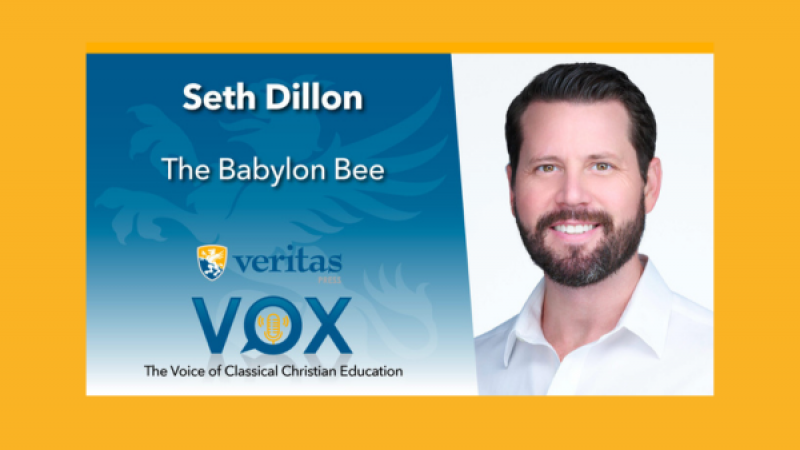
Today we chat with Seth Dillon, CEO of The Babylon Bee, about the power of humor and our First Amendment rights. Freedom of speech isn’t just about fighting censorship; with this freedom also comes the responsibility to stand up for truth and call out erroneous ideas that damage culture and humanity.
Marlin Detweiler:
Hello and welcome again to another episode of Veritas Vox, the voice of classical Christian education. Today we have with us Seth Dillon. Seth, welcome.
Seth Dillon:
Thanks for having me. Good to be here.
Marlin Detweiler:
If you don't know who Seth is, you probably know his organizations, Not the Bee, and The Babylon Bee. Actually, I should have said the Babylon Bee, because that's really the lead organization. But before we get into that and talk a little bit about how that engages the marketplace, tell us a little bit about yourself, your family, your education, your career.
Seth Dillon:
Well, my own family. I have a wife. I got two boys, ten and 13. They're a joy. I live in South Florida with the rest of my family. My father is a retired pastor, so I grew up in the church. Fortunately, we have them around here close by to be around the kids quite a bit.
Best grandparents in the world. No offense to the grandparents out there who think they're the best, but you're not. Mine are, my parents.
Marlin Detweiler:
It could be a tie.
Seth Dillon:
Yeah. I yeah. So I mean, I did I grew up in the pews listening to my dad preach, so I had the kind of inside church experience that you hear from the Babylon Bee's voice. When we're doing all these evangelical Christian church culture type humor, you know, the Holy Spirit unable to move through the congregation is fog machine breaks type jokes, you know.
So that's kind of like my background. You know, I've been a Christian my entire childhood and adult life. So it wasn't like a later conversion experience or something like that. I was raised in the faith. I did start exploring the reasons for my faith as I was, you know, reaching college age.
Later in my teen years, you know, I started studying apologetics. I wanted to be able to answer objections to Christianity at that time. If you remember, you know, back around the year 2000 or so, the New Atheism movement was really taking off. You had, you know, Richard Dawkins, Christopher Hitchens, Daniel Dennett, you know, all those guys attacking religious faith and using, you know, radical Islam as kind of their wedge and reason for doing that, because they were viewing religion as being so poisonous.
And so they decided to attack all faith. Religion flies you into buildings, was their thing. And so science flies you to the moon. Religion flies you into buildings. Of course, now we're questioning whether or not the moon landings are real and we're getting into all that stuff. But my Christian faith is kind of fundamental.
It is fundamental to who I am. My education, you know, I was homeschooled for a while, which is trending now, wasn't so much back then. And then I went to Palm Beach University, which is a private Christian school, and graduated from there with a degree in business management and ended up going out into business myself. Internet marketing was kind of my thing in the early days when Google was first taking off and eventually became an entrepreneur and now I run the Babylon Bee.
Marlin Detweiler:
Tell us about the Babylon Bee. Now, it's important you make this clear, and I want to make sure that it's understood you didn't start it. You acquired it. Maybe talk briefly on that and talk to us about the mission of the Babylon B, because I'm fascinated. I love what you guys do.
Seth Dillon:
Oh. Thank you. I loved the Babylon Bee. You know, I approached the bee initially as a fan like you. You know, it's this funny and refreshing take that you hadn't really seen. And so it was very unique, had a unique voice, was upsetting this kind of perception that people had, that comedy was really dominated at the time by the secular, progressive left, that Christians weren't funny, conservatives weren't funny.
They were the butt of the joke. You know, from Saturday Night Live and the late-night shows to The Onion, which is our, you know, kind of our counterpoint on the other side of the aisle for news satire. The Bee came out of nowhere is this kind of new and refreshing thing that was doing comedy really well from a Christian conservative perspective.
You know, the tagline was your trusted source for Christian news satire. And so I saw it in my feed, you know, scrolling through Facebook, I'd see these jokes pop up and I was like, man, that's funny. That's funny too. Okay, that's another good one, another good banger. And so I ended up reaching out to Adam Ford, the guy who had started the bee and was running it almost by himself.
I mean, he had a little bit of help from a group of people that he'd kind of pulled together that were Christian commentators and comedy writers, you know, that were contributing. But he didn't really have much revenue to speak of, so he couldn't really pay much. So it was kind of just this collaborative volunteer effort where people were pitching ideas back and forth in a think tank to try to get this thing off the ground.
But I reached out to him more from the perspective of somebody who is interested in helping him grow the Bee. You know, I was like, I love this. I wish I'd been the one to start it. You know, I'd like to be involved any way I could. And I'd had, you know, I've always had an affection for satire and humor as being effective ways to communicate the truth to the culture through humor.
You know, I think humor is incredibly disarming. It's a great way to kind of wrap the package. It can get through people's defenses in a way that I think, you know, arguing with them isn't always as effective. So I always appreciated that myself. I loved comedy and satire. I kind of dabbled in it myself.
When I was in college. I actually almost got kicked out of my university for writing these anonymous satirical emails, making fun of the school and its administration and professors. And they found out it was me and I had to plead with them to let me stay.
Marlin Detweiler:
So you've had it in your blood before doing it professionally?
Seth Dillon:
Yeah. It just kind of, you know, and this is all this is the way, you know, God kind of pulls the threads together for us and strings something together and makes things work. It was a really good fit for me personally, but I wasn't again, I wasn't really trying to own it or drive it. I was just trying to help it grow.
And Adam was like, really concerned about social media censorship in particular, because the way that the bee worked initially was it was this still, to this day, really is kind of the fundamental business model is you publish these articles on social media that generate engagement and traffic to the website, and then you have ads on the website, and that's how you generate revenue.
And his concern was the fact that he was getting fact checked all the time and being threatened with demonetization or removal from these platforms. It made him feel very uneasy about the future of publishing jokes that challenged the prevailing or popular narrative, rather than promoting it.
Marlin Detweiler:
Let me ask you a question that helps parse the time a little bit. So was deplatforming and being challenged for being able to stay on social media something that happened before Covid?
Seth Dillon:
Yes. Yeah. So pre-COVID, if you go back to like 2018, this is when I was getting involved and talking with Adam. Pre-COVID, you had a lot of concern about the rise and spread of misinformation. That was the main thing. That was, you know, because at this point, Trump had been elected. And one of the concerns that was being voiced by, you know, members of Congress, the media, you know, Mark Zuckerberg was taking the blame.
Jack Dorsey was taking the blame for allowing misinformation. And by misinformation, they meant, you know, like opinions that we don't like disfavored speech. That's their euphemism for speech that they don't like. It's misinformed and misleading. They have to control what the narrative is and what the truth is. And so, you know, you had these conservative publications.
The Daily Wire started right around the time that we did in 2016. And they were spreading like wildfire on social media and growing really rapidly and stuff like that. It set off alarm bells to them. They realized that when the so pre social media, when the media was able to just drive the narrative themselves, there were no, you know, viral challenges to that.
Social media kind of opened the floodgates to people being able to push back on whatever the popular narrative is that they wanted to shove down our throats. And so they saw that as a big concern. They viewed it as one of the reasons that Trump was able to get elected in the first place was because of the rampant spread of information.
So, yeah, it was pre-COVID when they started clamping down on that and decided, we're going to work with fact checkers, we're going to make sure that misinformation isn't allowed to spread and that the bad actors who are spreading it are shut down in their voices silenced and suppressed. So that was all happening around the time I was talking to Adam.
And he had a very real concern about that. And from my perspective, I was like, well, yeah, it's a real concern, but we're doing comedy. We should be able to tell jokes like this is it'd be pretty crazy if they censored comedians, and I think that would backfire on them. And we would generate a lot of media attention for ourselves if they did, in fact, go forward with trying to stamp out our voice.
Marlin Detweiler:
Opportunity out of a challenge.
Seth Dillon:
Yeah. And I saw I was right. I was right about that because that's actually exactly what happened. I'll take a step back real quick before we get further into that, just to tell you kind of the mission of the Bee, because you asked about that earlier. And I think, you know, I mentioned briefly that I think humor is a very effective way of communicating the truth.
And that's really part of what the mission of the Bee is. Obviously we are an entertainment site, you know, kind of first and foremost satire, comedy. Like you want to make people laugh, you want to entertain them. There's a lot of absurdity in the world that deserves to be mocked and made fun of, but that deserving of mockery is also part.
It's not just a matter of making people laugh, it's also a matter of convincing them and showing them that these are bad ideas. They're harmful ideas, and they deserve mockery, not praise or affirmation or validation. They deserve to be undermined. They deserve to be ridiculed. They deserve to be torn down. And ultimately given the disrespect of being laughed at.
Yeah. So that's kind of fundamental to I would say, the Bee's mission statement, succinctly summarized, is to ridicule bad ideas. That's as simple as I would put it in. And I do sometimes get pushed back on that, you know, people will say, well, that sounds very un-Christian because you're using mockery and that's mean and it's cruel and it makes people feel bad about themselves.
And I would, of course, distinguish between mockery that's meant to make somebody feel bad, from mockery that's intended to expose foolishness for what it is so that it isn't taken seriously, I think. Yeah, mockery in that context is from a Christian perspective, from my perspective, a moral imperative.
Marlin Detweiler:
So easy example of that. In case the listener is looking for a handle. Here is the understanding that there are two sexes and not 47.
Seth Dillon:
Right? Yeah. That's this idea that boys can become girls, that men can become women and chest feed or become pregnant, you know, like these things are not just absurd. They're actually harmful. They're actually damaging. You end up cultivating confusion in children, and then these children go on to medicate and chemically castrate themselves and do surgeries on themselves.
And then they find out, you know, they go through puberty in years later, they're like, wait a minute, I want to have kids now. And I can't because I'm sterilized or, you know, I'd love to breastfeed my child, but I removed my breasts as a teenager because I thought I was a boy. I was convinced I was a boy, you know, that is serious stuff.
That is not just absurdity. That's a catastrophe. It's a tragedy. So I love to cite this example on that particular issue of a way that jokes can effectively undermine this ideology. You know, there's the liberal comedian Bill Maher, who's an atheist. He's no friend of Christianity, that's for sure. But he loves free speech.
Marlin Detweiler:
He is also a friend of some common sense.
Seth Dillon:
Yeah, he does have a healthy dose of common sense. While I disagree with him a whole lot of policy issues and on religion in the truth of the Christian faith, obviously I do agree with him that we should be free to speak. He's defended the Babylon Bee publicly, you know, as being free to do what we do.
He's like, well, you know, they're Christian satire. I thought Christianity was satire, but they have a right to be Christian satirists if they want to be. So he has defended our right to speak freely. He also poked fun at this idea that boys can become girls.
In his monologue a few years ago, he talked about how if we affirmed kids, kids are fluid about everything. If we affirmed them and what they wanted to be and what they believed they were when they're only eight years old, then the world would be filled with cowboys and princesses, which is still. And he said, when I was eight years old, I wanted to be a pirate.
Thank God no one said me for peg leg surgery and eye removal. And his audience laughed at that. And I remember thinking when I first heard that joke, I'm like, you know this. It's so important that someone like him is telling a joke like that because he's mocking this woke, radical gender ideology, and it deserves to be mocked.
He's also doing it at a time. This is a few years ago when he was doing this, where you really get yourself in trouble by challenging that stuff, you know, you put yourself in their crosshairs. You don't only generate death threats, you generate the very real possibility of being completely deplatformed yourself and taken off the air.
So that was very bold of him. I think it's a but I think it's why humor is necessary in this. It's a great illustration of exactly the attitude that we should have towards these absurd ideas.
Marlin Detweiler:
Well, you're talking about censorship and deplatforming. Something very interesting a few years ago happened to you, and the rescue is a story worth telling. Tell us what happened and tell us how it came to work itself out.
Seth Dillon:
Well, it started before that. I mentioned 2018. That's when we started getting fact-checked. We were getting flagged for misinformation. The media's take on it. The New York Times take on what we were doing was, you know, they claimed that we were trafficking and misinformation under the guise of satire. Those are their exact words.
You know, we're pretending to do satire, but we'll be really want to do is get you to believe the wrong things, to get you to believe false ideas. And so they were characterizing us this way, and the fact checkers were treating us this way, rating our stories false, but not just rating them false, which is silly because they're jokes.
Jokes shouldn't really have a truth rating. They're really just funny or not. But that was kind of where the censorship started. It eventually, though, morphed into this kind of ideologically driven terms of service type stuff where if you challenge the wrong ideas, the gender issue, for example, you start running afoul of their hateful conduct policies.
They had these kind of Orwellian trust and safety teams set up to make sure that the marketplace of ideas was safe and sanitized and wasn't filled with any hate speech. And what they deemed to be hate speech was anything that just literally said the truth that, for example, men can't become women. You say that and that's hate speech.
We had published a joke in response to a real headline that was this headline about how Admiral Rachel Levine, this transgender individual in the Biden administration.
Well, Rachel Levine, originally Richard, is a transgender health admiral who was named woman of the year by USA today, which I joked that it sounds like it's something out of a South Park episode. You know, a man in a dress is woman of the year. Like they couldn't find any actual women to nominate for this high prize.
It's a great example of how reality gets when you start going down these weird paths, this woke ideology, you end up in this place where parody and reality are basically indistinguishable from each other. That could have been a satirical joke five or 6 or 7 years ago. And all of a sudden it's actually happening in the real headlines.
So we were thinking of ways to try to mock this or parody it. And one of the challenges of doing satire when reality feels like parody is the methods that we use. We caricature what's happening. We kind of exaggerate it. We draw it out. We amplify what's there in reality. And to make it funnier, to kind of show how absurd it is. And it's hard to do that with something that's already so exaggerated and absurd.
Marlin Detweiler:
It's tough to make it more absurd.
Seth Dillon:
Yeah. So we couldn't really come up with a good headline. One of the ideas that one of our writers pitched was naming Rachel Levine our pick for man of the year, just to be kind of provocative and turn it back on them and say, you know, the Babylon Bee has chosen a man of the year, and it's Rachel Levine.
And so that was what we decided to go with. But we had this internal discussion beforehand. We're like, okay, we know what's up. We know where we're at right now. We know where things stand. We know where the power is. And these guys that run these social media platforms have these policies in place where they will treat this as hateful conduct.
They'll treat it as a violation of their terms of service. And we risk actually getting kicked off for telling this joke because they don't care that it's a joke. They just care that it's misgendering. That's it. It doesn't matter if it's a joke, it's still misgendering to them. Misgendering of course, in quotes because we're properly gendering a person who's male.
So, we had some hesitation, but we did run the headline because from my perspective, and this is what I told my team when we were debating this internally, I was like, these are exactly the kinds of jokes at this moment in time that need to be told, the ones that you should, that they don't want you to tell, the ones that you have kind of reservations about because you think you might get censored.
I'm like, we can't do the tyrant's work for him and censor ourselves and not publish it. We have to challenge this stuff with mockery; that's our job. That's what we're supposed to do. That's what comedians are supposed to do. That's what Bill Maher was doing when he told that joke a couple years later. So we ran it.
And what happened was, of course, very predictable. We got locked out of our account for Twitter, on Twitter specifically. And so we received this notice telling us that we have to delete the joke, check this box that says we admit that we engaged in hateful conduct and violated these policies, though, like you have to do, you have to check this box and delete this tweet, otherwise your account will just remain locked indefinitely.
So it was kind of a predictable outcome. But I put out a statement almost right away. I'm like, guys, we can't delete this. This is like, this is actually a hill worth dying on because this is that important. If society loses sight of simple biological truths, basic facts of reality, objective reality, objective truth, if we lose sight of that, then we go very dark places, very fast, and we're already on the fast track.
Marlin Detweiler:
Let me point out something that you might not be inclined to also, and that is that the Babylon Bee is a for-profit business that you own, and it is your livelihood.
Seth Dillon:
Yes.
Marlin Detweiler:
So you weren't just putting a nonprofit organization that could be shut down and you move into a different career. You were risking all of what you had in terms of value that you'd built up in livelihood.
Seth Dillon:
That's exactly right. That's why this was such a weighty decision for us to decide whether we post it and then whether we take it down because Twitter is not the it wasn't the biggest of the platforms that drove the most traffic at the time. Facebook was, you know, Facebook was our main traffic driver. Of course, we have these same concerns and risks with Facebook, and we've been threatened by them before and penalized by them before.
Twitter drove at the time about 38% or something. Almost 40% of our traffic, which is substantial. To just give you an idea of the business model, I mentioned it earlier. You publish these jokes on social media. The social media gets engagement and drives traffic, and the traffic is then monetized with ads or subscription appeals or whatever merch sales on the website.
But you have to have the traffic get to the site in order to make any money. If you're not generating any traffic to the site, you can't make money. So yes, it was a huge it was a terrible business decision. Honestly, if we wanted to survive and get as much traffic as possible and make as much money as possible, we never would have published the joke and we certainly would have taken it down.
Marlin Detweiler:
Except God, yes.
Seth Dillon:
Yeah. So, Elon Musk, who is a fan of the Bee and we had actually in 2021, met him in person and interviewed him in Austin, Texas. So we'd actually already established some contact with Elon and had developed some rapport with him. He had agreed to do an interview with us in 2021. This was happening in 2022.
So it was shortly after that, and he became aware of the fact that we weren't publishing headlines anymore, that we were locked out. He started to hear these rumors at the Babylon Bee’s been suspended. He saw people talking about that. And so he reached out to us and he's like, this is a crazy situation where comedy isn't legal anymore.
You can't tell jokes anymore. This is really bad. You know, like he talked to us about wokeness as being this divisive, exclusionary and harmful ideology that tries to stamp out dissent. And you have to be able to speak freely in order to push back on it. This has to be something that we debate. And if we can't do that, that's a problem.
It means that the bad ideas win by default. And of course, wokeness and radical gender ideology has affected him very personally because he has a child, a son who got caught up in all of that and transitioned. So he has a very strong personal motivation and feelings about that issue and the need to be able to have a debate about that issue. And so he reaches out to us and he's like, this is crazy. And comedy should be legal. And maybe I just need to buy Twitter. It's he just throws that in there as like this kind of a side comment.
And you know, we thought it was a joke obviously, but it became very clear shortly thereafter that it wasn't that he was, you know, buying up stock and Twitter and trying to get on the board. And then he makes an offer and we're watching this from the sidelines. We're like, wait a minute, this could actually happen.
He might actually acquire Twitter and set the Babylon be free. So this is not something I try to tell people all the time. I'm like, when you take a stand like we did, you can't ever really count on the world's richest man getting involved to bail you out of Twitter Jail.
But it does kind of illustrate the point that if people are willing to push back and fight and take a stand, you know, it will attract the attention of some people in powerful positions with a lot of influence who will be motivated by, inspired by, and emboldened by your own action to do something themselves.
And so, you know, Elon decided that it was necessary for the sanity of society that we have free speech. The Babylon Bee was one of the examples that made it very clear to him that, you know, we no longer have free speech. And so eight months later he buys Twitter and I've got it framed on my wall.
You can't see it here. But he sent me a message the day he took over it said, do you want the Bee restored? There will be no censorship of humor. So he bailed us out eight months later after that incident. And so we've grown now. I mean, we had 1.4 million followers when we got suspended. And we have 5.2 million now.
Marlin Detweiler:
Wow. Well, Elon is an interesting character, and it is really cool to know that the Babylon Bee was instrumental in the free speech initiative that Elon candidly paid too much for.
Seth Dillon:
Yeah.
Marlin Detweiler:
And he was willing to do it because it was the right thing.
Seth Dillon:
Yeah. And I do not take, some people try to give us credit like, oh, all this happened because the Babylon Bee. That's not true. I think Elon would have bought Twitter anyway. Okay. I think that the bee was just a, you know, an obvious example, a glaring example to him. This is a site that he follows that he thinks is funny, telling jokes that he thinks need to be told.
And we got locked out for a joke that we weren't supposed to tell. So, you know, we were kind of a glaring example of one of the more prominent examples of censorship that he saw. But his greater concern was just the spread of bad ideas and the fact that we're not free to push back on them.
And that went way further than the Babylon Bee. There were a lot of other people who'd been suspended. Donald Trump had been permanently suspended from Twitter and many other prominent accounts. We're being either throttled or removed. And so, it was a much bigger thing than just the Bee. But yeah, we did have a small but instrumental role in that, I think.
And the fact that he was so concerned about whether or not we could tell jokes and do comedy and was so if you read his his biography by Walter Isaacson, there's a section there called A Bee in His bonnet, and it tells this story and it tells a story of him actually going into Twitter and sitting down with the trust and safety team and saying and telling them on day one, like bring back the Babylon Bee.
I want the Babylon be back on Twitter. This is this is a direct order from me. You got to do this. And they were giving all these reasons why they couldn't make exceptions. You know, we have our rules. We have to follow our rules. He's like, treat it like a presidential pardon. Just bring them back.
Marlin Detweiler:
This is an executive order in a form that is undeniable. Tell us about the opposition that you feel today or that you are concerned about on the horizon. There are elements of tailwind that I'm sure you feel with the current administration and the nature of where we sit, but we won't always sit in this position.
Seth Dillon:
Well, there's good, and there's bad. So I think one of the things that's been good, and, you know, Elon was a massive factor in this, you know, he's been driving this initiative to restore more speech, like opening up.
You had the gatekeepers that were there that were preventing people from speaking, including us. And then Elon comes in and he's like, no more gatekeepers. Like, let people speak, even if it comes at a great cost to me personally. Elon was fighting the same issue because you had the advertisers, for example, IBM and Disney, you know, these big, big name brands that were spending tens or hundreds of millions of dollars in ads on his platform, threatening to withhold that advertising spend and saying, if you don't censor and keep this place safe and sanitized, we're not going to do business with you and run our ads with you.
I can't repeat the language that he used, but he told them, no, I'm not going to do that. You can't hold money over my head and get me to put people back in jail when I just set them free. That's not going to happen. I'm the one person you can't do that with. I'll fund it myself if I have to.
So there was a lot of pressure that was exerted on him, and he resisted that pressure. And thankfully he did, because what ended up happening was you had some of these other platforms kind of follow his lead. You know, Twitter became known as the Free Speech Platform, and all the others were the censorship platforms. And so Zuckerberg started to get kind of apologetic and backpedal and loose in his restrictions, and he got rid of this whole fact checking apparatus that had been throttling us for so long and attacking us.
And so you had a lot more freedom on other platforms. It spread beyond just Twitter. So that meant that alternative voices and views could challenge whatever that prevailing narrative was in a very healthy way. So we were kind of getting back to where we were before big Tech tyranny really started rearing its ugly head, I think.
I think the bad is and the challenge is that, when we had the gatekeepers, we weren't able to say what was true. And without them, with this kind of free for all that we're seeing now and the virality of conspiracy theories and whatever, without the gatekeepers, it's not just that we have the freedom to say what's true.
Well, yes, we do have freedom, but we have the incentive to mislead people and spread. You know.
Marlin Detweiler:
It's hard to know what is true.
Seth Dillon:
Yes. It's hard to know what is true. You've got a lot of commentators, podcasters, who are, who are kind of cynically exploiting the distrust that people had in the legacy media, the mainstream media, to build trust in themselves by saying, I'm the source of truth, I'm going to investigate what's really happening. I'm going to tell you what's really happening.
But they end up spreading their own lies and in misleading people without outrageous claims, defamatory claims, slander of people they don't like, radical conspiracies that undermine that don't, that don't actually promote the truth. They're using their freedom and abusing their freedom. It's a double edged sword. You know, freedom is an interesting thing.
It's great. It's a good in and of itself. But freedom is not enough in the sense that you have to have the principles to use it for the right reasons, to actually fight for and contend for the truth. And so we now see when I say it's incentivized, the algorithm rewards the outrage, the algorithm rewards the radical, the extreme.
And so you do have this new problem of it's not that people are censored for saying what's true, it's that people are amplified for saying what's false and damaging. And so we kind of go back and forth from one extreme to the other. And so that's the challenge we have to deal with now: people with principles have to continue to fight for and contend for the truth, for objective reality, for objective truth, what's good, true, and beautiful in the public square.
And that's really the answer to bad speech anyway, because what I'm describing right now, this radical conspiracies and all that stuff, I'm not calling for it to be censored. I don't think it should be censored. I think that it needs to be challenged. Yeah. And that's the responsibility that comes with freedom. Freedom itself is not enough.
Marlin Detweiler:
Yeah. Thank you very much. Boy, this has been remarkable. The time has gone fast and the work that you're doing is truly, desperately important. Thank you.
Seth Dillon:
Oh thank you.
Marlin Detweiler:
And folks, thank you for joining us on another episode of Veritas Vox, the voice of classical Christian education. We look forward to seeing you next time. Bye-bye.
Have questions? Talk to an expert for free!
Our Family Consultants are here to help! Fill out the form below to schedule a quick call for free.