

Self-Paced: A Complete Guide to Veritas Press’s Online Homeschool Curriculum
Homeschooling families share a conviction: an education that forms both mind and character is worth pursuing. Where they differ is in how they want that education delivered, and more often than not, the answer isn't one format for everything.
Self-Paced courses exist for the subjects where a student is ready to own the learning. They sit alongside You-Teach and Live Online classes as the third piece of how a Veritas education gets built, and for many families, all three show up somewhere in the same school year.
This is a complete guide to how they work: what’s in them, who they fit, what a student’s day actually looks like, and how they connect to the rest of a classical Christian education.
What Is Self-Paced?
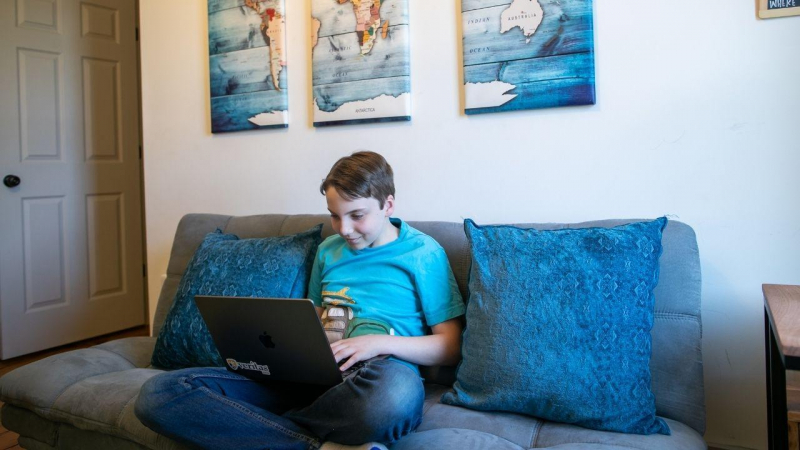
Self-Paced courses are online courses your student completes independently. There’s no live class to attend, no lesson for the parent to plan, and no papers to grade. Expert instruction is built into the platform itself, delivered through video lessons, interactive exercises, and built-in review that functions more like a game than a quiz. Think "lessons on demand."
The courses are available wherever you have an internet connection and run for 12 months from the date your student activates them. Students log in, pick up where they left off, and work at whatever pace fits your family’s schedule.
Veritas offers Self-Paced courses in four subjects: History, Bible, Omnibus, and Rhetoric. Together, they span grades 2 through 12, though the format and depth of each is quite different. What connects them is the same classical Christian approach that runs through everything Veritas builds: chronological learning, biblical worldview, and content designed to form students, not just fill them with facts.
Who Is Self-Paced For?
Self-Paced courses cover four subjects: History, Bible, Omnibus, and Rhetoric. They aren't a complete curriculum on their own, and they aren't designed to be. They're designed to handle specific subjects exceptionally well, so a family's teaching energy can go where it matters most.
That framing shapes who they fit. The self-motivated student who is ready to work independently is an obvious match. So is the parent managing multiple children at different grade levels, who needs certain subjects handled well without requiring their direct instruction. Families with irregular schedules, families who travel, and parents who want rigorous classical Christian content in these particular subjects without carrying the full instructional load will all find something useful here.
Most families who use Self-Paced courses aren't using them alone. A typical year might combine You-Teach for subjects a parent loves to teach, a Live Online course where live instruction makes sense, and Self-Paced for history and Bible. The Complete Grade Level Packages from Veritas are designed with exactly that kind of mixing in mind.
The parent doesn't disappear. They stay aware, check progress, and ask questions at dinner. But for these four subjects, the instruction is handled, and that frees up real time and energy for the rest of the school day.
What’s Inside: The Courses
History (Grades 2-6)
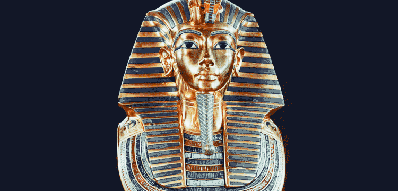
The Veritas history sequence covers five chronological periods, each as a standalone Self-Paced course: Old Testament and Ancient Egypt, New Testament / Greece and Rome, Middle Ages / Renaissance and Reformation, Explorers to 1815, and 1815 to Present. Families can start wherever their student is in the sequence and work through them in order, building a comprehensive timeline of history from creation to the modern world.
Each course covers 32 key events through the same basic structure: video lessons, interactive review, and built-in games that reinforce what students have learned. The history flashcards are a recommended companion for all five courses.
One thing worth noting about these courses is the care that went into making them genuinely engaging. Each period has its own cast of characters that guide students through the material. In New Testament, Greece and Rome, students learn from Hector, Phoebe, and Athena, a talking sculpture. In the Middle Ages, Basil and Aidan (a seasoned monk and his younger apprentice) lead the way, along with Ava, a gargoyle. The Explorers to 1815 course follows James and Abigail, a newlywed couple on the 18th-century American frontier, alongside Ikuhabe, a humorous talking totem pole. And 1815 to Present introduces Marcus, Eva, and Gorton, a vintage 1960s robot.
These aren’t decorative. They’re the mechanism by which younger students stay oriented across 32 events and return for the next lesson. Lessons run approximately 30 to 45 minutes, short enough to hold attention, structured enough to build genuine knowledge over time.
The classical tradition understood something important about the grammar stage: young children have a remarkable capacity for memorization, and that capacity is best honored by giving it something worth keeping. The history courses lean into this rather than working around it.
Bible (Grades 2-6)
The Bible sequence runs parallel to the history sequence in format, and the two are designed to complement each other. Like the history courses, each Bible course covers 32 key events through video, interactive games, and guided review.
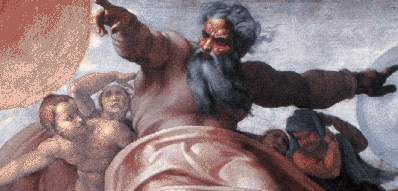
The three current courses are Genesis to Joshua, Judges to Kings, and the Gospels.
Genesis to Joshua follows Abigail, her brother Asher, Teb the aloof cat, and Tizzy the pesky gnat through the sweep of Scripture from creation to Joshua’s final words. The goal is a “big picture” understanding of the Old Testament, the kind that gives students a mental map they’ll carry into future Bible study.
Judges to Kings picks up where Genesis to Joshua leaves off, carrying students through the period of the judges, the rise of the monarchy, and the reigns of Saul, David, and Solomon. It’s one of the richest and most dramatically complex periods in all of Scripture, and the course does it justice.
The Gospels follows Benjamin the carpenter, his apprentice Jude, and a supporting cast through the full narrative of Jesus’s life from the announcement of John the Baptist’s birth to the Ascension. Every Old Testament course in the sequence points toward this one.
Lessons in the Bible courses run approximately 20 to 30 minutes. Flashcards are recommended alongside each course for students who want to strengthen long-term retention, and bundles are available.
Omnibus (Grades 7-12)
Omnibus is a fundamentally different kind of course. Where the grammar school History and Bible courses are built around memorization, narrative, and chronology, Omnibus is built around ideas.
Omnibus is a Great Books humanities curriculum that integrates history, theology, and literature into a single connected learning experience. When a student takes both the Primary and Secondary courses in the same year, they earn three credits: one each in history, theology, and literature. The sequence runs six years (Omnibus I through III, each with a Primary and Secondary course), covering ancient, medieval, and modern history twice over, and the full sweep of the 66 books of the Bible across all six years.
Three of those courses are currently available in Self-Paced format: Omnibus I, II, and III, each in both Primary and Secondary versions.
Omnibus I covers biblical and classical civilizations. Primary students work through texts including Genesis, Exodus, the Gospels, Gilgamesh, The Odyssey, The Aeneid, Julius Caesar, and The Last Days of Socrates, among others. Instruction is delivered by Bruce Etter, one of the Omnibus authors, filmed at locations across Europe connected to the material. Omnibus I Primary runs 175 lessons. Secondary students engage works like The Chronicles of Narnia, The Screwtape Letters, The Holiness of God by R.C. Sproul, and Till We Have Faces, guided by teacher Tammy Duby in 105 lessons.
Omnibus II moves into the medieval and Renaissance world. Primary texts include Augustine’s Confessions, The City of God, Beowulf, Dante’s Divine Comedy, The Canterbury Tales, and writings connected to the Reformation. Secondary students engage The Screwtape Letters, The Bondage of the Will, Paradise Lost, Macbeth, Hamlet, Foxe’s Book of Martyrs, and The Pilgrim’s Progress, among others.
Omnibus III addresses the modern era. Primary students engage The Federalist Papers, Democracy in America, The Communist Manifesto, The Brothers Karamazov, A Tale of Two Cities, and Narrative of the Life of Frederick Douglass. Secondary students read Animal Farm, Frankenstein, Pride and Prejudice, Gulliver’s Travels, The Old Man and the Sea, Death of a Salesman, How Should We Then Live?, and Little Women, among others. Secondary instruction comes from Dr. Michael Collender, filmed throughout Europe, with man-on-the-street interviews that put competing modern worldviews in conversation with Scripture.
Across all six Omnibus courses, the question is the same: how do we evaluate these ideas through the lens of biblical truth? Students aren’t simply reading great books. They’re learning to think about them, which is what the Great Conversation has always asked of its participants.
Omnibus Self-Paced courses are recommended for grades 7 through 12. Courses can be taken out of order, and it isn’t necessary to take all six, though taking both Primary and Secondary in the same year earns the full three credits. Veritas recommends completing Omnibus I through III before 10th grade; Omnibus IV through VI are better suited for 10th grade and beyond.
If your student is pursuing the VSA Diploma Program, check with your academic advisor about how Omnibus credits apply.
Rhetoric (Grades 10-12)
The Rhetoric I Self-Paced course occupies a distinct place in the Self-Paced library. Where History and Bible serve the grammar stage and Omnibus serves the logic stage, Rhetoric is the capstone of classical learning: the art of communicating truth wisely and lovingly.
The course is taught by Dr. Michael Collender, a TEDx speaker and co-creator of A Rhetoric of Love, the textbook on which it is based. The course draws on the classical tradition of rhetoric while grounding it in something the tradition often lacked: a distinctively Christian understanding of persuasion. Students learn to organize ideas clearly, communicate with confidence, engage disagreements graciously, and speak truth in a way that reflects the character of Christ, not just the skill of an orator.
The course serves a wide range of students. For those who carry anxiety around public speaking, it builds confidence privately before asking them to perform publicly. For students with gaps in logic or writing, it reinforces foundational thinking and communication skills. For high-achieving students, it develops the rhetorical mastery that preparation for college, ministry, debate, or leadership demands.
Bonus interviews throughout the course feature contributors including Roger Love, Nolan Bushnell, Brian Godawa, and others, discussing voice, storytelling, persuasion, and the nature of influence.
What a Self-Paced Day Looks Like
Here is a concrete picture of what the Explorers to 1815 course looks like in practice, which is fairly representative of how the grammar school courses run.
Your student logs in, and the course picks up where it left off. The lesson for the day covers one of the 32 key events of the period, James and Abigail on the frontier, or a new encounter with Ikuhabe the totem pole, framing an explorer, a revolution, or the founding of a new nation. The teaching portion runs roughly 30 to 45 minutes, combining video instruction with the narrative and characters that make the period feel alive. After the lesson, the student completes an interactive review, the kind that feels less like a quiz and more like a game.
Your job during all of this is to know it’s happening. You can check progress on the parent dashboard at any time, without grading a single paper. There is no lesson to plan, no script to read, no materials to gather. Your energy for the day goes toward the subjects you are teaching.
That’s the trade Self-Paced is making: the curriculum carries the instructional load, and you carry everything else.
Built-In Grading and Progress Tracking
Grading and progress tracking are built into every Self-Paced course. Worksheets, quizzes, and assessments are completed within the platform and recorded automatically.
For parents managing several children across multiple subjects, this matters more than it might seem at first.
The question “did they do it and do they understand it?” is answered by the platform, not by a stack of papers waiting on the kitchen table. You can check where your student is at any time without interrupting their work or your own.
Optional Add-Ons That Deepen the Learning
The Self-Paced courses are complete as they are, but many families choose to extend the learning beyond the screen.
For the history courses, Flashcards are recommended companions and help students master the chronological timeline that each course builds. Project Workbooks offer hands-on activities for students who learn well by doing. Literature Kits pair historical fiction with each period, including titles like Johnny Tremain and The Witch of Blackbird Pond for Explorers to 1815, The Door in the Wall and Martin Luther: A Man Who Changed the World for the Middle Ages, and Billy and the Rebel or The Hiding Place for 1815 to Present.
For the Bible courses, Flashcards are similarly recommended for reinforcing retention of key people and events.
These add-ons aren’t required. But for students who connect emotionally with a period through story, or who need to move and make things to learn them, they’re worth knowing about.
How Self-Paced Fits Into the Bigger Picture
Self-Paced is one of three ways to learn with Veritas Press. You-Teach puts the instruction in the parent’s hands, supported by scripted lesson plans. Live Online courses bring students into a real classroom taught by Veritas faculty.
Many families use all three in the same school year. A parent might teach literature and Latin themselves using You-Teach, enroll a student in a live course for grammar, and let Self-Paced handle history and Bible. That’s a common way to build out a year, and it’s exactly what the Complete Grade Level Packages are designed to support.
If you haven’t tried a Self-Paced course before, Veritas offers a 14-day free trial at veritaspress.com/sp-trial, with no credit card required. There’s also a 90-day satisfaction guarantee, so you can try a course risk-free and return it if it isn’t the right fit.
Getting Started
The full Self-Paced catalog is available at store.veritaspress.com. You can browse by grade level and subject, or explore Complete Grade Level Packages that incorporate Self-Paced courses alongside You-Teach materials.
If you’re figuring out how Self-Paced fits into your student’s broader plan, or how to combine it with other Veritas formats, a free consultation with a Veritas Family Consultant is a good place to start. They can help you think through your options and put together something that actually works for your family.
Have questions? Talk to an expert for free!
Our Family Consultants are here to help! Fill out the form below to schedule a quick call for free.