

What Saxon Math Gets Right About Classical Education
Saxon Math has a reputation in classical homeschool circles, and it’s well earned.
For decades, families have built their homeschool math programs around this curriculum.
Parents who struggled with math themselves found it teachable. Students who needed a methodical, predictable structure found it reliable. And families who cared about genuine mastery found that it delivered.
When you finished a Saxon level, you owned it.
That reputation didn’t come from marketing. It came from results, passed along by word of mouth across homeschooling families.
So if you’ve built your math program around Saxon and something has recently disrupted that, your instinct to take it seriously is correct.
A curriculum that has worked for your family is worth protecting.
Why Saxon Resonated with Classical Families
Saxon’s appeal to classical homeschoolers was never accidental. The structure reflects principles that classical educators have valued for a long time.
The first is incremental development. Saxon introduces new concepts in small, manageable steps. Each lesson adds something to what came before, and nothing is introduced before the groundwork is laid. This mirrors the classical insistence on cumulative, ordered learning — the idea that understanding builds, and that the sequence of that building matters.
The second is systematic review. Saxon doesn’t introduce a concept and move on. It circles back, integrating earlier material into new lessons so that students encounter ideas repeatedly over time. The goal is retention, not just exposure.
The third is the cumulative test structure. Saxon’s assessments measure whether students have actually absorbed the material across the full sequence, not just the most recent lessons. That’s a mastery orientation: the measure of learning is durable understanding, not performance on the day of the test.
These are genuinely classical instincts. It’s no surprise that families drawn to the Trivium, to Latin, and to the Great Books also found a natural home in Saxon.
The Mastery Question
Here’s where the conversation gets more substantive, and more important.
Not all math curricula are built the same way, and the differences matter more than they might appear on the surface. The central distinction worth understanding is between mastery-based and spiral approaches.
A mastery-based curriculum teaches a concept until the student owns it, then builds on that foundation. Progress is sequential and cumulative. The student who reaches long division has genuinely mastered addition, subtraction, and multiplication first. Every step rests on solid ground.
A spiral curriculum revisits the same topics repeatedly across multiple years, adding depth with each pass. The idea is that students will deepen their understanding over time through repeated exposure. There are contexts where this approach has merit. But it carries a real risk: students can move through the material on schedule without ever truly owning any of it. Gaps accumulate quietly. By the time they become visible, they’re difficult to diagnose and harder to fix.
Classical education has historically favored the mastery approach, and for reasons that go beyond math: the trivium itself is a mastery model.
Grammar stage students own the foundational facts.
Logic stage students build on that foundation to develop reasoning skills.
Rhetoric stage students synthesize and express what they’ve genuinely internalized.
You can’t shortcut the sequence. Each stage depends on the one before it.
Research supports this instinct. A landmark analysis by Kulik, Kulik, and Bangert-Drowns, published in the Review of Educational Research, found consistent positive effects of mastery learning on student achievement across grade levels, from elementary school through college.
More recently, a 2024 study published by Springer tracked mastery-based math instruction across more than 500,000 U.S. students in grades 3-8 and found positive effects that held across demographic subgroups.
The classical tradition arrived at the same conclusion through a different route.
The practical question for any family evaluating a math curriculum is straightforward. Does this curriculum actually require mastery, or does it assume the spiral will take care of the gaps?
What to Look for in a Classical Math Curriculum
If you’re evaluating your current math program, or looking for something new, the criteria that made Saxon work for so many classical families are a good place to start.
Cumulative, Logical Sequencing
Each concept should prepare the student for the next.
The sequence should feel inevitable, not arbitrary. If you can’t see why topic B follows topic A, that’s worth examining.
Genuine Mastery Requirements
The curriculum should require students to demonstrate understanding before advancing.
This shows up in how assessments are designed, how often foundational material is reviewed, and whether the program has a mechanism for identifying and addressing gaps.
Developmental Appropriateness
What a second grader needs from math instruction is genuinely different from what a ninth grader needs. A curriculum designed for a specific stage should reflect that stage’s strengths and demands. This question of developmental fit is worth exploring on its own, and we’ve done that in a companion piece. (Scroll down for the link.)
Understanding, Not Just Procedure
Students should be able to explain what they’re doing and why.
A student who can execute an algorithm they don’t understand is one confused application away from a wrong answer they can’t diagnose.
Parent Accessibility
For homeschooling families, this matters practically.
A curriculum that requires the parent to have an advanced degree to teach it isn’t serving the family well, regardless of its mathematical rigor.
How Veritas Press Approaches Math
At Veritas Press, we’ve thought carefully about which curricula best express classical math principles at each stage of development. The result is a curated lineup rather than a single program.
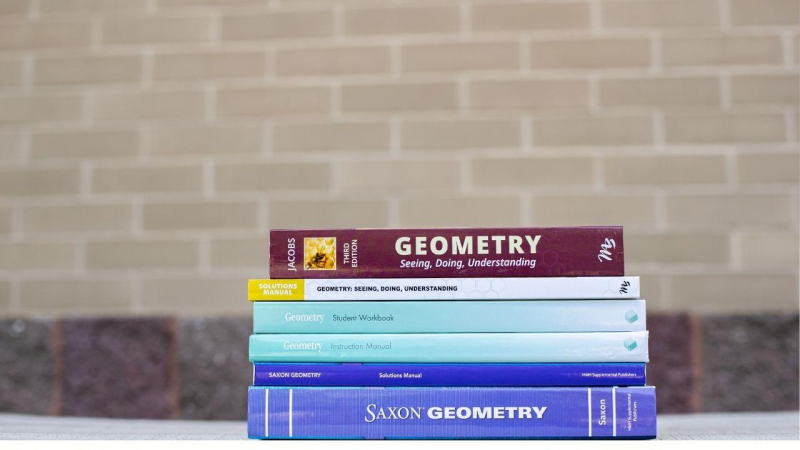
For kindergarten through sixth grade, we use Saxon Math and Math U See.
The incremental structure, the systematic review, and the cumulative assessments of Saxon Math align naturally with grammar stage learning, when students are building the foundational facts and operations they’ll carry through everything that follows.
Math-U-See complements Saxon for students who benefit from a more visual and concrete approach. Its use of physical manipulatives to build conceptual understanding before introducing symbols reflects the classical instinct that genuine comprehension has to precede abstraction.
As students move into the logic stage and the rhetoric stage, we begin to use more Jacobs and Foerster (along with Saxon and Math-U-See).
Jacobs Algebra and Jacobs Geometry carry them into abstract mathematical reasoning. Harold Jacobs wrote these texts with clarity and intellectual seriousness. They reward careful thinking and build the kind of algebraic fluency that makes advanced mathematics accessible.
Foerster Algebra II and Pre-Calculus take students the rest of the way. Paul Foerster’s texts are rigorous and cumulative, exactly what a rhetoric stage student needs: material that demands synthesis, precision, and sustained reasoning across complex problems.
The through-line is the same classical principles at every stage.
Mastery before advancement. Logical sequencing. Developmental appropriateness. Understanding over procedure. The curricula change as the student changes. The principles don’t.
If you’re looking for the broader framework that connects all of this, our introduction to classical math is the place to start.
And if the developmental question is at the center of what you’re thinking through, the next piece in this series explores how math instruction should look at each stage of the trivium.
On Curriculum Changes
If you’ve recently had a math curriculum decision made for you rather than by you, you’re in good company among families thinking carefully about this right now.
The good news is that the classical math landscape is rich with strong options. The criteria above give you a real framework for evaluating what’s in front of you, and the curricula Veritas Press uses give you a tested path through the stages.
Your instinct to take curriculum seriously is the right one. Math is too important to leave to default.
Have questions? Talk to an expert for free!
Our Family Consultants are here to help! Fill out the form below to schedule a quick call for free.