

Calvin Coolidge, A President Worth Knowing | Daniel L. Wright | Veritas Vox
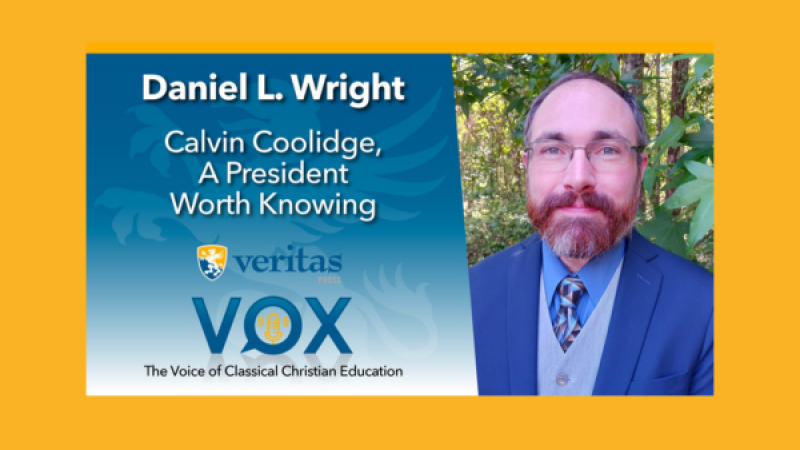
Why is the example of Calvin Coolidge still relevant for us today?
Join us as we learn with author Daniel L. Wright how Calvin Coolidge’s principled leadership, economic stewardship, humility, and sincere Christian faith shaped an era of American history that is often misunderstood or forgotten.
Ready to explore Coolidge on a deeper level? Check out Daniel’s book, Salient Cal’s America.
Episode Transcription
Note: This transcription may vary from the words used in the original episode.
Introduction
Marlin Detweiler:
Hello again and welcome to another episode of Veritas Vox, the voice of classical Christian education. Today we have with us a classical Christian education teacher and author, Daniel Wright. Daniel, welcome.
Daniel L. Wright:
Thank you. Thank you very much.
Marlin Detweiler:
Good to have you here, Daniel. You and I met in a very interesting circumstance that relates to what we're going to talk about. I'll hold that for just a moment. But first, if you would talk to us a little bit about your background, your family, your education and your career, and then we'll jump in and talk a little bit about the book that you've written that captured my imagination.
Daniel L. Wright:
Certainly. So I was fortunate to be classically educated myself. I was out in Colorado and then moved to Iowa and through that course of time, homeschooled from fourth grade on. And we got into the classical languages at a time when largely homeschooling was non-existent. It was just we were making it up as we went along, kind of like building the plane while we were flying in it.
Marlin Detweiler:
Well, I've lived my life that way. I can relate to that.
Daniel L. Wright:
For sure. So we've had that great chance to be kind of pioneers in our region of the country. And so we look back on it now and we would not change it. We would not go back into the regular ways of, oh, this is how you're supposed to educate children and so forth. So we have taken on the great privilege of homeschooling our daughter from the beginning.
So it's been great to have that chance. I was in the military for a time, and then through the course of events I got into teaching. I wanted to teach for a long time, and it's starting to slowly work there. And so we were able to start two schools in the course of the last five years. And we're working with the second school.
Marlin Detweiler:
Tell everyone where you teach and what you teach.
Daniel L. Wright:
So I teach Latin and history at a school in Orange Park, Saint John's Classical Academy.
Marlin Detweiler:
Very good. Saint John's is a classical Christian school that's been around a long time. In fact, Laurie and I were invited to a dinner that was intended to announce the school goodness more than 30 years ago. And it was at that dinner that we presented the idea of classical Christian education as kind of a kickoff to the community there.
It was located at that point just a little bit north of where it is now, and closer to Saint Augustine, Florida. Correct?
Daniel L. Wright:
It is, it is. There are two schools. So there's the older school in Fleming Island, and then there's the sister school that started up about three years ago.
Salient Cal’s America
Marlin Detweiler:
Oh, wonderful. Very good. But you wrote a book called Salient Cal's America. Cal is referring to Calvin Coolidge. But before we jump in to that book, I had a pretty good idea what salient meant, but I had to look it up. So let's not take that for granted with our audience. What does the word salient mean? How are you using it in the title?
Daniel L. Wright:
I'm using it more as he has a wisdom born of perspective. It's a well chosen, well prepared way of presenting ideas, of crafting and framing leadership. It's more than just that he never said anything worth hearing, worth reading, worth digesting. And so salient is more timely than silent suggests.
Marlin Detweiler:
You captured my imagination with this to bring the audience up to date. We met just a few weeks ago around the events of unveiling a statue of Calvin Coolidge at a botanical garden called Bok Tower, which is near where we live some of the year. And you and I met at a little get together after that and got a chance to visit.
I have had the pleasure of getting to know a good bit about Calvin Coolidge from a couple sources, and have served with Laurie on a jury of the scholarship competition that happens each year. That is remarkable, the winners of which I think this year there were 8 or 10. I don't know the number exactly. Get a full ride to a college or university of their choice for four years.
It is one of the best scholarships I've ever heard of, and I really want to encourage our community and the community of classical educators to consider and look at it, because we are raising students who are very capable of winning one of those scholarships. But you've had a real love for Calvin Coolidge. So before we get into the book more directly, how did that come about?
What was it about Coolidge that captured your imagination? Because if anybody out there is like me, and I expect most are, he's been a forgotten president in some senses. And that's changing, at least in the visibility that I have. And I know that you intend to do something about that too.
Daniel L. Wright:
Yes. So I first you always hear about him when you're in grade school of this is president number 30.
Marlin Detweiler:
He's one of 47. Yeah.
Daniel L. Wright:
Yes. He's one of. Okay. So then you move on and usually it's going to be one of two approaches. Either you quickly pass him by and skip over to the real presidents, or you just have this vitriol of how bad he was. He was terrible for the country. He took them down into this avenue of big business worship and greed and the rich versus the poor and all of these things that then become part of.
Here's how you characterize it. And so I first picked up a book by Robert Sobel in what was written about in 1998, I want to say, Coolidge The American Enigma or An American Enigma. And that intrigued me still further, because he goes into those two approaches to him, and it brought me into why is he so hated?
Why is he so heaped upon for insult and for derision?
Marlin Detweiler:
You know, I didn't even know that that was something that was characteristic of the belief about him. My perspective was simply he was uneventful.
Daniel L. Wright:
Nothing happened. So get to either you've got observing the Passover of either the World War One is the real era, and World War Two is even more the real era. And then the rest you just that little. Unfortunately.
Marlin Detweiler:
We have this thing called the Roaring 20s and the stock market crash that happened around the time of Coolidge. So we can't simply say nothing happened.
Daniel L. Wright:
But all the things that then took down the country into a decade long depression and then set the stage for a catastrophic Second World War on the eve, basically within the generation of the First World War that fought there. So it brought me into why is he one so skipped over, so readily dismissed, or two why is he so hated?
Why is there so much venom out to get him? And I discovered from Sobell it set me on a journey of I see where the layers can be peeled back. And the more you learn about him, he's one of those rare individuals that the more you learn, the more you like him. Yeah. And respect him.
Was Calvin Coolidge a Christian?
Marlin Detweiler:
Yeah. Well, not all of my sources for information about Cal would be considered to be evangelical or reformed Christians. And so I don't hear that as prominently about him as I think is the truth. But the first question I really want to understand is, was he known to be a Christian through and through?
Daniel L. Wright:
I would say that he was regarded as a Christian and a very sincere one, not just a follower for the optics of it. He was not a joiner. He was not one who was going to then just be seen doing the religious expectations or the rites of, oh, I am religious because I do these things for you or for attention. He was a sincere and really a heartfelt believer.
Marlin Detweiler:
He was also known as somebody that sometimes was a man of few words. I think the funniest story I've ever heard, I'm sure you've heard this story, but was when he was at a state dinner. Correct me if I'm wrong on this, but he was at a state dinner, and a woman sitting near him or next to him said, I have a bet with a friend of mine that you won't say three words tonight. And his answer, as I understand it, was, you lose.
Daniel L. Wright:
Yes. That's right.
Marlin Detweiler:
Is that a true story?
Daniel L. Wright:
It's a true story. And it created, it was part of what created a whole slew of stories about him, his retorts, his witty comebacks. He was incredibly quick witted and dry New England humor. So he at one point has some friends who ask him after the presidency or pleading with him, please come back and run again.
And he says, well, it would she. The wife who is pleading with him, said, you should come back. It would be the end of this depression that we're in. And he says it would be the beginning of mine. And so quick understanding, very rapidly of there is a lot that goes into the presidency. And part of what makes his tenure so uneventful is not that things did not happen, but that he handled them so smoothly, and it ended up resolving a lot of things that now look like to the surface level, nothing occurred.
Marlin Detweiler:
Yeah. Well, let's start at the high level. What did you hope to produce by writing the book? What did you I shouldn't say produce? What did you hope to accomplish?
Daniel L. Wright:
Well, I would say that understanding Coolidge in a fuller way, giving him and his generation a chance to speak for themselves and not have it become just a here's someone from either like the phrase I use in the book, the chronological snobbery that occurs where you're looking back on it and of course, you see all these wrong things, terrible mistakes made, or you are then judging it from your own vantage point rather than first trying to understand it, and so giving them that platform to speak for themselves after 100 years should be the first step any of us who want to really honestly approach the era have to do. You have to understand it before you can critique.
What Example Did Calvin Coolidge Leave?
Marlin Detweiler:
It in a couple instances. Now you've referred to his era and what he's done as misunderstood and needs to be understood. I have a more optimistic view of what he did and how it ought to apply in how presidents might learn from him. What would you say were some of the very significant things that he did that we would stand to benefit, to respect and replicate?
Daniel L. Wright:
I would say that he does much more than just the budgeting, which is a very important component of his administration. One of the themes through the book is the Coolidge era is a real phenomenon that he was reframing and offering an alternative to presidential leadership. That does harken back to what came before in the early Republic and maps away because he's living in a very modern era, really the first generation of our modern America, and able to then chart the bridge the two.
And with that, he brings a cultural force to how we should then take initiative as citizens and not just wait for the government to work out a plan for us, or.
Marlin Detweiler:
That starts to allude to some things that I was going to ask about. So let me just ask, give us some policy perspectives that were really the foundation for how he operated. Help us understand with some real practical examples what he did that made him, quite honestly, very successful.
Daniel L. Wright:
I would say that he had an unheralded impact on the federal courts and picking judges who are really going to know the law. That was a key principle, not just playing the politics or able to obtain confirmation, but some of the best, most trained and prepared judges from wide spectrum of this is their level of competency. Not here they are as their this party affiliation.
They are owed a political favor. So we just appoint them. And it's interesting to note that later on, as you get into the 30s, 40s and 50s, a lot of these judges are still around. And so Coolidge's legacy casts a wider shadow than just the one Supreme Court appointment that he did name, which has its own significant weight.
But that's one key contribution he brings beyond his own time. Another would be the way that he approaches conservation. There's a great unheralded legacy of a lot of those sites that are going to be national parks, national battlefields. He's going to even recognize the Statue of Liberty as it is a national historic site. It is one of those that become so during his time.
He's looking at the whole country though, and not just here. I'm a New Englander serving the northeast, and then the rest can fend for themselves. He's constantly reiterating that we are all in the same boat. And so his leadership style, his way of handling civil rights issues as a way of defusing the tensions rather than ramping them up with your us versus them.
And you then have your place over here and you get down into that place and we have our thing here. And he constantly was battling that in his speeches and his public messages and examples. He's one of those who while in many cases his contemporaries were avoiding pictures with those that were of the other side.
Marlin Detweiler:
Interesting.
Daniel L. Wright:
He was very much using the photographic image and the handling of the press, the way he crafts his persona and his public image through the development of photographic image. He's one of the most photographed presidents at a time when it's entering into its high mark of we use photos for everything now. So yeah, the cultural impact that he has, he's a cultural force.
And so this book is going to be a big part of showing how he leaves his influence culturally, not just as a political leader, but someone who, like Robert Nisbet would put it, he deserves the moniker of this is the Age of Coolidge, and he shows how that could be the future of America that gets unfortunately suspended by the economic downturn that turns into a depression, that then goes to a second World War, and we really don't pick up with where he left it until the 50s and 60s.
Calvin Coolidge and the Economy
Marlin Detweiler:
Well, the thing that I probably have spent the most time reading about has been related to the economy, his policy, his understanding of taxation and what he implemented and his successes with regard to any deficit or the budget in America, are those things that you spent a lot of time studying?
Daniel L. Wright:
Certainly, certainly have. And there are a number of pieces in the book that deal with his budgeting practice and how he's driving relentlessly to tighten where we waste, where there is something that is expended that doesn't need to be expended. And at the same time, he understands there is a time and a place to spend.
And so keeping. It's not that he's a Scrooge sitting there presiding over that. No, we're never going to spend a dime. But he understands the balance that is needed by keeping those twin goals of you have the surplus and you have tax relief. Those both need to march forward together at the same time. When there's a need that goes across the country for expenditure, he's going to be there trying to say, we don't just stand on we spend nothing, but we spend it prudently.
We spend it carefully. It goes to what it's intended to do, just like he said with laws, they need to accomplish what they're really meaning to attend, to accomplish or to resolve to supply to help result in some outcome, not leave it opaque and amorphous as to well, we'll figure it out.
Marlin Detweiler:
One of the things that is a blessed economic irony that he demonstrated, I think, by lowering the top marginal and all, I believe, tax rates three times over his tenure, and every time he lowered them, the revenues increased. And it starts to become a bit of a political theory conversation, but it is quite obvious that at least what happened when he did it, he was on to something that at that point in time was quite effective.
Now, I believe that there's a lot of truth in that that's valid today, but I understand that not everyone does. But he was very successful at lowering tax rates, thereby increasing the revenue from taxes. Do you have any sense of that? Have you interacted with people as they've read your works and you've talked about Coolidge and how that's received today?
Daniel L. Wright:
It is a mixture of it depends on who you're speaking with and whether the paradigm of every dollar that a government entity wastes has to be paid by someone. There's someone there on the other end of it who has to then make up for that deficiency. There's the other side of that of, well, it's just this limitless pool of money from somewhere that government can draw upon and not connecting that there is someone, as Coolidge put it, someone always working on the back end to supply that fund.
Marlin Detweiler:
Well, that's on the expense side. But what about on the revenue side.
Daniel L. Wright:
And then on the revenue of having those means of income to the federal government through the tariff system in the 20s, having that as now it's in a global economy, it's oh, we don't do that. That's going to lead to another depression or that's going to lead to all kinds of economic hiccups and mistakes. And that's what got us into the trouble of the mid and late 20th century anyway.
And I think it's a bit of a disconnect. It's jumping too close too far too fast to say that tariffs are unequivocally a bad policy option.
Marlin Detweiler:
Yeah. One of the other things that I have heard, you'll be able to get this factually right for me because I'm not sure I'll be able to say it, but my understanding is that he was the last president and maybe one of the only presidents who left office with a smaller federal government than when he came into office.
Daniel L. Wright:
Yes, there is a lot of merit to that. It was one of his recurring policy recommendations that we condense and reorganize the federal bureaucracy. And he was effectively then doing a lot of that under current work that consolidates and centralizes or makes more efficient, not simply saying decisions are made from the top down, but that you decentralize in a sense.
So laissez faire is not his policy, but he does have it as a tool in his toolbox that can say that there is a space in which that operates. At the same time, the government does have certain things it is expected and needing to do. And if it's given the too broad of a spectrum to preside over, it doesn't do anything well.
And that is in fact the default setting of most state, local and government entities. When you give it too much, then it doesn't do any of the tasks well that it's supposed to be doing when it's narrowly constructed and tailored for them. This is what you do. And that's interesting when we talk about the economy as well.
He was very actively seeking for what are the options when we're dealing with the stock on Wall Street? What level of the federal government is even allowed to take a role? And he spoke with economists like Williams Ripley. He spoke with those who were experts in the field. He was reading articles, academic pieces to better understand, even though he did naturally know a great deal.
He was constantly seeking expert more and gain input. And the basic conclusion came down that the governor of New York had greater clout over Wall Street than the federal government. And ironically, the governor of New York at that time was Franklin Delano Roosevelt, who later on runs on the well. The president and the federal government should have taken a greater role knowing that that was not legally allowed.
Marlin Detweiler:
That was a bit disingenuous, is what you're suggesting.
Daniel L. Wright:
I'm suggesting a little bit speaking out of one side to one audience, and then later on it's convenient to recast it. So yeah.
Marlin Detweiler:
Yeah, well, that's one of the things that impressed me about Coolidge. He didn't do that. One of the examples of that was when there was a federal disaster. You'll again be able to provide insights in this and details, but it was a federal disaster for which he said the federal government or there was a yeah, there was a natural disaster in an area, and everybody wanted him to bail it out, to use federal money to help in that local area.
And he refused to do it. And then and he was accused at that point of, well, if it was in your area where you're from, you would have bailed them out. And then in the providence of God, there was a disaster in his area just a few months later, as I understand it. And he didn't bail them out either, presenting himself as a man of principle and a man that meant what he said and didn't speak out of both sides of his mouth.
And it's that kind of thing that I think causes us to really recognize that Coolidge and his humility and his operating at a principled level is one of the reasons why he's not the flashy guy that everybody knows, but is really worth emulating and knowing a lot more about. Let's say.
Daniel L. Wright:
You so very much so. He was even handed and fair, and that's a painful place to be. There is no easy ground for anyone to then be when you're under that level of pressure to give concessions or provide promises to this segment of the country or this region of the nation, and then you have it happen to your own native region, and now you're truly tested on are you going to hold up to it?
Are you going to be fair and even handed and as impartial as you can be? And he passed that test. He was one who at the other side of things was taking steps on the Mississippi River flood that happened in 1927. And at the same time, knowing that Congress loves to spend money it doesn't have. And so he's constantly monitoring tailoring.
Marlin Detweiler:
Things never change.
Daniel L. Wright:
Some things don't. They never do. Congress is still Congress, but they are going to be wanting to throw in that other amendment to the measure and add this other region to the benefit list and a less intense level of bargaining going on when the Vermont region is flooded in the following months. And yet even going out there and giving the other side material fodder to then make a case on how stingy and unfeeling or how whatever Scrooge like characterization, he is not giving them the satisfaction.
And I think that speaks to one. He is holding to principle with that level of great restraint and inner strength. And at the same time, he's also understanding the power of the image and the photographic image, the optics. He's not fooled and he's not going to play the game. So he walks into something that someone's laid for him.
Marlin Detweiler:
Yeah, yeah. If there's anything that I've learned from all of these stories and circumstances, is that Calvin Coolidge was a man of principle, not interested in playing political games.
Daniel L. Wright:
Yes.
He was not a he was not attack dog. He was ever endeavoring to be above that. And so here's how you can be a leader without engaging in the kind of vitriol back and forth, the retributive, the retribution of, well, they did this to us. So we then need to answer back kind of. So it's tribal politics that we see throughout time.
But he's not going to play the game as usual. And I think that is also what made contemporaries scratch their heads. And how is he the president of the United States? How is he able to then work his way from the town level, a municipal lawyer all the way up 19 different positions, 25 years in office, and now he's bested us at our own game. We're supposed to be smarter.
Take Aways from Calvin Coolidge and Salient Cal’s America
Marlin Detweiler:
That's great. What? In our closing minutes, tell us what you hope your book will accomplish in the reader. What is it you want us to take away?
Daniel L. Wright:
I would say that one of those is his courage to step forward and show an alternative to the way things had been for America, the policies he champions, the ones he fights for all the way through his time. There is a whole debate that has gone on for some time over. He really quit caring and quit trying after his younger son died.
And I take issue with that, as he does say in his autobiography, that the glory and power of the presidency went with Calvin Jr when he died in 1924. But he didn't relinquish the job. He didn't quit while he still had work to do. And he knew that work was going. And he runs for reelection after his son dies and he leads for four more years.
And so having the courage to show America that they can take initiative to build their country and make it better and take the mantle of citizenship to a higher level without waiting for him to do anything for them, without waiting for Congress or the courts or you name it, whatever governor or state entity, local authority, you can take on a whole lot more for yourself than waiting for someone else to fix it.
Marlin Detweiler:
What a message. What a wonderful testimony, and what a great place for our work in classical Christian education to be a tribute to him and an example for the students we get to serve. Thank you, Daniel.
Daniel L. Wright:
Thank you.
Marlin Detweiler:
And folks, thank you for joining us on this episode of Veritas Vox, the voice of Classical Christian Education. We hope you'll join us again next time.
Have questions? Talk to an expert for free!
Our Family Consultants are here to help! Fill out the form below to schedule a quick call for free.