

Vocatio: Classical Education and Career Readiness
Sooner or later, every student asks some version of the same question: "What am I going to do with my life?" Parents ask it on their behalf at kitchen tables and open houses. Teachers hear it in the hallway and in the quiet of an advising meeting. It is one of the biggest questions a young person carries, and it deserves a real answer.
Most of the time, the answer we reach for is career readiness. That answer is worth something. Students should leave school able to do good work, hold a job, and provide for a family. But career readiness tells a student what they might do without saying much about what the work is finally for. There is an older word that fills that gap, and classical Christian education has been quietly built around it.
That word is vocation. It comes from the Latin vocatio, which simply means "calling."
What Is Vocatio?
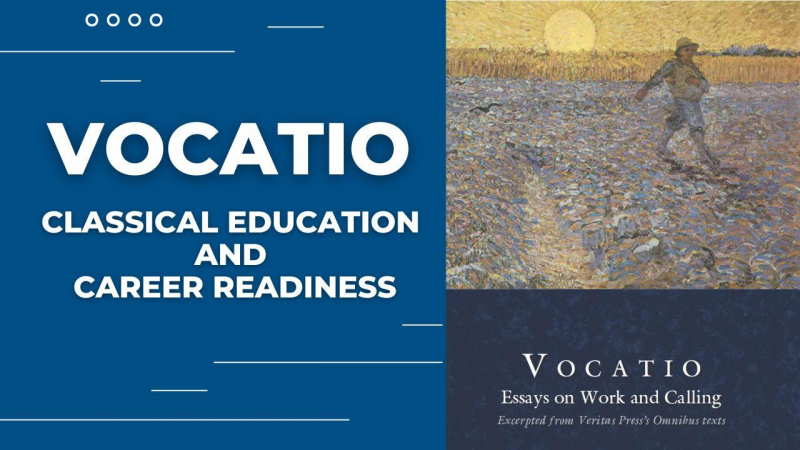
Vocatio, the book, is a collection of eighteen essays on work and calling, each written by someone who knows a field from the inside. A businessman writes on business. An engineer writes on engineering. A literature scholar writes on beauty. Together they take eighteen different fields and show two things at once: the real intellectual depth of the work, and the sense of calling that runs beneath it.
The essays were first published in the Omnibus IV, V, and VI texts, edited by Gene Edward Veith, and later gathered into one volume so the through-line would be easy to see.
Read on their own, they are eighteen good essays. Read together, they make a quiet argument: that no honest field of work is too "ordinary" to be a calling, and that thinking carefully about a vocation is part of being formed for it.
The Idea of a Calling
The conviction holding the book together has a long history. For much of the medieval period, a "calling" meant a call to the monastery or the priesthood, and everyday work sat a rung below. The Reformation changed that. Martin Luther argued that the farmer, the magistrate, and the mother were each as truly called as the monk, because God works through ordinary labor to serve our neighbors. The book's foreword puts a verse to it: "Only let each person lead the life that the Lord has assigned him, and to which God has called him" (1 Corinthians 7:17).
Gene Edward Veith, who edited the texts these essays come from, has spent a career bringing this idea to a modern audience (see his God at Work, Crossway, 2002). Its usefulness for the career-readiness question is direct. Career readiness answers what work a student might do. Vocation answers what the work is for: a place to serve God and neighbor, done well because the work itself is worth doing well. One trains a student for a job. The other forms a student for a life.
A Walk Through the Book
The eighteen essays cover more ground than any single student will pursue, and that breadth is the point. You can read them as four neighborhoods of work.
First, the makers and builders. The essay on business opens with a balance sheet pressed into a clay tablet in ancient Ur, around the time of Abraham, a reminder that commerce is older than we tend to think. Architecture teaches you to "read" a building the way you read a sentence. Engineering walks through the discipline of solving a real problem, with the Millau Viaduct in France, taller than the Eiffel Tower, standing as proof of what the discipline can do. Economics weighs the moral question sitting under all the others: is it right to seek a profit, and what makes an economy actually serve people?
Next, the thinkers. Mathematics traces the line from Euclid's Elements, a book so influential that only the Bible has been more widely translated. Philosophy follows the modern mind from Descartes forward. The natural sciences recover the plain curiosity that drove the early scientists, and psychology asks what is gained and lost when the study of the soul tries to become a laboratory science.
Then the culture-shapers. Aesthetics makes the case that beauty is more than the eye of the beholder and points beyond itself. Music finds order and proportion running from Pythagoras through Boethius and the medieval Quadrivium. Poetry shows how a single image can carry the weight of a whole feeling, and the essays on dramatic arts and media trace how stories and news have shaped audiences from Shakespeare's playhouse to the penny press.
Finally, the fields that order our common life: law, politics, sociology, cultural anthropology, and even sport and recreation, which the author reads through the grammar, logic, and rhetoric of the Trivium itself. By the end, the breadth has made its case. Whatever a student is drawn toward, someone has already thought about it carefully, and Christianly, before them.
Who Is Vocatio For?
Vocatio is written for the student standing at the question, and it is just as useful to the people standing beside them. A student feeling the pull of one field can start with that essay and find a serious, encouraging guide. A teacher or homeschooling parent can hand a student the right chapter and have a conversation about calling rather than only about salary. A school can fold these readings into advising, so that "what will you do" slowly becomes "what are you being called to."
A student does not need to have it all figured out to begin. The book is there to help them think the question through.
Preparing for Life
"Preparing for life" is the phrase Veritas keeps returning to, and a book like this is what the phrase means in practice. A diploma matters. A first job offer matters, and a good education should help a student reach both. Formation reaches further than either: students who can think clearly, work well, and see their labor as part of something larger than themselves. Career readiness gets a student to the doorway. Vocation is what waits on the other side.
You can read Vocatio here. It comes out of our Omnibus program, where these essays first lived, and where the same conviction runs through everything we teach.
School Consultation
If your school is thinking through curriculum gaps, advising, or how to weave vocation more intentionally into what you already teach, we would be glad to talk. Our school consultations are free, and they start with listening.
Christus nos Liberavit,
Eric VanDerhoof
Sales Manager, School Sales Executive | 17601
(800) 922-5082 / D (717) 229-1425 | Schedule a Free Consultation