


Making Great Better | Roger North | Veritas Vox
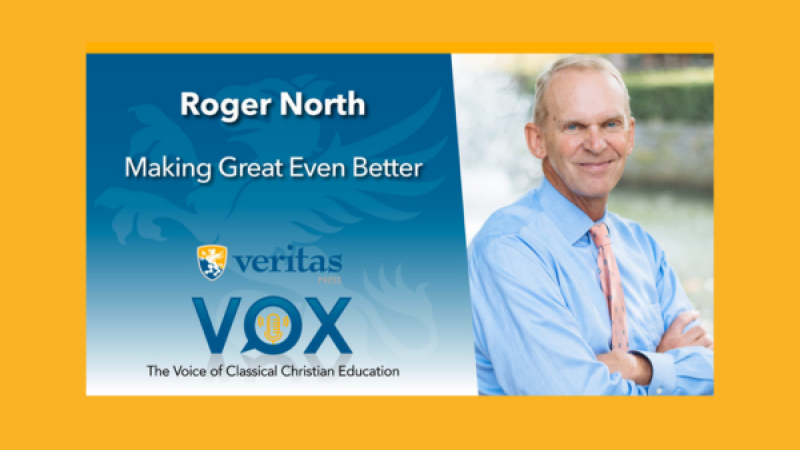
On today’s episode, you’ll gain wisdom on balancing work and family life, biblical leadership, effective time management, and even hear some practical career advice for young people from our guest, Roger North.
Roger is the founder of North Group Consultants, a unique consulting firm dedicated to organizational development, leadership growth, and guiding businesses (especially family-owned ones) through generational transitions.
Episode Transcription
Note: This transcription may vary from the words used in the original episode.
Marlin Detweiler:
Hello again, and welcome to another episode of Veritas Vox, the voice of classical Christian education. Today we have with us someone that I've enjoyed getting to know over the last maybe ten years, Roger North. Roger, welcome.
Roger North:
Thank you, Marlin. And it's an honor to be here with you. Thank you.
Marlin Detweiler:
Roger is a fellow Lancastrian and started an organization called the North Group. But before we get into that, maybe, Roger, if you would introduce yourself a little bit about your family, your education, and then leading into that question of the North Group, your career.
Roger North:
Yeah. Thank you. Marlin. I'd be happy to do that. Well, I'm, you called me a Lancastrian. I am that for my adult life. I grew up in the Garden State of New Jersey. Generally a place that people like to be from.
But I came out here in central Pennsylvania to go to college at Messiah College. I went, met my wife there and she was a native Lancaster County first. And that's what landed me here. So I got a degree in business from there and while in the insurance business for about 16 years.
And there was a point in my life it was in 1996. That'll date me pretty well. Where God was doing some work in my life, and it was one of those times that for whatever reason, I was actually paying a little bit of attention to what he was doing. And there were several disturbances in my life in 1996, none of which are large in and of themselves, but they operated a little bit like a pebble in the shoe.
Something was irritating me that maybe I wasn't where I needed to be vocationally even though the external pieces of vocation were fine, meaning I was making career progress. I was meeting my family's obligations. I had a future. Those sorts of things. And then I had a moment in time and it was October of 1996, when I felt like I got a direction from God, but I would say from the Holy Spirit, if I can use that language and if I haven't, I don't think I've had it before.
I don't think I've had it since. If I did, I missed it. But in the moment it was clear to me that God was directing me to resign the position I had, which is a very favorable one, and not to seek another vocational role until it was clear what that vocational role should be. Wow. And it was so clear to me at the time, and I am not a risk taker.
Marlin Detweiler:
And it's notable that you're not part of the charismatic tradition that might be more inclined to thinking in those terms.
Roger North:
No, and that's excuse me. That's an interesting point. I have a lot of respect for folks that have clear spirit led direction. And I'm certainly a believer in the indwelling power of the Holy Spirit, but physical manifestations of that are not familiar to me. But at that point, it was just so clear that God was directing me.
I couldn't resist it. And my wife is just the finest person you're ever going to meet. And when I went to her, she just said, you know, hey, I'm going to resign my job. And I don't know what I'm going to do next. And I got to take some time to figure that out. She just had one question, and that was, do you have a plan for our family?
And we had it. We had three children, nine, six and one at the time. And I said, yes, you know, we have a little bit of savings. And I had a non valued non-compete contract with my former employer would pay me a little bit while I went along. So I did that. So I resigned that position at the end of 1996, and I went on a quest visiting with people like yourself, people that I respect.
I wish I had talked to you at the time, but I don't think I did. But it was just I was in sales, three appointments a day. You know, I knew how to get appointments, and people just kept influencing me in a direction where it finally gave me the idea that I should start a consulting firm.
And that was not on the menu when I started this, but it got placed on the menu, and as time went on, people just started influencing me in that direction. So I had a partner at the time and I should say I went into business with a partner, which is important to me because I'm not an alone type of person.
And we started what is now North Group consultants. We started that back in April of 1997. And like any start up business, it was an uphill climb, hand-to-mouth kind of thing till we got some clarity on what we had to offer and that there was a marketplace for that and so forth.
But 28 years later, at the opposite end of that and as you know, just finished transition plan, where I sold my stock and now I'm a part time employee of the firm. I found that we have 20, 23 employees and stockholders and a group of people that's willing to carry the mission forward.
Marlin Detweiler:
Well, that leads wonderfully into the questions. And I want to really understand here what is the North group? Why does it exist? I'm fascinated by what you have done. It's unique in many ways in the marketplace, certainly in Lancaster, Pennsylvania. But I think even more broadly than that, you carry with the creation, the way you've created, carries some very unique attributes.
Roger North:
Yeah. We refer to ourselves as organizational development and transition consultants. So we help organizations. Our mission statement is that through sustain relationships, we help people and organizations grow toward their highest potential. So what does that mean? The analogy I often use is that when people go into business, they'll generally hire an accounting firm and that accounting firm will maybe at first help them do payroll, help them put their monthly financial statements together as they grow.
They might hire a payroll person so they don't need the accounting firm to do that. But the accounting firm, if they're any good and we have many good ones around here, will move along with that firm and evolve their services to meet the needs of the firm as they evolve. When people ask me, Roger, you know, why do these clients stay with you for years at a time?
And they do. That's our business model. I said, well, think of it like a basketball game. You have that consultant or excuse me that accountant that's doing that. They're helping you monitor the points on the scoreboard and we're helping you play the game. So we're helping you develop your leaders, your leadership team, your fidelity to your founding mission, your fidelity to your core values and live out your organizational life in the way you intended.
And we're your partner in doing that. We're an objective partner in doing that on an ongoing basis. So how would that play out? Well, typically our consultants would be involved with leadership development coaching with an executive team. They might be helping them do strategic planning. They would certainly be developing that team toward cohesion, clarity and better communication with the firm and just serving as an expert, an objective source so that that is done well.
And every organization is moving at some point as you are and as I am toward transition of some kind and helping to get clarity for the owners of that firm is what is your desired pattern for transition? Is it to monetize what you've created? That's fine. We can help you do that. Is it to perpetuate it through some external source?
We could help you do that. Is it to perpetuate it internally as we have done and the majority of folks that are attracted to North Group are looking to perpetuate it internally. And of course, you know our geography is a fertile field for family businesses. But in many cases, they are going through the challenges of moving from one generation to another in a family.
And we are their partners in doing that. So we're often involved in the family dynamics and helping manage father to daughter or mother to son or what's called cousin collaboratives, those sorts of things. So we're a strategic and development partner for those kinds of things in business.
Marlin Detweiler:
Do you find yourself taking on clients that you don't get to see in person very often because of distance?
Roger North:
Rarely.
Marlin Detweiler:
Okay, so you are really committed to a model of personal direct contact and interaction which limits then your geographic reach somewhat.
Roger North:
Exactly. And you said it perfectly. And I would just say that that came from a commitment that I made to my family when we started the business because you might recall that I said my family was young at the time, nine, six and one. I was fortunate to grow up in a family where the dinner table was important.
Right. And so our family had three sisters, a mom and dad, and my dad was home at 6:00 every night. So we ate at 6:15. And that was a locus of family development. It was a locus of faith development. It was a focus of cohesion for our family. And then Carolyn and I wanted that for our family. So I felt like if I'm starting a business, I made the commitment that I needed to be home for dinner.
18, I have 20 business nights a month. Yeah. And so that dictated a restricted geographical area. And that has actually continued to this day. We have a few out-of-state clients, but they're mostly served by consultants who are like me now. They're more in an empty nest stage because our method of business, while we do some virtual meetings, the majority of our meetings are in person.
Marlin Detweiler:
Yeah. Well, it certainly would have been necessary starting when you did back in the mid 90s. But today you would have flexibility. But you've still maintained that connection. That's interesting. Now there's another aspect to I'm familiar with one client of yours who heads up a school. He heads up a nonprofit organization in that school.
And he has benefited from the work that you all have done. It's slightly different than the model you described. Is that a significant aspect of what you do as well?
Roger North:
Yeah. About 15% of our annual revenues come from not for profit organizations, which might be Christian schools, larger ministries, senior living communities would be the three categories that would fit into that. And really for the work we do, the only difference in not for profit and for profit is they are in a different section of the tax code. For the type of work that we do, organizational development, leadership development, transition — those may have the same challenges.
They just need to have a little bit of size to them. A little bit more than a one man, one woman operation to make our services worthwhile. Yeah. We're more than happy to serve not for profit organizations and get a lot of benefit out of doing so.
Marlin Detweiler:
In my experience with you, I have had this tremendous sense that more than most people, more than almost anyone I know, I gotta say, you've really thought in categories and priorities and maintained discipline around those commitments. You talked about a commitment to your family, a commitment to a certain type of client, the organizational development.
I imagine you've developed some very significant systems, including a system that you've lived by, you've been promoting to others and now or practicing yourself or maybe have to some extent finished that process. Tell us about the transition that you've gone through personally at the North Group.
Roger North:
Yeah. Thank you. And I would say North Group, it has at the company, it has been an extension of my personal commitments. Which you know, people articulate these and but you need accountability and discipline to stay focused with, you know, this will resonate with some of your listeners, I would hope I am a committed follower of Jesus Christ. And that's an easy thing to say and a hard thing to do. Amen. Yeah. I think.
Marlin Detweiler:
You're probably speaking to a choir of about 100% on that.
Roger North:
One. Okay. And so there's biblical wisdom about how we carry that out. And I am far from perfect on that. But that has dictated the way that Carolyn and I have developed our 45 year marriage. It has heavily influenced the way that we've raised our children and how they're raising their children. We have three children, and they're married, and we have six grandchildren.
And to keep your priorities in order is not an easy thing in a society that is pulling us forward toward metrics of success and materialism that do not necessarily align with the values that we have declared. So how do I effectively follow the red letters in the Bible, which is some of the real hard stuff that Jesus said with a reasonable approach to Ecclesiastes, which would say that we've been given a station in life and we should be able to enjoy that.
And so there's a challenge to mix those two things together. Some of your listeners, some of the folks that are listening to us, may be familiar with one of the many assessments that are out there. It's called the Strengthsfinder. And I took that a couple months after it came out. And it really influenced my life because three of the strengths that showed up for me were something they called maximizer, which is I am good at taking something that works well and having it work even better.
Marlin Detweiler:
Okay.
Roger North:
And so the clients we attract at North Group are generally very functional. They don't come to us because they're trying to get out of bank work out or fall off of the cliff. But they have a solid business, but they have someplace they want to head and they need help to get there. Two of my others are the most boring strengths you could ever want, and they're called focus and discipline.
And I have those gifts. So I am able to stay focused on my life mission, focused on my family mission, focused on the business mission, and do so with discipline. So my daily routine is as boring as it comes, but I rarely, apart from it.
Marlin Detweiler:
Well, I've played golf. I don't know how many people I've played golf with over the years, and I can tell you I have rarely, maybe never felt more encouraged by a fellow golfer in a group that I was in than I have when playing with you. You're very kind. Thank you. You are really to be commended as somebody who understands how to be encouraging as well.
So I don't know that falls on the strength or not, but I'm putting it on the list and gifts.
Roger North:
Well, it is a spiritual gift. You know, encouragement is a spiritual gift. And that's one that I've wanted to develop over the years. There's not enough of it in the world. People listen to too many negative voices. If I can be a positive voice in someone's life, I'll tell you a quick golf related story.
So and if anybody's listening, I don't want to know about golf. They gotta listen to Marlin and Roger for a minute on that. So I am trying to get away, Marlin, from what I call the early call, which is a good golfer like you or like our friend Dale. I see the book. I see good contact.
So I immediately say, oh, great shot. And then you see the ball going a little bit off line, and I should just wait until I know that the shot meets the expectations of the person that hit it, which in your case and Dale's case are higher than my own. And so my gift of encouragement goes overboard sometimes in driving it.
Marlin Detweiler:
And I think the best thing I've ever heard is a little bit rough on a fellow competitor. And that's the idea of keep your lips off my ball.
Roger North:
I have been I have been soon.
Marlin Detweiler:
And if you believed in things that could be jinxed, you just could not. You can work out the way I wanted it to.
Roger North:
I have, I have work to do in that area for sure, but,
Marlin Detweiler:
Well, in the work that you moved into, in the work that you flourished in, we've talked a little bit about navigating life's priorities, something that is something that you really have helped people do. It's been important to you, and you've been by extension able to take that commitment and help others do that in really good and healthy ways.
Talk to us about some of the things that you would say are very broad wisdom, things of wisdom for living that you have learned over your years that our younger listeners would benefit from hearing.
Roger North:
Yeah, well, thank you for asking that, to come immediately to mind one on the family side and one on the business side with time management side, maybe. And the family side was interesting. My dad actually passed away when Cal and I were married, but before we had children. But he gave me some life wisdom that I have passed on to many different people.
But he gave it to me before we ever had children. And he said, you know, Roger, he said the best thing that a father could do for his children is to love their mother. And I thought about that and I have really worked on practicing that over the years. And when you think about the practicality of that, it actually goes beyond just marriage.
If I think about, you know, obviously in a in a marriage where the children see that the parents are aligned and committed to each other, that they speak with one voice, it makes child doesn't guarantee outcomes but it makes child rearing easier. The same principle applies in an organization that when the employees in the organization know that the leaders care about each other, they speak directly to each other.
They have cohesion, they speak to the organization with one voice. Then we have clarity of direction. We know what's expected of us. We know what we're going to hold accountable for. We know we're going to be rewarded for. So I took that wisdom from my dad. The best thing a father can do for his children is to love their mother.
And hopefully a practice that I think I have. I can tell you I'm head over heels in love with my wife after 45 years hurt 45 years, 45. Okay, just it just gets better every year. She gets more beautiful. Every year she gets more graceful every year it's just terrific. The other one, what I tell people, you know, a lot of people have difficulty with getting everything done.
And their method for getting everything done is to work more. Very poor approach in my view.
I have a theory that has worked for me, and that is and I'll say it in the negative fashion because I don't know how to say it in the positive, but what you have to do expands to fill the time. You have to do it in.
I have limited myself. It's different now that I'm partially retired, but I have limited myself over the years in business to a 50 hour workweek, which I have generally accomplished in five ten hour days so that I can reserve the weekend for family time. And back when things were really intense in business, maybe 6 or 8 years ago, I would get to say 3:00 on a Friday.
And let me tell you a quick story here. One year, you know, is putting my goals together for the year. Count on my wife. Hey, is there anything that you would like me to have part of my goals? You said? Well, my wife is very non demanding. She said, you know what? It would be nice if rather than coming home at 6:00, if you would come home at 5:00 on Fridays. Well, that's a pretty modest request that I'm.
Marlin Detweiler:
Not asking for much.
Roger North:
I'm not asking for much. So I would find that when I got to 3:00 on a Friday afternoon, because I'm a goal oriented person, I would get as much done between 3 and 5 as I would on a Wednesday between 3 and 6 because you had an amount of time to accomplish it. Right? So I have recommended to a number of people that they put limits that they can be held accountable for on their working hours.
And the primary reason for that is that they allocate enough time to faith and family and other pursuits and that in all likelihood, they will get just as much done as long as they have a focused work plan.
Marlin Detweiler:
Yeah. I'm I'm tempted, but I want to get on to some other questions. So maybe if you answer this real quickly, we can do both. What do you think the reason is that when we have a deadline, we get it get it done quicker.
Roger North:
Because there's usually consequences to missing the deadline.
Marlin Detweiler:
So it's just a matter of avoiding the distractions. Yeah. Sometimes avoiding good distractions like just healthy interaction with peers or subordinates or superiors, but it's a matter of focus on the work at hand.
Roger North:
Exactly. And that's why I'm a fan of something that I call artificial deadlines. I create them for myself. Yeah, and I said consequences. I attach a reward to it. For instance, I'll say, hey, I got a meeting with Marlin at 3:00. I have a meeting plan that I have to get done prior to the 3:00 meeting. If I get that done before 3:00 and there's 5 or 10 minutes there, I can look at a golf website.
Marlin Detweiler:
Oh, see, I would I might say I get chocolate.
Roger North:
Oh, there you are. Yeah. I can take a little walk. I can, you know, set up a tee time or whatever the case may be. But artificial deadlines, because I'm responsive to rewards, so I reward myself.
Marlin Detweiler:
Interesting. Well, maybe for the last few minutes here, talk to us a little bit. Talk to the young people listening in their parents. Some words of advice for career planning. And I want to ask you also, what is leadership and how should it be exercised? Okay. Two separate questions. Yeah. You can take together.
Roger North:
Yeah. Career planning. So when I avoid asking 17 or 18 year olds what do you want to do with your life? What do you want to do when you grow up? There are exceptions to that. My daughter, my youngest daughter, Kirsten, loves school. And she decided in the first grade she wanted to be a school teacher.
She never changed her mind. And she's out of teaching now and she loves it. What I would say is she is an exception.
Marlin Detweiler:
Yeah. Oh, it happens between 17 and 18 and 22 and 23.
Roger North:
Yes, exactly. So all I knew when I went to college is that I wanted to wear a suit and carry a briefcase, so you know, hey, let's go major in business. And I got out of college at a time that was not favorable economically. And for some reason I told everybody there's only two fields I don't want to be in insurance and banking.
And of course, I got a job in insurance because I had to work my wife, who I'd already married before I even had a job. So what I would say is take advantage of what's right in front of you and then apply work ethic and learning opportunities and maximize them early in your career and see where they take you.
Because once I got into the insurance business, which is not a business that almost anybody sets out and says I want to be an insurance dude, I found well, when I go into business, because nobody really sets out with that as a career plan, that there was less competition within the supply and demand. There was less competition of young people that were really motivated.
So I got motivated to get as much education as I could. I'd take on as much responsibility, and as a result, my career trajectory was faster. And the things I learned in the 16 years that I was in that business prepared me for what I'm doing now. But there's no way I would have ever said what I'm going to be doing now.
So I think and when I look back, I had four employers prior to starting North Group. I have a firm belief that I couldn't have done any job next without the one immediately prior.
Marlin Detweiler:
Interesting. Yeah.
Roger North:
So the advice I would give is don't try to career path the whole thing out. If you happen to know that you want to be a medical doctor and you're completely focused on that, I have a friend that went that path and was fabulously successful in that field. Same with my daughter. I think that's an exception.
Marlin Detweiler:
Yeah.
Roger North:
Follow the path that God puts in front of you and then.
Marlin Detweiler:
Seize the opportunities. Act on what you know.
Roger North:
And recognize how fortunate you are to have been born in the United States of America. Wow. It's still the land of the free and the home of the brave. And whatever's happening out there, it's just noise because there is opportunity around every corner, and the opportunity is largely focused on serving other people. If you serve other people well and you work hard and you pursue the growth opportunities that are available, you'll be able to support your family.
Marlin Detweiler:
Talk just a little bit about leadership. Yeah. How do we identify leadership in people? How do we identify it in ourselves and how do we then apply it and exercise that leadership?
Roger North:
Yeah. Great question. So the best definition I've ever heard of leadership, and I've heard many and I've authored a few myself, is simply that leadership is positive influence.
And then you've probably heard the old cliche, when somebody asked, are leaders born or made? The answer is yes.
So even if we are given some natural inborn leadership characteristics, and I might have gotten a couple, certainly you did, they still need to develop. Right. And I think a lot of it centers on having a positive enough self-image. And my self-image comes from being a redeemed son of the Most High God.
You know that right there is a positive self-image. I was also given a gift of positive self-image by the way I was raised. You have to have a reasonable portion of that in order to have the confidence to enter in and be willing to help develop other people's skills.
Marlin Detweiler:
The risks associated. You have to have confidence to endure the downside and be ready for whatever might happen. Yeah.
Roger North:
And leadership is at its core a selfless act. But it's a paradox because it's a selfless act that when done well has high rewards. Yeah.
Marlin Detweiler:
Yeah. That's real.
Roger North:
I think if I focus on myself I'll get better rewards. It's actually just the opposite. Yeah. So when you execute, you're willing. And I would say a lot of leadership comes to am I willing to help make decisions or make decisions under conditions of ambiguity? Yeah. And a lot of people just simply aren't willing to do that.
Marlin Detweiler:
There's a perilous paralysis that sets in that doesn't understand you can't know everything when you're making a decision.
Roger North:
Exactly. And the willingness to do that and to take responsibility for the outcome to that and have people look back on it and criticize it because you made a decision at a point in time that doesn't look so good a year later, and to stand in front of that and say yes, I messed up on that one, but let's move on.
That goes with the territory, and not everybody is willing to do that. Not everybody is willing to set aside the time to just spend the necessary time with people. And not everybody's willing to have a hard conversation with another person. Yeah. I always start my hard conversations with encouragement. Here's some things that I'm seeing that I really admire about you that's moving the organization forward.
At the same time, I'm really thinking that you need to work a little bit more at X, and if both of those things are honest and true about that person, you will be able to help them grow.
Marlin Detweiler:
Yeah.
Roger North:
Really need to start with reinforcing the person's self-worth with something that's true. It can't be blowing smoke. It has to be something that they also recognize about themselves. That then gives you an entree to say, and for one, having a hard conversation is one of the most important attributes of a leader. Knowing how to go about doing that, doing it in a respectful way but a way that challenges another person to grow.
And that's an area that a lot of us like to avoid. And so finding your way to influencing people how to do that better is an essential part of leadership. And also just being willing to take the head of the table at a situation where other people are not. I'm currently in a situation where I'm sitting at the head of the table of a group of five people who I clearly know the least about the subject matter that we are tackling, but I am in the best position to look at it objectively because I'm not weighed down by all the knowledge of the subject matter.
Yeah, there's a paradox there that exists for leaders.
Marlin Detweiler:
Yeah, and that happens quite a bit.
Roger North:
It does. It really does.
Marlin Detweiler:
Roger, thank you so much for sharing your wisdom and insights and your wisdom. This, I know, you have done great work for many people. And thank you for addressing our audience today.
Roger North:
It was an honor and hopeful that it was helpful. And yeah, I have great respect for you and your organization. Thank you.
Marlin Detweiler:
Thank you, Roger. And folks, thank you for joining us on this episode of Veritas Vox, the voice of Classical Christian Education. We hope to see you next time.
Have questions? Talk to an expert for free!
Our Family Consultants are here to help! Fill out the form below to schedule a quick call for free.