

Some Cultures Are Better Than Others | Lennox Kalifungwa | Veritas Vox
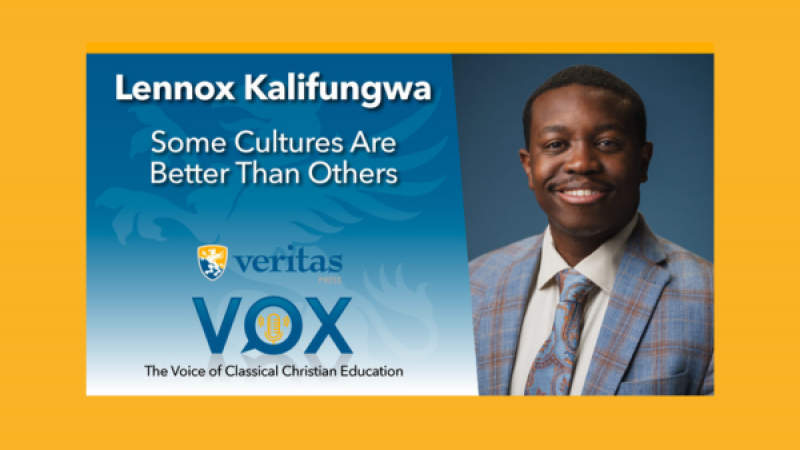
In America, where loud and well-meaning voices assert that every culture is equal, Lennox Kalifungwa’s stance that some cultures are better than others rings out as controversial.
What defines culture? What makes things true, good, or beautiful? And why does who or what we worship ultimately shift entire cultures for better or worse? Find out in this episode of Veritas Vox!
Want to hear more from Lennox? You can explore additional cultural topics on the Kings & Statesmen podcast at https://kingsandstatesmen.podbean.com/
Episode Transcription
Note: This transcription may vary from the words used in the original episode.
Marlin Detweiler:
Hello again and welcome to another episode of Veritas Vox, the voice of classical Christian education. Today we have with us at just. I just realized I didn't get the pronunciation of your last name, and I'm going to stumble on it, I can say. Lennox. Lennox. How do you say your last name?
Lennox Kalifungwa:
So if you can think of California, it's the same syllable structure as California.
Marlin Detweiler:
I can say California. That is great.
Lennox Kalifungwa:
There you go.
Marlin Detweiler:
I'm guessing that your relatives are not Italian.
Lennox Kalifungwa:
No, not at all. But you never know, you know.
Marlin Detweiler:
Good point.
Lennox Kalifungwa:
Well, welcome.
Marlin Detweiler:
So glad you could join us. Start. Start by introducing yourself. Become familiar to our audience. Tell us a little bit about your family, your education, your career. And then we'll jump into a very interesting topic.
Lennox Kalifungwa:
Yes, yes. So I was born in Zambia and raised in South Africa. And so it's those those two contexts had a very pivotal role in shaping who I am today. I grew up in the home of a minister of the gospel, and it was his ministry that actually took me to these different places and exposed me to a whole lot.
And my father and his own influence, you know, really influenced and inspired me a great deal. I often like to describe my father's library as one of the most shaping influences in my life, and not just because I had access to his books, but because of the kinds of conversations we have in his study. Yes, absolutely.
And so he introduced me to things like classical thought and gave me a wonderful classical Christian education. And so that was my entryway into this world. And as my family and I were moving back to Zambia after a while. That was a very big moment in my life, because that's really when I saw the significance of culture and the differences that shape it.
And I'm sure we'll get into the meat of that later on. But I also had a passion to propagate a Christian worldview and a Christian way of thinking across the African continent and specifically in Zambia. So I was involved in various initiatives trying to promote classical Christian education and really enjoy doing that. And so my background is very much in cultural apologetics, classical Christian education, some theology, communications, and marketing. I happen to go to business school where I had a focus on marketing specifically.
Marlin Detweiler:
Where did you go to school?
Lennox Kalifungwa:
I got my degree through the University of Greenwich. So this is out of a college in the UK. Although I did it from a distance. I didn't actually live or go to the UK, but my degrees to the University of Greenwich and so yeah, got a degree with them and then was involved in various initiatives upon graduation. And again, still just pushing Christian worldview thinking and Christian education.
Marlin Detweiler:
So how did you end up in America?
Lennox Kalifungwa:
Great question. I often like to say, just by the providence of God, I'm still trying to figure it out, you know. But a long story short, I was part of an initiative called the African Christian University in Zambia. And I remember at the inception of the college, we were looking at colleges we'd like to model ourselves after.
And you said Andrew's College was actually one of those colleges, and that was the first time it was on my radar. Over the years, we actually started to form real relationships with people in Idaho and specifically at Newton Andrew's College. And it's in all that that an opportunity to open up for me to move out here with my family.
And so I'm married to a wonderful lady named Cindy, and we have four children and just enjoying life in Idaho at the moment.
Marlin Detweiler:
That's wonderful. Do you report directly to Ben Merkel?
Lennox Kalifungwa:
I work very closely with Ben from time to time. So as far as I'm involved in development work, I work very closely with him. The rest of the time, I'm. I'm involved with NSA marketing.
Marlin Detweiler:
Yeah. Very good. I happen to hear Ben preach this past Sunday in Washington, DC. Yeah, we were wonderful. But to Christ Church, Washington, on our way on our travels. One of the reasons I was so interested in having you join us on Vox was because I heard you speak at the Association of Classical Christian Schools conference just a few weeks ago, and the statement that just captured me was, and you unpacked it, and I'm going to ask you to do it now, go in any direction you want to with this.
But not all cultures are equal. That's flies in the face of a mindset that all cultures are equal except for Western civilization, which is negative, right? At least in some circles. But really talk to us about what that means.
Lennox Kalifungwa:
Yes, I think the idea that not all cultures are equal. Another way that could be said is that some cultures are superior or inferior to others.
Marlin Detweiler:
Those are hard words for the politically correct to take, aren't they?
Lennox Kalifungwa:
That's exactly it. And you're right. I think we do live in an egalitarian age where everything is meant to be androgynous. Everything is supposed to be neutralized in many people's minds, and therefore to speak about superiority or inferiority, or to make the assertion that not all cultures are equal really is socially disruptive in people's minds. And yet what I mean when I say that is just one at face value.
When you compare different cultures, you recognize that you know, not all of them come to the same conclusions or live exactly the same way. And that's rooted in the fact that not all of them worship the same deity. Right? And so I think at the, at the root of culture is, is religion. What do people worship?
What do people worship has an influence on absolutely every single aspect of their life and their culture. And therefore the assertion that all cultures are equal is very much a statement that interrogates or goes at the heart of what a people worship. And that's why I can make such an assertion. And I think it's an important assertion to make one, because of the crazy times that we live in, in which lies have been very prevalent.
And I think also the world that has sought to think that multiculturalism, which is this idea that different cultures can coexist alongside each other despite the fact that there's a different cosmology in the way they think about life. We've seen that experiment tried and it has been found wanting. It has colossally failed. It has actually been the occasion upon which societies have been ruined.
And so in making those kinds of assertions, asserting that not all cultures are equal, my goal is really to get people thinking about what culture is, to think about the religious underpinnings that constitute culture, and to get people to start to think about what it means for cultures to begin to be good and continue to be excellent.
So I don't make the statement simply to be offensive, but simply to shed light on darkness and to pave the way forward in terms for people to actually shape culture in the context that they inhabit, and to get into even more of the weeds of the idea that not all culture is equal. I think culture, the way I would define it, is the visibly manifest, more manifestation of what a people worship.
I've kind of used that as a category, but that has a very shaping, direct shaping influence on the laws, the language, the esthetics, the customs and the traditions of the people and even its cuisine. There's so much that it influences. And because of that, I think we can even make the assertions that not all languages are equal. Not all laws are equal, not all cuisines are equal.
All of them actually have a telos to them. All of them carry a worldview. All of them actually hold to some kind of theology that shapes exactly what it is. And so I think those are important assertions to make. If we're going to be the sort of people, the sort of Christians who can go on and shape excellent cultures.
Marlin Detweiler:
Well, well, I can think of a number of different questions to ask, but I've got one that I think will be fun to pursue. So tell me about the hate mail that inspires.
Lennox Kalifungwa:
It's always fast and interesting. It's from different camps. A lot of people determined to misunderstand and be offended. I think half the time I'm just it feels like I'm just swatting off wasps, you know?
Marlin Detweiler:
So that's great. Our mission at Veritas has been for decades now, restoring culture to Christ, one young heart and mind at a time. As you say what you do. I realize that there are some things that we haven't really thought through in the context of what we say, and I guess maybe the best way to ask you to help with that is: how would that hit you if you were pursuing that as a mission?
In fact, you are in some sense, what does that look like? What are the things that we're restoring and how do you think that will happen?
Lennox Kalifungwa:
Yeah, that's an excellent question. I think I think the thing that we actually have to restore, and this is a very simple answer, but it's an important one, is essentially the acknowledgment that Christ is king, that Christ is Lord, and Lord over absolutely everything. What we're restoring is a Christianity that is robust in its applications. What we're restoring is the idea that Christianity has been the only religion.
And I'll emphasize that the only religion that has ever prompted freedom and flourishing anywhere in the world. And therefore, if a society is going to be free and if they're going to flourish, that's. They have.
Marlin Detweiler:
To think that in exaggeration.
Lennox Kalifungwa:
Not at all. Not at all. Christianity's track record speaks for itself in that regard. It's Christianity that has shaped the excellence of, of of anything that exists in this world and specifically in Western civilization. And so I think we do live in a time where people are rightly concerned about how Western civilization seems to be losing itself and losing its way, and it's not because we simply lost some sentiment or something superficial.
It's that Western civilization has lost what enabled its greatness, which was Christianity. And so what we're trying to recover fundamentally is Christianity, is the understanding of who Christ is as Redeemer and as Lord, and recognizing who we are as subservient to him, as worshipers of him, and in worship of him, as those who then go out and are able to build culture.
I think we live in a world that in which when we think of culture, we think of it as something to be merely observed and consumed. But in understanding and reckoning with how God has made us, especially in accordance with Genesis one and two, you see, that man was actually created to be a shaper of culture, to be a cultivator who makes, who makes and creates things that are true, beautiful and good.
That's the goal. That's what we're trying to aim at. And so even in the context of the question you asked about what does this look like, even in shaping people and shaping students? For me, it's about giving them the only religion and all its robust applications that prompt freedom and flourishing. I think that's the goal.
Marlin Detweiler:
Wow. Okay, there's an elephant in the room here. Why do you get away with saying this stuff?
Lennox Kalifungwa:
I don't know. I sometimes wonder if it's my melanin proficiency that enables me to say these kinds of things.
That might be the biggest reason, but I think maybe also it's hard for people to put me into a singular box. It's hard to argue with someone who's experienced different cultures.
Marlin Detweiler:
The breadth of your experience is probably far greater than 90 plus percent of any detractors.
Lennox Kalifungwa:
That's likely the case, as I have discovered myself. So.
Marlin Detweiler:
So what? What should we do? Give us some encouragement and instruction on how we follow your lead to see a Christ be recognized. Almost, said Christ. Be Lord. That's not what it is. It's Christ be recognized as Lord over the creation and how it's providentially superintended by him.
Lennox Kalifungwa:
Yes, I think my encouragement, especially to your audience, is one is just to say, press on, keep on. I think what you're doing is actually the foundation of what makes the most excellent cultures. Western civilization was enabled by the kind of education that Veritas Press and various other entities in the classical Christian world offer. And so press on. What many educators are doing is not simply producing smart kids, is not merely producing kids who can score well on a test or will excel vocationally.
You are developing the kind of people who are going to shape the most excellent cultures. And that's what excites me about what about what you're doing at Veritas Press, and what general educators in the classical Christian world are doing as well. So press on. I think what you're doing is, is no small thing. I am a firm believer in the cadence of UK that you see in history and in God's Word, you catastrophe basically being defined as the seemingly small being able to overwhelm the seemingly great, the smallest light, devastating the greatest darkness.
And so, regardless of whether you have a small classroom or you are teaching at a small school or you're a homeschooling family, that's just trying to figure things out day after day, week after week, God is doing something with your small acts of faithfulness, and that's something. He’s building Christendom through the building of great cultures. And that's what you're doing in your homes and in your classrooms.
You're cultivating a culture. You're in culture in your students so that they can go on and be shapers of excellent cultures.
Marlin Detweiler:
Yeah, that that is so good. And that is so much what we hope to do, instilling not just a boatload of knowledge, but godly wisdom in the process of becoming a parent, a professional, a laborer, a church member, a pastor, whatever it might be, to instill godly wisdom and see that really go out to the fingernails and all of what we do.
I took this off of the internet. You'll be familiar with this. I'm going to read it as a quote from a site that introduces you: transcendent unity found within Christ's kingdom, a unity that weaves together diversity, disparity, and distinction. And then you refer to Ephesians 4:1-16. This is not the superficial diversity heralded by the modern zeitgeist, rooted in Marxist theory and DEI initiatives; rather, it is a unity anchored in the timeless ideals of truth, beauty, and goodness which transcend ethnic, national, and continental divides.
Because Christ is the sovereign Lord over all creation. It's a pretty succinct way of saying what you've said, but I'm curious what motivates…
As you've referred to the modern Zeitgeist and Marxist theory, DEI initiatives? What motivates that? Is that a Secular, humanist copy of what we see and want to produce, you know, the things that we're talking about? Oh, is it something wholly other that is still secular humanism and man being the measure of all things?
Lennox Kalifungwa:
Yeah, I think it's all of the above, to be honest, and not even frame it this way. I think what's really going on here is, you know, as people try to push this idea of diversity, as people try to push this idea of multiculturalism, what they're really trying to do is to live life on their own terms rather than God's terms.
This is an attempt to push God out of the public square, out of anything that has to do with the affairs of man. That's what this is about because you think about it, multiculturalism or diversity accommodates every other religion except Christianity –
Marlin Detweiler:
That’s the only real threat it has.
Lennox Kalifungwa:
Exactly. That's, in fact, exactly the point. It's the only real threat it has. Why? Because Christianity is the truth. Christianity is the only religion that stands in man's way of living by lies and pursuing vice. It is. It is a deterrent to evil, the only deterrent to evil. And that's why Christianity has been. Well, at least there have been great attempts to expunge it from society.
So I think on one hand, that's certainly one of the contributing things to it in secular humanism doing that. But I think the other side of it is also a sort of pietism employed by Christians. And I actually like to think of pietism and secularism as twin sisters, as two sides of the same coin. The secular tries to push God out to the public square.
The Piet, the one who buys into Pietism, says amen to secularism, is claim and retreats into into a little corner and says, yes, you can have that space. Christ is only interested in these narrow avenues of life anyway, and I actually think that there's a sense in which I am a lot more concerned with Pietism than I am secularism.
I expect pagans to be pagans, and God's enemies will be defeated. But when those who belong to Christ, who are called to be salt and light, who are sons of God, who are ambassadors of his kingdom on earth, concede ground to God's enemies. I think that has a much greater shaping influence than even anything devils could craft. And so I do think there's a sense in which, as Christians, we are very much complicit in enabling what we've seen happen.
And our retreat from the public square allows it to be infiltrated by all kinds of ideas that will do harm to civilization. And so I'd say that those are two secularism, pietism. Of course, we could talk about modernity and how it turns man into machine, how it's it's fundamentally dehumanizing and what that's done to our society where multiculturalism is just an experiment to bring different kinds of people together to enable this sort of economy or machine to keep running.
And that's certainly had its effect as well. But all of it, all of it is premised on an abandoning of God. All of it has an atheist framework where man seeks to live life, where man thinks he can be free and flourish apart from God, and it's just not possible.
Marlin Detweiler:
Yeah, classical Christian education, I think, has done and continues to do it increasingly. I don't know if I'm saying this in proper grammar. Increasingly. Good job at instilling in its students that life is not that. Christianity is not just evangelism, contrasting it with discipleship. Probably. I think one of the greatest misnomers is to think of the Great Commission as an evangelistic exercise, when in fact it's an exercise in discipleship, which clearly subsumes evangelism. There's no diminishing.
But what we live in today, the overwhelming expression of the Christian church, at least in America, which is all I really know.
Focuses itself on evangelism and not on discipleship and not on maturity, and not on a comprehensive sense of living in God's creation and all of what that means, right. It's kind of easy to understand in some senses how we got there. A bit of a reaction to liberalism in the early 20th century would be one point. What are the in addition to the initiatives of classical Christian education, what are some other things that you would encourage us to consider as a way of producing disciples and seeing the glory of God covering the earth as the waters cover of the sea?
Lennox Kalifungwa:
Yes, absolutely. I think that's great. I do think it is very important and I'd say a very important tool for the household specifically. And so what we need is to establish the institutions that God has for the enabling of healthy civilizations. Namely, you want healthy families, you want healthy churches. Of course, you want healthy institutions across the board.
You want to have a healthy civil government that also understands its role in things too. But I think Christians also have a very important role to play in building various kinds of institutions. We need Christian businesses. We need enterprise. We need Christians leading the way in whatever it is its hands find to do. And that's the way to shape culture.
As people are engaging with these institutions that Christians build, they're seeing a tangible, visible manifestation of truth, beauty and goodness in the ordinary cadences of life. And so in that sense, it's not rocket science in terms of what of, you know, the solution or the answer to your question. But it does require people who are willing to be faithful, people who are willing to sacrifice for a greater good, and people who are willing to be pioneering as well.
I think that's the only way around it. For example, I'll take just where classical Christian education is in Africa. It's still very, very much in its infancy, to say the least. There's only small pockets where it exists on the African continent. But those who buy into it, it demands a lot out of their demands, out of their time. It demands a lot of a willingness to be ridiculed and criticized. It demands.
Marlin Detweiler:
For what? For being Western, for being bookish?
Lennox Kalifungwa:
Partly for being Western. Think some people kind of see it as a betrayal of African ideals. But also, I think there's a sense in which people perceive the novelty is often a threat to people because it's new to them and they just don't know what to do with it. It's not been tried and tested in their context.
And so they're not sure how it's going to pan out. And so I think those are those are few weeks. And so you need people who have a steel spine in all of it. And you know, one of the things that encourages me about even just us having this conversation is we need masculine courage and we need masculine presence even as we build these institutions, even as we push classical Christian education, I think we need masculine voices that push this forward. And I think if we cultivate that, I think we can get a lot done.
Marlin Detweiler:
So you're a young man having taken a lot of initiative in the prime of being a father and parent and a husband. You look back 30 years from now. What is success look like for you? What would you like to be able to say? I did what I set out to do.
Lennox Kalifungwa:
I appreciate the question. I'll begin with this. I recognize that I am very much on the clock. I think on one hand, I am sold out for what Christ calls me to do. And so I want to honor him and lift up his name as best as I possibly can. I want to employ what he's given to me in the best way possible.
I think, for example, one of the gifts he's given me is the ability to communicate. And I want to do that faithfully, and I want to be fruitful with what God has given me. And I'd love to be able to look back and see that I want to be able to build things for the honor of Christ, build the kind of institutions that shape culture and shape civilization.
I want to be able to say that people have been blessed through the efforts that I have been engaged in, and all pointing to Christ ultimately in my very short life. In fact, even just in the last 7 or 8 years, I have lost some of my closest friends, a few of them, several of them to various things.
All of them serving the Lord very faithfully. And I think the Lord has used that as an example of what it looks like to redeem the time. Yeah. So they are brothers who have gone to glory before me. I don't know how much time I have left.
Marlin Detweiler:
Those are suffering thoughts that are easy for us to push aside.
Lennox Kalifungwa:
Yes. Yes, indeed. And so every single day I wake up conscious of my mortality. I don't take for granted that I will even have the next 30 years. But I want to. I want to serve my God and my King faithfully in these moments that he gives me. And ultimately, while I do have grand plans and grand visions, I just want to be able to hear the words, “Well done, good and faithful servant,” even if my name dies and I'm sure it will.
Marlin Detweiler:
I call it playing to an audience of one.
Lennox Kalifungwa:
Playing to the audience of one. That's exactly it. So success would be hearing those words from him.
And acknowledging the mercy and grace of God, and allowing someone as flawed as I am to have contributed to what God is doing in this world.
Marlin Detweiler:
How can our audience hear more from you? Tell us a little bit about where you are, what you're speaking into, what you've got in the way of podcasts or other public-facing means?
Lennox Kalifungwa:
Yes. Thank you. I appreciate that question. I am pretty engaged on most social media platforms. If you just look for my name, Lennox Kalifungwa, on Facebook, Instagram, or Twitter, you'll find me.
Marlin Detweiler:
Probably don't have to worry about getting the wrong Lennox Kalifungwa!
Lennox Kalifungwa:
Yeah, not at all. Unless you get some crazy impostors. There is that. But generally speaking, I should be the only name that pops up there. I also write quite a bit on Substack as and when I can and post several of my thoughts. So if you just look for Linux without Substack, you'll find my writing there.
And then I also am a host of a podcast called Kings and Statesmen that is hosted by New Saint Andrew's College. If you just look for that, Kings and Statesmen, you'll find my work. A former project that I'd worked on for New Saint Andrew's College was Of Flames and Crowns, can also be found on YouTube. Andrews College's platforms where I was dealing with culture, very specifically in the correlation between Christianity and culture. So those are a few places you could.
Marlin Detweiler:
Very good. Thank you. Lennox, thanks for joining us too. And I trust that our audience will be interested in hearing more. I love interacting with you, and I really was fascinated when I first heard you speak at ACCS. I'm glad we got together today. Thanks.
Lennox Kalifungwa:
Absolutely. Thank you for this. Great. I really appreciate it.
Marlin Detweiler:
Thank you. And folks, thank you for joining us on this episode of Veritas Vox, the voice of classical Christian education. We look forward to seeing you next time.
Have questions? Talk to an expert for free!
Our Family Consultants are here to help! Fill out the form below to schedule a quick call for free.