


Maybe a friend from church switched to classical education last year and hasn’t stopped talking about it. Maybe you’ve watched a neighbor’s ten-year-old recite a long stretch of history from memory and wondered how on earth that happened. Or maybe you simply sense that your child is capable of more than the current school day is asking of them.
Whatever brought you here, you’re asking a wise question. Enthusiasm is easy to find. You want to know whether the benefits of classical education are real, and whether they’d be real for your child.
We’ve spent 30 years walking alongside families on this road, and we’re glad to share what we’ve seen. Even better, we can share what researchers have found. Here are seven benefits, along with the evidence behind each one.
In this article
- What We Mean by Classical Education
- Knowledge That Makes Reading Possible
- Learning That Works With How Children Grow
- Clear Thinkers and Confident Communicators
- Lifelong Readers
- Ready for College and Career
- Faith and Character That Last
- Connected, Trusting, Engaged Adults
- What This Means for You: Parents Matter Most
- Frequently Asked Questions
What We Mean by Classical Education
Classical education is the approach that formed students for most of Western history. It follows the trivium, three stages that match how children grow: the grammar stage (absorbing facts and foundations), the logic stage (asking why and reasoning through arguments), and the rhetoric stage (expressing ideas with clarity and grace). Along the way, students read great books, study history in order, learn Latin, and treat truth, goodness, and beauty as worth pursuing for their own sake.
(For a fuller introduction, see our guide, What Is Classical Education?, and The Trivium Explained.)
1. Knowledge That Makes Reading Possible
Most of us assume reading comprehension is a skill, like riding a bike: once you learn it, you can apply it anywhere. Cognitive science paints a more interesting picture.
In a well-known 1988 study, researchers Donna Recht and Lauren Leslie gave middle schoolers a passage about a baseball game. Students who knew a lot about baseball but were weaker readers understood the passage better than strong readers who knew little about the game. Background knowledge did more for comprehension than general reading ability.
That finding has been confirmed many times since, and a recent study shows what it means for a whole school. University of Virginia researchers followed students who won admission lotteries to Colorado charter schools using Core Knowledge, a curriculum rich in history, science, literature, and art. By sixth grade, those students scored about 16 percentile points higher in reading than students who applied but weren’t selected (Grissmer et al., 2023). The gains were large enough to close the achievement gap associated with family income.
A classical education builds exactly this kind of knowledge, year after year, story upon story. When a child has walked through ancient Egypt, Rome, the Reformation, and the American founding in order, every new book they open lands on prepared soil.
2. Learning That Works With How Children Grow
If you’ve ever heard a six-year-old sing the same song forty times in a row, you already understand the grammar stage. Young children love repetition, rhythm, and collecting facts. Around middle school they start questioning everything (sometimes to their parents’ exhaustion). By high school they want to be heard.
Dorothy Sayers noticed these patterns in her 1947 essay The Lost Tools of Learning and argued that education should follow them. Classical education does. Young students memorize through chants, songs, and timeline cards. Middle schoolers study formal logic just as they’re itching to argue. High schoolers learn rhetoric when they most want to persuade.
Memory work sometimes gets dismissed as old-fashioned, and that concern is understandable if you picture children reciting things they don’t understand. The research tells a more hopeful story. In a widely cited experiment, psychologists Henry Roediger and Jeffrey Karpicke found that students who practiced recalling a passage remembered far more of it a week later than students who simply reread it (Psychological Science, 2006). Retrieving information is one of the most powerful ways to keep it. The chants and recitations of the grammar stage put that principle to work, and they give children a store of knowledge they’ll draw on for years.
We often describe this as teaching with the grain. When learning matches the way God made a child, it feels less like a fight and more like growth.
3. Clear Thinkers and Confident Communicators
Many approaches to education hope students will pick up good reasoning along the way. Classical education teaches it directly. Students study formal logic, practice spotting fallacies, and spend years in Socratic discussion, where a good question matters more than a quick answer. (Our posts on the Socratic method and why studying logic matters go deeper.)
The results show up in adulthood. A University of Notre Dame analysis of alumni from six types of schools, published as The Classical Difference: Good Soil (2020), found that graduates of classical Christian schools scored more than twice as high on independent thinking as the next-highest group. The difference held up even after researchers accounted for family background.
Latin plays a quiet role here too. Learning an inflected language trains attention to precise meaning, and students of the classics consistently post the highest verbal reasoning scores on the GRE of any field (Educational Testing Service). (Hettie Weber makes the case well in Why Latin Is the Key to Education.)
4. Lifelong Readers
Here’s a benefit parents tell us they treasure most: classical students tend to love books.
From the Good Soil study
6.7 times more likely to be regular readers
Classical Christian alumni were 6.7 times more likely to be regular readers than the median respondent, even after accounting for family factors. That gap was among the largest in the entire study.
It makes sense. When children spend years with stories like The Odyssey, Beowulf, and The Chronicles of Narnia, reading becomes a place they want to return to, and a habit they carry into adult life. (Our classical literature list offers more than 180 titles to start with.)
5. Ready for College and Career
Every parent wants to know their child will be prepared for whatever comes next. The Good Soil alumni rated themselves highly on college and career preparation, and nearly 90% had completed a bachelor’s degree or higher.
What employers say they need lines up closely with what classical education builds. In a 2023 survey of more than 1,000 executives and hiring managers by the American Association of Colleges and Universities, oral communication topped the list of skills rated very important for new hires (64%). Only about a third of employers felt recent graduates were very well prepared in it (The Career-Ready Graduate).
A student who has spent years discussing ideas aloud, writing persuasive essays, and defending a thesis in front of others has a head start on exactly that skill. (For more on how a classical foundation supports science and math, see STEM Skills in Classical Education.)
6. Faith and Character That Last
Education shapes the heart whether we intend it to or not. Classical Christian education is simply intentional about it. Students meet heroes worth imitating and cautionary tales worth heeding. They discuss courage, justice, and wisdom by name. They study history as the unfolding of God’s story, and they learn that all truth is God’s truth.
That formation seems to last. In the Good Soil study, about 90% of classical Christian alumni attended church at least three times a month. They reported gratitude averaging 6.8 on a 7-point scale. And when asked what mattered in a job, they ranked a sense of calling and the chance to help others well above pay.
This is the heart of why many families choose classical Christian education. They want their children to know a great deal, and they want them to become good, wise, and faithful people. (We explore this further in What Is a Classical Christian Education?)
7. Connected, Trusting, Engaged Adults
Some parents worry that a distinctive, faith-centered education might leave their children isolated or suspicious of the wider world. That’s a loving worry, and the findings here are some of the most encouraging in the research.
- The most trusting. Classical Christian alumni reported the highest trust of any group toward neighbors, coworkers, and even strangers, and more trust in scientists than alumni of other evangelical schools.
- Rich in friendship. About 90% reported having more close friends than the typical respondent.
- Fond of their school years. Looking back as adults, they had the warmest memories of high school of any group surveyed.
- Invested in their communities. The widest gap in the entire study came in what researchers called “influence”: classical alumni were the most likely to believe they could make a difference where they live, to know people in positions of leadership, and to volunteer beyond their own church.
Deep roots, it turns out, give people the security to reach outward. Students who know what they believe and why seem freer to engage the world with confidence and kindness. (You can hear one family’s story in Do Classically Educated Kids Turn Out OK?)
What This Means for You: Parents Matter Most
One finding in the Good Soil study deserves special attention, because it may be the most important of all for parents.
When researchers adjusted the results to separate the effect of the school from the effect of the family, some benefits shrank. A hopeful, purposeful outlook on life, for example, dropped by roughly half once family factors were accounted for. In other words, a great deal of what makes a child flourish comes from home.
You are the most important influence in your child’s education, and no school, curriculum, or teacher replaces you.
We find that deeply encouraging. The best a school can do is partner with you: bringing expertise, structure, and a community of fellow travelers to support the work you’re already called to. (A fair note on the research itself: the study was sponsored by the Association of Classical Christian Schools, and its authors are candid that no statistical method perfectly separates school from family. We read it as strong encouragement rather than the final word.)
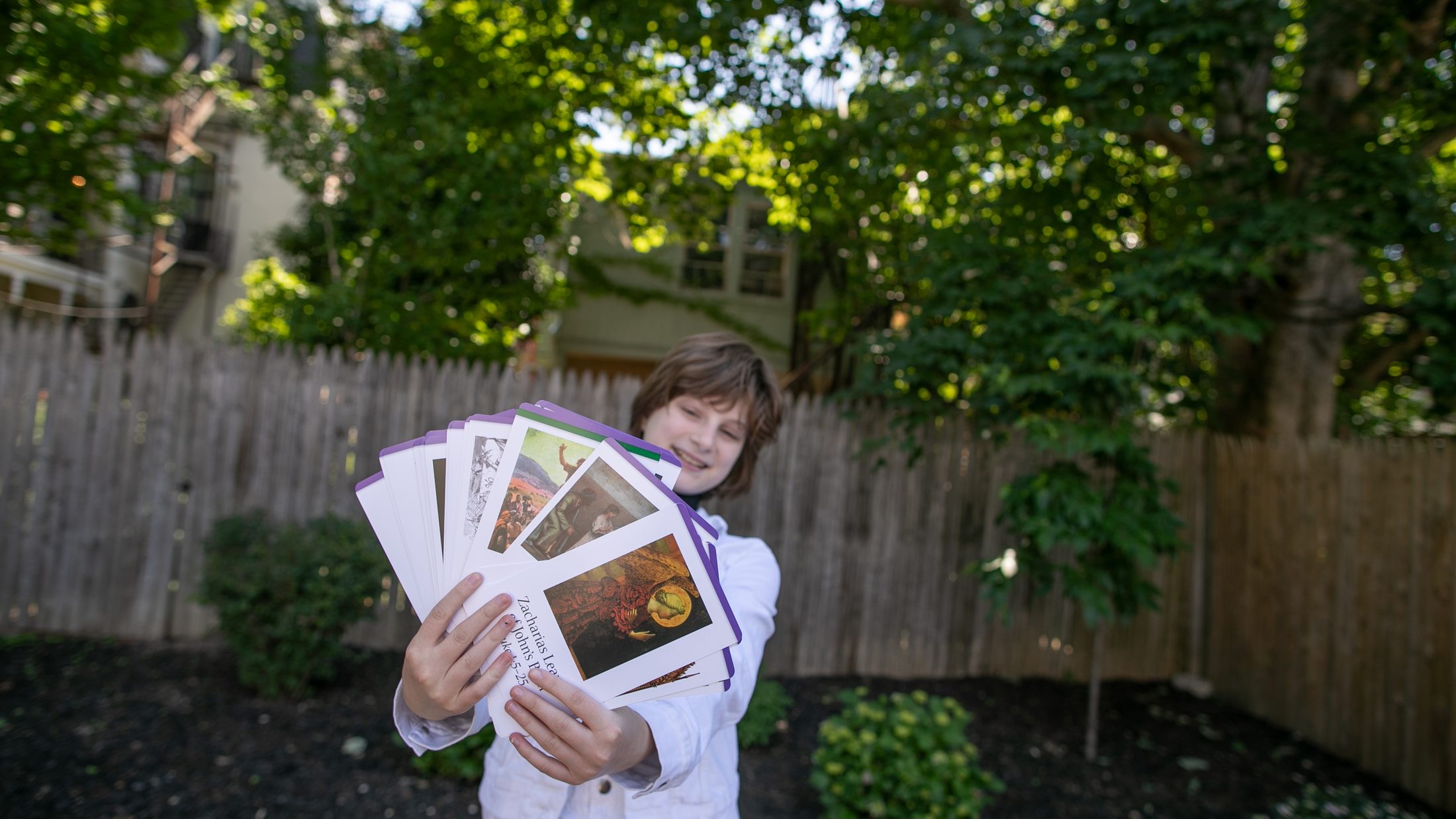
That’s how we’ve always understood our role at Veritas Press. Veritas began when Marlin and Laurie Detweiler made a set of history cards for their own sons in 1996, and 30 years later we still see ourselves as partners to parents, helping families carry a responsibility that has always been theirs.
Frequently Asked Questions
Is classical education really better?
“Better” depends on what you hope education will do. If your goals include deep knowledge, strong reasoning, a love of reading, and character formed by faith, the research we’ve shared suggests classical education serves those goals exceptionally well. Every child is different, though, and the best choice is the one that fits your family’s convictions and your child’s needs.
Is classical education too hard for my child?
It’s natural to wonder this, especially when you hear about Latin in third grade or Homer in high school. Classical education is demanding, and that’s by design. But rigor works best when it’s built gradually and matched to a child’s stage, and that’s exactly how the trivium is structured. Students grow into the challenge step by step, and most discover they’re capable of far more than anyone expected. (See Why Is Classical Education So Hard? for more.)
Is classical education only for gifted students?
Many parents worry their child isn’t “the type,” and that concern comes from caring about your child’s confidence. For most of history, classical education was simply how ordinary children were taught. Because it builds on how all children naturally learn, beginning with memory and wonder, it serves a wide range of students well. Strong readers and reluctant ones, eager talkers and quiet thinkers all find a place in it.
Can classical education help a child who struggles with attention?
If your child finds it hard to sit still or stay focused, you may worry a rigorous education will only make things harder. We understand that, and we think classical education is often part of the answer.
In the early years, it works with a young child’s natural energy. Chants, songs, motions, and short, varied stretches of memory work give restless minds something to do, and they reward the repetition young children already love. As students grow, the work stretches a little further at each stage: longer readings, deeper discussions, more sustained writing.
That gradual rigor builds attention the way exercise builds a muscle. Each stage asks just a bit more than the last, and over time students develop the capacity for deep focus that so much of modern life erodes. (Maryanne Wolf describes how sustained, deep reading shapes the brain’s capacity for attention in Reader, Come Home, 2018.) If your child has a diagnosed condition, the guidance of a doctor or specialist still matters, and a good classical education can work alongside that support.
Prepared for Life
The benefits of classical education reach well beyond test scores, though the academic results are strong. At its best, a classical education forms young men and women who read deeply, think clearly, speak graciously, and live faithfully. They’re ready for college and career, and ready for the harder and better work of loving God and their neighbors well.
If you’re considering this path, you don’t have to walk it alone. Talk with families who’ve gone before you, read widely, and trust your instincts as a parent. You know your child better than anyone, and that knowledge is the best foundation any education can build on.