


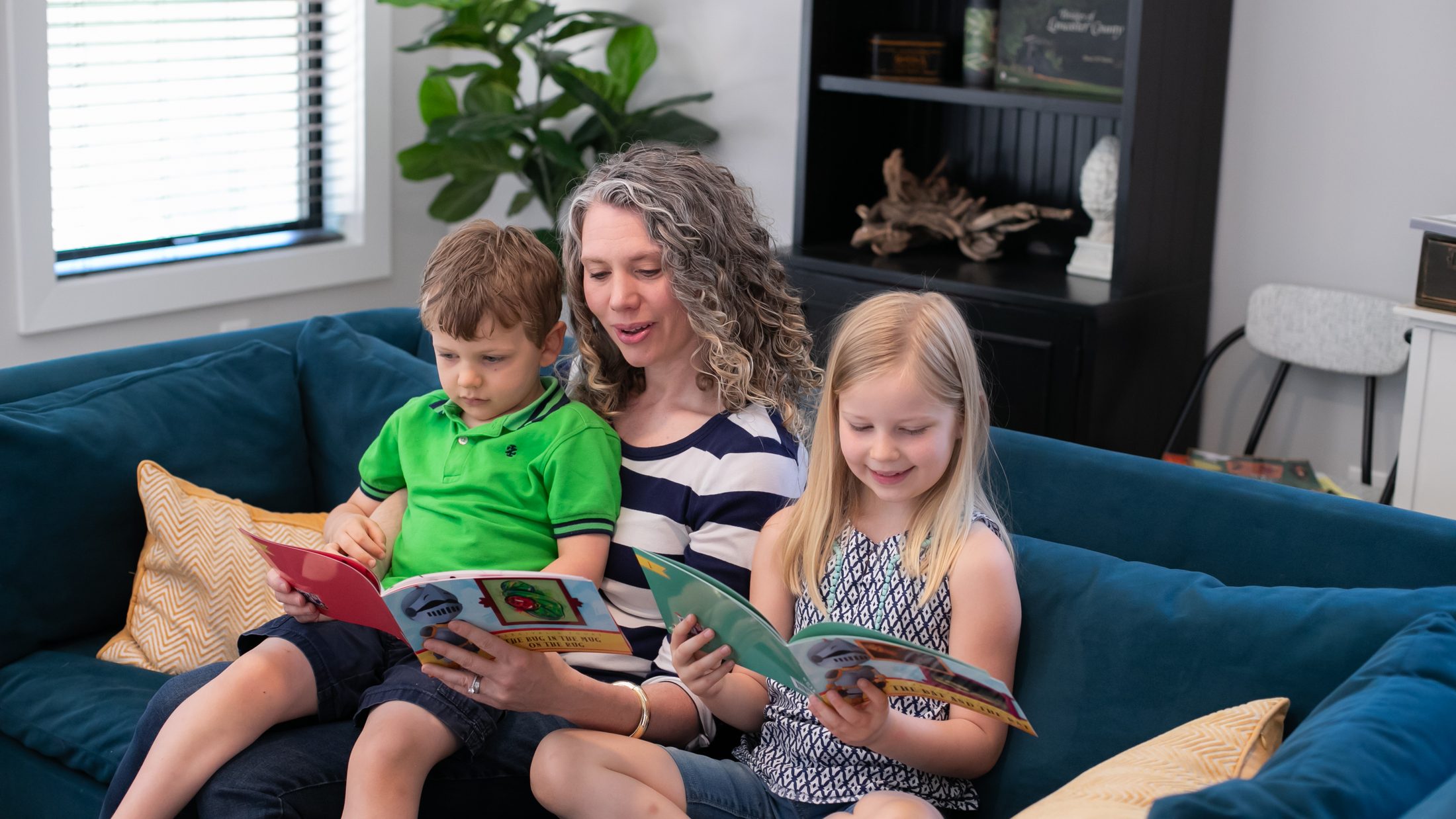
Most parents can name the moment. Your daughter vanishes into a library book about octopuses and resurfaces three days later able to explain how they change color. Your son, who groans at worksheets, builds an elaborate Roman fort in the backyard and asks, unprompted, why the legions eventually left Britain.
That spark is precious. Many families who choose unschooling do so because they have seen it flare up at home and watched it dim under the weight of bells, grades, and busywork in a classroom. If that’s your story, we understand it, and we share your desire to protect what you saw.
At Veritas Press, we have spent decades building classical curriculum and, through Veritas Scholars Academy, teaching students online. So you might expect us to come down hard on unschooling. Instead, we want to offer something more useful: an honest look at where unschoolers and classical educators agree, where we see things a little differently, and what to do if your child is asking for more than you expected.
In this article
Unschooling vs. Homeschooling: The Short Answer
Homeschooling describes where and by whom a child is educated: at home, under the direction of parents, rather than in a public or private school building. Within homeschooling there are many approaches, from classical education to Charlotte Mason to boxed curriculum to online school.
Unschooling is one of those approaches. It is a philosophy of education built on the idea that children learn best when they follow their own interests, without a set curriculum, scheduled lessons, or formal tests. The parent acts more as a facilitator than an instructor, providing resources and experiences as the child’s curiosity leads.
The term was coined by educator John Holt in the late 1970s, after years of watching bright children grow anxious and bored in conventional classrooms (see his How Children Learn and Teach Your Own).
So every unschooler is a homeschooler, but most homeschoolers are not unschoolers.
Here’s how the approaches compare in practice:
| Structured Homeschooling | Unschooling | |
|---|---|---|
| Curriculum | Chosen by parents or a school, often sequenced by grade | None set in advance; follows the child’s interests |
| Schedule | Regular lessons, often daily | Learning woven through everyday life |
| Parent’s role | Teacher, guide, or coordinator of teachers | Facilitator and resource-provider |
| Assessment | Assignments, narration, tests, or portfolios | Informal observation, if any |
| Who decides what’s next | The parent or teacher, with the child in view | Primarily the child |
If you’d like a broader tour of the options, our guide to homeschool styles walks through the major approaches side by side.
What Unschoolers Get Right
We’d like to start with real common ground, because there is a lot of it.
Children are made to learn. Aristotle opens his Metaphysics with the observation that all people by nature desire to know. Classical educators have built on that conviction for over two thousand years. Unschoolers and classical educators both start from the same hopeful place: a child’s mind is hungry, and the job of education is to feed it well.
Intrinsic motivation matters most. A student who reads only for a grade will usually stop reading when the grades stop. A student who has learned to love reading will keep going for the rest of her life. We see this every year at Veritas. The students who flourish most are rarely the ones chasing points; they are the ones who have fallen in love with a story, an argument, or a proof.
Our deepest hope is to raise students who love Homer, not students who merely pass a test on him.
A child is a person. Charlotte Mason, the British educator whose work many homeschoolers treasure, built her whole philosophy on the principle that children are born persons. They come to us with minds, affections, and wills of their own. Unschoolers honor this deeply, and so should anyone who teaches children.
Schooling can crush curiosity. Holt was right that much of modern schooling trains children to perform for adults rather than to wonder. Classical educators have their own long tradition of this critique (Dorothy Sayers made it memorably in her 1947 essay “The Lost Tools of Learning“). We share the frustration that brought many families to unschooling in the first place.
Where We See Things Differently
If we agree on so much, where do the paths part? For us, it comes down to three convictions we have seen borne out in thousands of students.
Curiosity Grows From Knowledge
Here is something that surprises many parents: curiosity tends to grow as knowledge grows. A child can’t wonder about something she doesn’t know exists. The girl who loves octopuses had to meet an octopus first, in a book, an aquarium, or a documentary someone handed her.
Cognitive scientist Daniel Willingham makes this case in Why Don’t Students Like School? People feel curious when a problem sits just within reach, and what puts it within reach is the background knowledge they already have. The more a child knows, the more questions she can ask.
This is one reason classical education leans so heavily on the Great Books. Very few twelve-year-olds will stumble onto Virgil, Augustine, or Dante on their own. Yet when a thoughtful guide places these works in their hands, many discover that they love them. We have watched it happen countless times. The books are an inheritance, and children deserve to be introduced to it. (For more on this, see The Great Books: Why They Matter and How to Teach Them and our classical literature list.)
Rigor Is a Gift
The word “rigor” can sound cold, as if it means piling on assignments until the joy drains out. We mean something warmer. Some of the deepest delight a student will ever feel lives on the far side of difficulty: the Latin declension that finally clicks, the geometry proof that suddenly makes sense, the paragraph of Thucydides that opens up after the third reading.
Children rarely choose that kind of difficulty on their own, and that’s perfectly natural. Adults rarely do either. A wise teacher invites a student into the hard thing, stays beside her while she struggles, and celebrates with her when she breaks through. That experience builds a kind of confidence that easy success can’t provide. We’ve written more about this in What Rigor in Education Really Means.
Children Need a Guide
Every great learner has had great teachers. Sometimes that teacher is a mother at the kitchen table. Sometimes it’s a father reading aloud after dinner, or a Latin instructor in an online classroom. What matters is the presence of someone who knows the territory ahead and loves the child enough to lead.
Good teaching looks less like lecturing and more like conversation. The Socratic method, which sits at the heart of classical education, offers a lovely middle path: the teacher guides through questions, and the student does the real thinking (What Is the Socratic Method?). The child’s mind stays active and engaged, and the teacher makes sure the conversation goes somewhere worth going.
Classical education also pays close attention to how children grow. The trivium, with its grammar, logic, and rhetoric stages, follows the natural development of a child: the young child who loves to memorize and chant, the middle schooler who loves to argue, the teenager who longs to express what she thinks (The Trivium Explained). Structure, done well, works with a child’s nature.
When the Path Feels Uncertain
Perhaps you’re reading this because something feels off. If so, we want to say first: that feeling deserves gentleness, not alarm. Every homeschooling parent, whatever their method, has lain awake wondering whether they’re doing enough. Noticing is a sign of how much you care.
What unschooling families say
Doubt is one of the hardest parts of the journey
In a 2013 survey of 232 unschooling families, researchers Peter Gray and Gina Riley found that one of the most common challenges parents reported was overcoming criticism and social pressure, along with their own ingrained ways of thinking about education (Journal of Unschooling and Alternative Learning, 7(14)).
Within unschooling circles, those doubts are often treated as old conditioning to push past. Sometimes that’s true. But sometimes a parent’s doubt is wisdom quietly raising its hand.
Here are a few signs that may be worth listening to:
- Your child has started asking for more. More challenge, more structure, a “real” class, or simply to know what kids their age are learning.
- Gaps are widening in the foundations. Reading fluency, handwriting, or math facts that haven’t come along, especially past the early elementary years. These skills compound, and they’re much easier to build early.
- Interests flare up and fade quickly. Your child dives into something enthusiastically but drifts away the moment it gets hard, and you’re not sure how to help them push through.
- You’re exhausted. Being the sole facilitator of every possible interest, with no plan to fall back on, is a heavy load. Many parents feel this quietly and assume it means they’re failing. It usually means they need support.
- High school is coming into view. Transcripts, college applications, and the subjects that build on years of prior work (advanced math, sciences, languages) can make a teenager’s future feel close very quickly.
None of these mean you made a mistake. Families change, children change, and the approach that served a seven-year-old beautifully may need adjusting for a twelve-year-old. Changing course is part of homeschooling.
Two Paths Forward
Wherever you find yourself, there are good options that don’t require abandoning everything you value.
If Your Child Has Fallen in Love With Something
Many unschooling families reach a point where a child’s interest outgrows what the library shelf can offer. Your son has read every book on ancient Rome he can find. Your daughter wants to read the real Odyssey, not the picture book. Your child is begging to learn Latin.
This is a wonderful moment, and you can follow it without changing your whole philosophy. A single, well-made resource can give that interest the depth it deserves. Families often start with one subject: a literature study, a history course, or a Latin program. Our Self-Paced courses let a child work through rich, engaging lessons on their own timeline, and our Omnibus curriculum guides older students through the Great Books in conversation with history and theology. Think of it as handing your curious child a map of the country they’ve already started exploring. (Our post on the Veritas approach to literature gives a taste of what that looks like.)
If You Sense It’s Time for More Structure
For some families, the realization is broader: the whole household would breathe easier with a plan. That’s a healthy thing to recognize, and there are gentle ways to step into it.
Some parents choose a classical curriculum they teach at home, keeping the warmth and flexibility of homeschooling while gaining a clear sequence and a sense of direction. Others enroll their children in live online classes, where a teacher who shares their love of learning takes on part of the load. At Veritas Scholars Academy, families can start with a single class part-time and add more as they’re ready. Students still learn at home, still have time for their own pursuits, and gain teachers and classmates to think alongside.
Many families find that a little structure makes room for more curiosity. Once the foundations are steady, a child has more to wonder about, and a parent has more energy left for wondering alongside them.
The Spark Is Worth Tending
Unschoolers and classical educators share the same hope at heart: a child who loves to learn, and who grows into an adult who loves what is true, good, and beautiful. We simply believe that love grows best when it’s tended, by a guide who knows the way, along a path worth walking, with plenty of room left for wonder.
Wherever your family is on that path, we’re glad you’re here.
Frequently Asked Questions
What is the difference between unschooling and homeschooling?
Homeschooling means educating your child at home rather than in a school building. Unschooling is one specific approach to homeschooling, in which children direct their own learning based on their interests, without a set curriculum or formal lessons.
What are the downsides of unschooling?
It depends heavily on the child and family. Commonly cited challenges include gaps in sequential subjects like math and writing, difficulty pushing through hard material without outside structure, the burden placed on parents as sole facilitators, and social pressure from those who disapprove. In a survey of grown unschoolers, the most frequently mentioned disadvantages were others’ criticism and, for some, social isolation (Peter Gray, Psychology Today, 2014).
Do unschoolers go to college?
Many do. In a survey of 75 grown unschoolers, Peter Gray and Gina Riley found that 83% had pursued some form of higher education and 44% had completed or were enrolled full-time in a bachelor’s program. The researchers note that the sample was self-selected and likely overrepresents people who were happy with their unschooling experience, so the findings can’t be generalized to all unschoolers.
Is unschooling legal?
Unschooling is legal anywhere homeschooling is legal in the United States, but every state has its own requirements. Some require notification, record-keeping, specific subjects, or periodic assessment. HSLDA’s state law summaries are a reliable place to check your state’s rules.
Can I combine unschooling with a curriculum?
Absolutely. Many families follow their children’s interests in most areas while using structured resources for foundational skills like math and reading, or for a subject a child is especially passionate about. Homeschooling gives you the freedom to find the blend that fits your child.