
Veritas Scholars Academy
Parent & Student Handbook 2026–2027
Everything VSA families need in one place: our mission, how live classes run, academic policies, grading, and the Full-Time Diploma Program.
Last updated September 1, 2026. Please download the handbook for the most up-to-date information. See Amendments.
In This Handbook
Introduction to Veritas Scholars Academy
Dear Parents and Students,
Welcome to Veritas Scholars Academy! We’re thrilled to have you here with us. This handbook provides a comprehensive foundation for understanding our school’s mission, policies, learning technology, and other information to help you navigate your experience with us.
Founded in 2006, Veritas Scholars Academy is a private, K–12 academic institution with a distinctly classical, Christian approach to learning and a truly international student body. Our faculty and students engage in rich discussion in all the “traditional” subjects you would find in a school—English, Math, Science, History, etc. We also study Latin, Logic, Rhetoric, Greek, and other disciplines that will only further inspire students in their educational pursuits and equip them in significant ways for life. As all truth is God’s truth, our academic explorations are conducted with a biblical worldview in mind. Our teachers are passionate about their respective subject areas, as well as how faith and learning intersect, and it is our ambition to pass that enthusiasm to our students.
“And whatever you do, do it heartily, as to the Lord and not to men, knowing that from the Lord you will receive the reward of the inheritance; for you serve the Lord Christ.”
Colossians 3:23–24
Yours,
Dr. Bob Cannon
Headmaster
Mission Statement
Restoring culture for Christ, one young heart and mind at a time.
Statement of Faith and Philosophy
We believe that the sixty-six books of the Holy Bible are the only authoritative, inerrant Word of God. Further, we believe that these Scriptures are our final rule in all matters of faith and practice.
Read the full Statement of Faith and Philosophy
We believe that there is but one God, eternally existent in three Persons, the Father, the Son, and the Holy Spirit. We believe that Adam, the first man, sinned in his disobedience toward God and that through his disobedience sin extended to all his posterity. Consequently, all are born sinners, spiritually dead and relationally separated from God.
We believe that because of the ineffable love of God for the world, Jesus Christ, born of the Virgin Mary, perfect Man and truly God, came to earth to fulfill the divine Law through perfect obedience.
Having lived a sinless life in obedience to His Father, He gave His life on the Cross as the perfect, complete sacrifice for sin. On the third day, God raised Him from the dead, after He had provided a full redemption for His chosen people—those for whom He died. We believe that God will regenerate all for whom Christ died through the invincible power of the Holy Spirit. We believe that we sinners appropriate this work of God’s salvation by His grace alone through our faith alone, not as a result of any of our works.
We believe that a true church may be known by its engaging in the pure preaching of the Gospel, the right administration of the sacraments, and the faithful exercising of church discipline. We believe that all Christians will seek to unite in fellowship with such a church.
We believe in the resurrection both of the believer and of the unbeliever—the believer unto the resurrection of everlasting life and the unbeliever unto the resurrection of everlasting damnation.
We believe and embrace the system of doctrine expressed in the early ecumenical creeds of the Church (the Apostles’, the Nicene, the Chalcedonian and the Athanasian) and the confessions of faith issuing from the Protestant Reformation, including the Belgic Confession of Faith, the Heidelberg Catechism, The Philadelphia Confession, the Thirty-nine Articles of the Church of England, and the Westminster Confession of Faith. Where these documents are in conflict we submit to the Westminster Confession of Faith with the understanding that such conflicts should be articulated carefully as if they are secondary doctrines and taught with balance and integrity recognizing that these differences should not cause a breach in fellowship.
We believe our role as educators to be in loco parentis (in the place of the parent). We believe that parents are responsible to educate their children in the Lord. We believe that educators must be the delegates of the parents, assisting them in the education of their children, but never usurping their God-given parental prerogative and responsibility.
We believe that biblical discipline, the encouragement of an obedient child and the correction of a disobedient child, is a critical and necessary part of education. Under no circumstances will the misbehavior of one child be permitted continually to hinder the education of other children.
We believe that fathers are the God-ordained heads of their households. Wherever possible, we desire that each father assume leadership in the education of his children.
We believe that conflict resolution should be accomplished as quickly and as simply as possible. Concerns and grievances should first be addressed directly to the party involved, in order that justice and charity be duly served.
Our History
In 2006, Veritas Scholars Academy (VSA) was started with the goal of offering educational services beyond merely selling curricula, a distinguishing characteristic being classical education with a biblical worldview. In 2007 the first live online classes were offered. At the beginning, there were approximately 32 students in two Live classes. Over the years, VSA has continued to add course offerings which now include over 10,000 students taking courses each year. In 2009, VSA went from simply offering single-enrollment courses to welcoming full-time students working toward a diploma. The K–12 school enrolled students who were accountable to academic standards in line with Veritas’s high classical Christian academic standards. While VSA had been accredited for some time, in 2014 it was accredited by the Middle States Association of Colleges and Schools, the same prestigious accreditation earned by the University of Pennsylvania and Princeton University along with many private Christian and preparatory high schools. VSA students take their courses exclusively online, or supplement with home study courses. These home study courses, now called “You Teach” courses, receive evaluation throughout the year to ensure that they meet our academic objectives. When VSA began offering diplomas in 2009, there were 90 participating students. Currently, there are many, many more from all 50 states and many countries throughout the world.
Educational Philosophy
We employ the time-proven method of the Trivium in the education of the student. This method includes three stages. The Grammar stage studies the fundamentals of disciplines in order to build a framework of knowledge on which later information can be hung. Questions of who, what, where, and when are the focus. The Dialectic stage brings the grammar of disciplines into ordered relationships. The goal is to equip students with the thinking skills necessary to recognize sound arguments and ideas and to detect and correct fallacious ones. This stage addresses the questions of “how” and “why.” The Rhetoric stage seeks to produce students who can use language, both written and spoken, to express their thoughts eloquently and persuasively. The goal of the Trivium is to educate students not primarily in what to think, but in how to think thoroughly, maturely and biblically.
Classical Education
In Recovering the Lost Tools of Learning: An Approach to Distinctively Christian Education, Douglas Wilson outlines a biblical response to the educational breakdown we have seen over the past few generations. Wilson’s proposed prescription is a Christian Liberal Arts education for students in Kindergarten through 12th grade. Much of the education of our American forefathers was based on this model, and over time our educational system has strayed far from it—primarily influenced by pragmatism and the idea that education is more about helping someone get a job rather than educating them to be free and able to do anything they want. We will provide a short overview of this paradigm, but we encourage you to read Recovering the Lost Tools of Learning for yourself to get a full and detailed account of what we are trying to achieve.
A Christian Liberal Arts education uses the Trivium, which is a Latin word that literally means “three roads” or “three ways.” It refers to the first three subjects or disciplines of the seven Liberal Arts. These three subjects are Grammar, Dialectic or Logic, and Rhetoric, and they each coincide with three stages of child development and learning ability.
The Grammar stage coincides with the elementary or “grammar” school years. The Logic stage generally corresponds with grades 7 to 9, commonly called Junior High, and the Rhetoric stage with the high school years. Each of the stages fits well with how we believe God has wired children to learn and forms the basis for our teaching methodology.
Grammar Stage: Elementary
Grammar School children love to memorize, and it comes easily for them. Think about how many nursery rhymes you remember from your childhood. Young children memorize better than we do as adults, and if that is the case, we have a golden opportunity to fix important information in their memory. And of course there is a wealth of knowledge that fits this description: Books of the Bible, math facts, states and capitals, countries, English grammar facts—the list is endless. We call it “filling the hard drive.”
Logic Stage: Junior High
When students reach Junior High, they are not as good at memorizing, but they develop another skill—they become very able and very willing to argue. They like challenging what they hear. They like to understand how one thing relates to another. For example, how does the War Between the States relate to the War for Independence? Rather than fight back, we embrace this God-given Logic stage and equip them with the tools to argue well.
Rhetoric Stage: High School
These young men and women care about their appearance and how they are perceived by others. During this stage we teach them how to communicate winsomely and persuasively. We want them to take the facts they’ve learned in the Grammar stage, organize them using Logic, and persuade their audience in such a way that they enjoy the process of being convinced of something—even possibly something they didn’t believe previously.
With these skills under their belt, we have seen students do remarkable things at comparatively young ages. We have students that are able to think clearly, interact with arguments posed by others, and disagree and formulate responses to other worldviews.
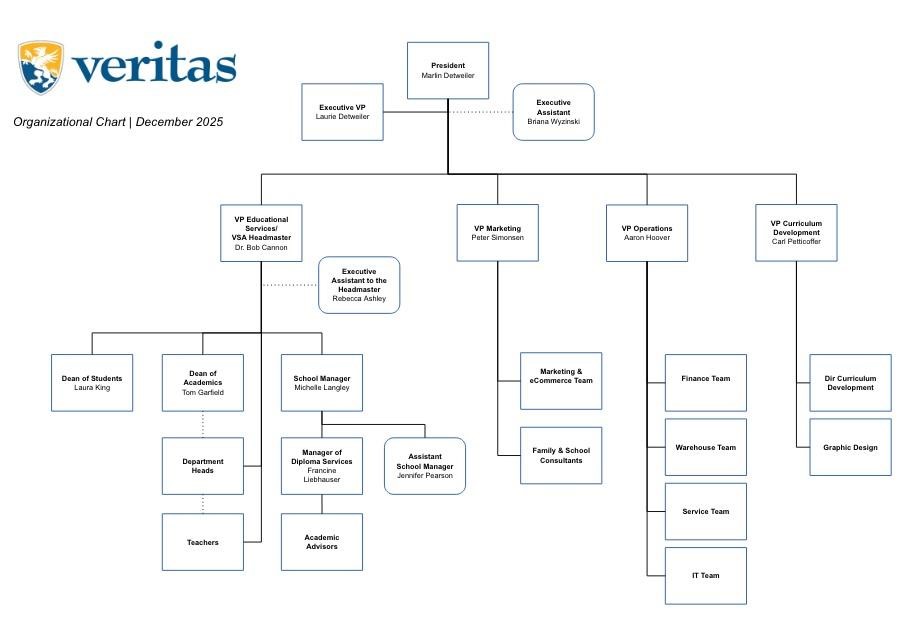
Veritas Press Organizational Chart
Affiliations and Accreditations
We are accredited by the Middle States Association of Colleges and Schools. We are a business member of the Association of Classical and Christian Schools (ACCS) and an approved curriculum for future NCAA athletes.
Options for Taking VSA Courses
Live Online Courses
Online live classes cap at 20 students per class plus up to two “Teacher Seats” for our teachers’ children and grandchildren. Our grammar school courses start in 3rd grade. In secondary school we have online classes for the courses required for graduation and many more of interest to our students.
Self-Paced (SP)
There is no class limit for self-paced courses. The student works through the material on the computer at his own pace. Courses are initiated when purchased and assigned to the student by the parent, and students are given one year from starting the course to complete the material.
Self-Paced Archive
A student taking a self-paced archive course will be enrolled in a separate section of the course. They will have access to archives, course assignment sheets, and assessments. Self-paced archive courses may be graded or ungraded. Students in an ungraded course will have no teacher contact; students in a graded course may have contact with a grader.
See the Full-Time Diploma Program section for more options.
Veritas Websites
- Welcome to VSA
A list of what you need to do next as you join VSA, plus access to frequently asked questions and useful blog posts. - Veritas Press website
Our catalog of curriculum offerings, where orders can be placed. Log in at veritaspress.com/vp-login to navigate to Live Online Courses (Schoology), Course Registration and Management, Self-Paced Courses and the Diploma (full-time) Program website. - Live Online Courses (Schoology)
Access to Live, Independent Study, and You Teach Diploma courses. - Course Registration and Management
Registering and paying for classes. - Self-Paced Courses
Log in to self-paced courses. - Online Classroom (Adobe Connect)
Where Live classes meet. Students enter the online classroom in Schoology. - Diploma Program website
Log in to the Diploma Program website.
For a full explanation of Schoology and Adobe Connect, refer to the VSA Technology Handbook. It can also be found in the VSA Parent Group in Schoology or on the Veritas website.
General VSA Information
Academic Year Calendar
The academic year calendar is available on the Veritas Press website and in the Parent Group in Schoology at veritaspress.com/academic-calendar. It is also included at the end of this handbook.
Terms and Conditions
The Terms and Conditions are available on the Veritas Press website and in the Parent Group in Schoology at veritaspress.com/terms-and-conditions.
VSA Pricing
See Appendix A of the Terms and Conditions for a full explanation of VSA pricing: VSA Pricing (Appendix A).
End of Year Gathering (EOYG)
The end of the Academic Year culminates with the End of Year Gathering. This event takes place in Lancaster, Pennsylvania, the week after the end of the Academic Year. Wednesday is the first day of fun, educational, and community-building activities for VSA families. Events are different every year. We hope you will join us, as we hear from families and students that the EOYG is a highlight of students’ VSA experience. It’s a place to meet—sometimes for the very first time—other students, parents, and VSA teachers. It’s truly an event like no other for the VSA student. Check the Academic Year calendar for dates.
VSA Systems
Best Practices for Students
There are practices that set teachers and students up for the best possible experience in the classroom. When even one aspect is ignored the experience is often compromised.
- Headset: Students should use a headset connected directly to the computer via USB. This eliminates background sounds and noises, recycled audio and computer-generated boost, which can make the sound come through as “metallic” for the students.
- Wired to router: All computers used in classrooms should be wired directly to the router. Connecting directly to the router ensures a consistent connection. Routers have several Ethernet ports on the back so multiple students can be wired simultaneously.
For a full list of system requirements, see the VSA Technology Handbook.
Etiquette and Behavior Standards
Below are guidelines for student behavior. Biblical behavior standards will be followed at all times. These biblical standards include, but are not limited to, the following:
- Speak in such a way as to lift others up (Ephesians 4:29).
- Respect and be obedient to authority figures (Titus 3:1).
- When someone offends you, seek reconciliation in a Biblical manner (Matthew 18).
- Do not gossip or speak poorly of others (Proverbs 16:28).
- Recognize the image of God in yourself and in others, and treat this image of God with dignity and respect. This includes accepting our bodies and our natural abilities as gifts from God, which are to be accepted and honored as gifts from God (Genesis 1:27; James 1:17).
- Be honest: do not lie, cheat, and do not claim another’s work as your own (Psalm 101:7).
In the online classroom:
- Talking (including instant messaging in any chat box or otherwise) will not be permitted except:
- when the teacher asks for a response.
- when it can be inferred that it is permitted by the Teacher and is on topic.
- Background noise or music is not permitted.
- Parents are not permitted to log in to a live course session.
- Use the “raise hand” option to request permission to speak in the classroom.
- Always use appropriate language.
- Ask questions via text chat.
- Avoid excessive use of emoticons. (Students tend to be distracted by them.)
- Avoid excessive internet slang.
- Please do not text chat with others during class.
Chat Box Guidelines
Veritas Scholars Academy uses an online classroom that includes a Chat Box. This is a box visible to the students and the teacher. The Chat Box enables all students and the teacher to send and read short comments/questions. It is managed by the teacher and may be removed or have its chat history cleared to start a new comments thread.
For students, it is a privilege and responsibility to use the Chat Box. Therefore, use it wisely and courteously. Students should use the Chat Box in a manner that reflects the etiquette and behavioral standards above, and that is worthy of their mission as young Christian scholars. As a community of young Christian scholars, VSA students should not only be interested in what we are learning academically. We are also interested in learning how to become a scholarly community which not only learns a biblical worldview but also learns how to build Christian community in our class behavior. We are pioneers not only in trying to be more faithful to God’s Word in academics, but also in using new technology to forge Christian bonds all around the world. One of our tasks is figuring out how best to use our time in class wisely and to treat each other with love and respect as we do so. The novel thing in our online classes is how to properly use the Chat Box in conjunction with the more traditional verbal communications through the microphones.
The guidelines below are not exhaustive, but should give you a good idea of the basic manner in which the Chat Box is to be used.
Do’s
- Use the Chat Box for constructive interactions between your classmates and your teacher. Follow the teacher’s instructions for the specific interaction desired for the lesson at hand.
- Your teacher may allow you to participate in a short time of casual conversation in the Chat Box at the beginning of a class session.
- Refrain from typing comments during prayer times and during teacher, guest, or student presentations, unless directed otherwise by your teacher.
- Be prepared to be called upon regularly to give comments/answers in the Chat Box, even if you are reluctant to contribute. Communicating well is a significant part of your development as a student, and as an individual.
- When you write a comment or answer, use as full and thorough a thought as possible and stick to the topic at hand.
- As with all communication, be kind, considerate and respectful towards others. Honor the Lord with your choice of words (Ephesians 4:29).
Don’ts
- Do not dominate use of the Chat Box (see #6 above).
- Please don’t initiate or encourage comments that are inappropriate or off topic.
- Please don’t use acronyms (e.g. ‘omg’) or emojis (see #5 above), even though it may take more time to write out your thoughts.
For a full explanation of VSA technology, refer to the VSA Technology Handbook found on the Veritas website.
Academic Policies and Procedures
Orientation and Start of Classes
Two weeks prior to the start of classes, course pages will be available in the Learning Management System (Schoology). It is the responsibility of the student to carefully review course pages and determine what is needed before the first day of each class. The teacher will post a Welcome Update that students should watch before the first day of class. The Course Assignment Sheet for the first quarter will be posted in the Course Documents folder. It is imperative that students look at the Course Assignment Sheet and read any messages posted by the teacher to be fully prepared for class. Students will most likely have homework due on the first day of class, so plan for your “first week of school” to actually be the week before classes start. The Technology Handbook is available in the VSA Parent Group, with a full overview of VSA systems.
The week prior to classes each class section will hold a 60-minute orientation to build community, cover course expectations, and become familiar with classroom technology. Attendance is not mandatory, but is strongly encouraged. An Orientation session will be held for each class section at the regular class time. Monday/Wednesday and Wednesday/Friday classes will meet on Wednesday, September 2, and Tuesday/Thursday classes will meet on Thursday, September 3. See the Academic Calendar for dates.
Note: Teachers will not review the same information on the first day of class that is covered during Orientation. Students are responsible for all information covered in Orientation.
Late Enrollments
Any student enrolling in a class after the class has met for two weeks will be considered a Late Enrollee. Students are expected to be fully prepared for the material being covered at the time of their admission into the course or shortly thereafter. Regardless of when a student enters the course, they are responsible for and will be tested on all material from the start of the school year. Late Enrollees will work with teachers to determine any necessary makeup work.
Classroom Discipline
As noted in our Statement of Faith, Veritas believes that while parents are primarily responsible for the discipline / discipling of their children in the Lord, our teachers also play an important role in helping parents educate and form their children. Please keep in mind that as corrections and consequences for behavior are considered and administered, it is the first priority of VSA to shepherd children’s hearts (Proverbs 4:23).
A teacher may restrict a student in any way the teacher deems advisable to minimize any adverse effect on others. If a student has been addressed by his teacher and continues to act inappropriately, a message will be sent to the student’s parents to explain the behavior and to express a teacher’s concern for the student and his peers. If the student continues to act inappropriately, a Disciplinary Action Form will be submitted. A copy will be sent to the parent for signature.
Academic Integrity
All students and parents will be asked to sign an Academic Integrity statement which will be submitted per class. As valued members of Veritas Scholars Academy, we recognize the importance of maintaining a God-honoring, healthy, productive learning environment as we strive to educate our students and “restore culture to Christ one young heart and mind at a time.” To strengthen our community in this endeavor, we ask students to:
- commit to upholding the highest standards of academic integrity in all aspects of education at Veritas Scholars Academy, including but not limited to in-class activities, discussion board posts, uploaded assignments, quizzes, tests, and exams. Students affirm that all work that the student claims as his own will be his own original work and that the student will credit those to whom credit is due.
- avow not to share or otherwise disclose personal login information in any format with others, regardless of the reason.
- understand that failure to maintain academic integrity is grounds for disciplinary action according to the Academic Dishonesty and Other Disciplinary Challenges policy.
- complete assessments and exams without interruption, within the designated time frame, in one continuous session unless expressly stated otherwise by the teacher.
We ask parents to:
- commit to holding student(s) accountable for academic integrity.
- affirm to proctor assignments, quizzes, tests, and exams as required by teachers and the Handbook.
Generative Artificial Intelligence (AI)
Generative AI (e.g., ChatGPT) should be considered a useful tool of productivity in a variety of circumstances, including academic settings. When leveraged properly, AI tools afford learners and educators opportunities to enhance the educational experience. AI should be treated as a supplemental tool in learning and not a replacement for constructing meaning by one’s own intelligence. The temptation to use it for the latter and not the former should also be evident.
Veritas Scholars Academy is resolutely committed to facilitating the development of critical thinking and analytical skills, and as such, expects its scholars to generate original ideas and work—written or otherwise—using their own mental faculties and capabilities. Submitting written work that has been produced by generative AI is not solely of one’s own intellectual efforts, and is therefore generally regarded as academic dishonesty.
If a student determines to somehow leverage generative AI in the preparation or proofing of his or her work, he or she should not allow AI to write or rewrite the content of an assignment, and should be wary of accepting edits or changes suggested by AI. Students are encouraged to be acutely aware of AI’s tendency to present seemingly accurate information, when in fact these references are often inaccurate, incomplete, biased, or unreliable. Furthermore, these technologies have quickly proven themselves to often stifle one’s own independent thinking and inhibit the development of original ideas.
Should a student choose to use an AI tool in the preparation or proofing of his or her work, he or she must indicate, by appropriately citing sources, that AI technology has been used. If AI is leveraged in the creation of an assignment, and citations are not provided, it will invariably be treated as plagiarism. Examples of in-text citations of AI-generated content may be found in Purdue University Libraries’ guide to citing AI.
Teachers hold an academic prerogative to determine whether or not AI is appropriate for a given assignment, and/or the amount to which AI may be leveraged in the construction of a work. Determining whether or not use of AI aligns with learning objectives lies explicitly with the teacher, and when necessary, in consultation with respective department heads, the dean of academics, the dean of students, and the headmaster. On this point, AI use on any learning assessment (quiz, test, or exam) is forbidden.
Finally, should AI be used in the development of an assignment, even with the permission of a teacher, it should, as a general practice, be reflected in no more than 15–20% of an entire work, and again, with proper citations. The overwhelming majority of a student’s work should, without exception, be generated through the student’s intelligence alone, without the use of an AI tool.
Academic Dishonesty and Other Disciplinary Challenges
There are various potential forms of disciplinary challenges in the classroom. While specific examples will not be given here, a general rule of thumb to follow is this: Any instance of a student causing a disruption to the educational environment—the learning that ought to be taking place for that student or others—is grounds for disciplinary action.
Cheating on any assignment is considered academic dishonesty. This includes plagiarism in any form, which may be simply defined as one using another’s work as though it were one’s own, and without proper attribution to the author. This also includes student use of solutions manuals or teacher CDs in instances in which curricular support materials have been provided to aid parents in the instruction of their children.
Cheating will be dealt with in the following manner:
- If a student is caught cheating, he will receive a zero on the assignment and will be placed on disciplinary probation for the remainder of the school year.
- Three instances of academic dishonesty in an academic year is grounds for expulsion.
- No refunds will be granted for students who are expelled due to cheating.
- A Disciplinary Action Form will be submitted by the student’s teacher for any instance of academic dishonesty.
Grading Scale
The following grading scale will apply for all assignments and final grades.
| Percentage | Grade |
|---|---|
| 90–100% | A |
| 80–89% | B |
| 70–79% | C |
| 0–69% | F |
All grades are rounded to the nearest whole number.
Late Work
If a student fails to submit any assessment by the due date, it is considered “late.”
- Assignments submitted 0–24 hours late will result in a 10-point reduction off earned grade.
- Assignments submitted 24–48 hours late will result in a 20-point reduction off earned grade.
- Assignments submitted 48–72 hours late will result in a 30-point reduction off earned grade.
- Assignments over 72 hours late will not be accepted and the student will receive a zero.
- Parents may request an extension from their child’s teacher prior to the due date or in the case of an emergency.
- Late hours do not include Sundays.
VSA staff loves grace and the opportunity to exercise it, but also desires to instill a sound sense of responsibility in students, hence these expectations pertaining to late work.
Exam and Test Retakes
Any student may retake a failed assessment (except quizzes), but can score no higher than 70% on the retake. This policy also applies to formal labs in applicable courses. Secondary math, modern foreign language, and Physics classes are limited to one retake per semester; other subjects allow for more, as the objective is to afford students additional opportunities to learn material. There are no retakes allowed on secondary math, modern foreign language, and Physics midterm and final exams.
Retakes must be submitted within one week of the returned, failed assessment. If the retake is not submitted within one week, the original failing grade will stand. Assessments given a failing grade due to academic dishonesty are ineligible for a retake. Assessments given a failing grade due to failure to submit within three days of the due date are ineligible for a retake.
Attendance and Participation
Attendance, while not graded, will be recorded by teachers, as students are required to attend scheduled classes. Students will be formally graded for participation. Students are expected to view archives of any missed classes before a subsequent class, as they are responsible for learning the material discussed, and for obtaining any notes or assignments. Each Archive Viewing Report is worth five (5) points; missing reports are deducted from one’s quarterly Participation grade.
Students will receive quarterly grades for Participation. A percentage of the final grade will be attributed to relevant class participation, which typically includes raising their hands, commenting regularly via microphone/webcam, and using the chat box to contribute to the academic conversation. A grading rubric, which contains the percentage attributed to Relevant Class Participation for this course, is located on the course page.
Grammar Courses: Relevant Class Participation Grade (100 Possible Points)
- Rubric for students attending Live classes.
- Students are not penalized if an Archive Viewing Report is submitted.
| Points | Description |
|---|---|
| 100 | Actively, voluntarily, and consistently takes part in class activities through polls, chat box, and on the microphone. Contributes thoughtful responses and comments. |
| 95 | Actively and voluntarily participates in class activities through polls, chat box, and on the microphone. |
| 90 | Regularly and voluntarily participates in class activities through polls, chat box, and on the microphone. |
| 85 | Periodically and voluntarily participates in class activities through polls, chat box, and/or on the microphone. |
| 80 | Actively and voluntarily participates in polls, chat box, and/or on the microphone in varying degrees from class to class. |
| 75 | Is attentive, but voluntary participation in class activities is minimal. Responds when called upon. |
| 70 | Participates occasionally in class activities through either polls, chat box, or on the microphone. |
| 50 | Voluntary participation of any kind is minimal unless called upon. |
| 25 | Rarely participates in class activities. Does not readily respond when called upon. |
| 0 | Never participates in any class activities. |
Five-point deduction for each missing Archive Viewing Report.
Directions for Archive Viewing Reports: Write three sentences explaining a topic discussed during class (not things done, such as a quiz). Are you engaging with the material? What are you learning?
Secondary Courses: Relevant Class Participation Grade (100 Possible Points)
- Rubric for students attending Live classes.
- Students are not penalized if an Archive Viewing Report is submitted for missed classes.
| Points | Description |
|---|---|
| 100 | Consistently demonstrates engagement during class and meets teacher’s expectations for positive participation (use of webcam, microphone, chat box, and/or raised hands, etc.). Contributions to discussion and other means of learning are of the highest quality. |
| 90 | Demonstrates engagement during class frequently (webcam, microphone, chat box, and/or raised hands, etc.). Contributions to discussion are typically productive and of a high quality. |
| 80 | Indicators of engagement (webcam, microphone, chat box, and/or raised hands, etc.) are present, but are inconsistent/lacking in accordance with the teacher’s expectations for entirely meaningful participation. |
| 70 | Demonstrates inadequate engagement in class, rarely meeting teacher’s expectations for meaningful participation. Comments are lacking in the measure of quality the teacher expects from a student. |
| 0 | Simply does not engage in the learning dynamic, and thereby fails to meet teacher’s expectations for constructive participation. |
Five-point deduction for each missing Archive Viewing Report.
Directions for Archive Viewing Reports: Write three sentences explaining a topic discussed during class (not things done, such as a quiz). Are you engaging with the material? What are you learning?
Extension Request Form and Archive Viewing Report
Students are strongly encouraged to be present for all live, online classes. Today’s technologies make it feasible to attend classes from practically anywhere in the world, and it is our expectation that students will make every reasonable effort to be present for class. Attendance in our classes significantly correlates with academic success. When students do not attend class, the learning dynamic is affected for all students in that course. VSA advocates emphatically for the impact of social learning environments.
The Extension Request Form (located in the course material folder) should be filled out by a parent when a student is requesting an extension on a due date for an assignment or learning assessment (tests, exams, etc.). Submission of this form is a request, not an approval. Extensions are not permitted on midterm and final exams. VSA Administration has given each teacher authority to make extension request decisions for all other assignments/assessments. No request is approved until the teacher notifies the student of approval. Every class has its own dynamic, so while decisions from class to class will often be consistent, this will not always be the case. Again, teachers have respective decision-making authority.
Requests for extensions must be submitted at least 24 hours in advance of the due date of the assignment/learning assessment. Requests for extensions submitted on or after the due date of an assignment or learning assessment will typically not be accepted, as these late requests have an impact on VSA teachers’ planning and expectations. VSA policy permits a one-week extension (from original due date) for any approved extension request.
When class(es) is missed, Archive Viewing Reports are a factor in students’ Relevant Class Participation grades. For each class missed, students are expected to view archives of any missed classes before a subsequent class, as they are responsible for learning the material discussed, and for obtaining any notes or assignments. For each archive viewed, secondary students should complete the Archive Viewing Report and write three sentences explaining a topic discussed during class (not activities completed, such as a quiz) as a measure of accountability. For grammar students, the Archive Viewing Report serves as a parent confirmation that the archived class was viewed. Although the report is accessed through the student’s account, it must be completed by the student’s parent or guardian. Submitting the Archive Viewing Report for missed classes contributes to a student’s Relevant Class Participation grade. Quarterly Relevant Class Participation grades will be determined based upon students’ participation when present in class, as well as successful submission of Archive Viewing Reports. Each Archive Viewing Report is worth five (5) points; missing reports are deducted from one’s quarterly Participation grade. Archive Viewing Reports are only accepted in the quarter of the absence because they are attached to quarterly Relevant Class Participation grades.
For students who will regularly miss class due to schedule conflicts or time zone restrictions, Relevant Class Participation grades will be based on Archive Viewing Reports. Each Archive Viewing Report is worth 5 points; missing reports are deducted from, and noted on, the quarterly Participation grade.
Educational Accommodations
All requests for student accommodations must come through Administration. If a child has a learning disability or other documented medical need that impacts his education, VSA would like to be as supportive as possible and provide the parent with reasonable accommodations. If the student has particular needs, the parent must complete the Educational Accommodation Request Form so that administration might consider how to best support the parent, and the child’s learning.
If indeed it is determined that special accommodations are warranted, a fee of $50 per course will be assessed in an effort to recuperate a portion of the costs VSA administrative and teaching staff incur in the process. The minimum charge for any accommodations is $150 per student. The form can be found in the VSA Parent Group in Schoology or on the Veritas Press website.
Homework Philosophy and Guidelines
Fulfilling the goals of a classical education does not necessitate assigning several hours of homework each night, nor is this practice desirable. Teachers should have a specific purpose in mind when homework is assigned. In the online environment that meets only twice per week there are expectations for reading and work to be done outside of class, but within a reasonable time for each course. Please refer to the online course listing for anticipated homework hours.
Extra Credit
Consistent with classical pedagogy, VSA does not permit extra credit in any of its courses.
Written Assignment Standards
- Written document uploads will be submitted in Microsoft Word (.doc or .docx) or Adobe .pdf format. Submissions in Apple Pages will not be accepted.
- Acceptable formats may vary by course and teacher. An exception to this is when a teacher requests or allows hand-written work.
- The body of uploaded written assignments shall be double-spaced, 12-point font.
Course Assignment Sheet
Each course will have a quarterly Course Assignment Sheet that will be shared among all sections of the course. Students should always refer to the Course Assignment Sheet for homework and assessment due dates.
Prior to the first day of class, students are expected to review the Course Assignment Sheet for each course to ensure they are prepared for the first day of class.
“Save Your Grade” Day
While it is an expectation that teachers will continually monitor student grades and have regular contact with students and parents when problems are noticed, one day each quarter will be designated as “Save Your Grade” Day. It will normally fall two to three weeks before the end of the quarter. The purpose of the Day is to notify parents of any student in danger of receiving an F at the quarter’s end.
Quarterly Grading and Comments
VSA has dynamic grading; the grade displayed is the current grade and parents can print a report of student progress at any time. Teachers will provide scheduled comments on student progress four times per year at the quarter points. An official Report Card can be printed at the end of the academic year and the end of Summer B term which covers both Summer A and Summer B terms. Report Cards will not be emailed to parents of part-time students. Full-time Diploma students will receive a report card at the end of each academic year.
The dates can be found in the VSA Calendar and on the Veritas Press website.
Teachers are expected to grade and return all assignments to students within 48 hours, except for papers roughly 500 words in length (one page, single-spaced, or two pages, double-spaced) or longer. Papers roughly 500 words in length or longer must be graded and returned within seven days of the due date.
Upper level math and science courses, such as Physics and Calculus, may require additional time than the usual 48 hours to grade, depending on the assignment. At no time should an assignment be graded more than seven days following the due date.
Full-Time Diploma Program
Additional Options for Taking VSA Courses
The following options are available to full-time students only.
Independent Study Courses (IS)
Independent Study courses are available when a student needs to meet specific graduation requirements and cannot take the class during normal course parameters. These classes are also considered for students in different time zones and/or with other schedule constraints. Independent Studies are requested by Academic Advisors and approved by the Headmaster.
A student taking an Independent Study agrees to complete all coursework on the Course Assignment Sheet within the quarter assigned and understands all work not submitted during the quarter scheduled is subject to late penalties. All work must be completed by May 31. The teacher will grade work, answer questions, and provide feedback.
An Independent Study Agreement Form must be signed before the course begins. See the Information Sheet found in Diploma Resources in Schoology for more information.
You Teach Diploma Courses (YTD)
In a You Teach Diploma course a parent teaches the student at home. Courses must use VSA-approved curriculum and lesson plans (Grammar only). Students are encouraged to use all the teaching support materials available with the curriculum, such as DVDs and Teacher’s Manuals. A parent may choose to hire someone, for example a tutor or co-op, to assist in the teaching of the course. However, the responsibility of the course lies entirely with the parent.
You Teach Diploma courses are in the Learning Management System (Schoology). Grades are recorded in the VSA grade book and included in the yearly GPA on the transcript. A You Teach Diploma Agreement Form must be signed before the course begins. See the Information Sheet found in Diploma Resources in Schoology for more information.
- Grammar You Teach Diploma courses have a quarterly review of representative work. The representative work includes worksheets, tests and quizzes from the curriculum. Courses completed satisfactorily will be shown on the yearly report card with a grade of Pass or Fail.
- Secondary You Teach Diploma courses are completed principally under the supervision of a parent. The course must be completed during the regular school year (September to May). Requirements for YTD courses are the same as requirements for Live courses. Quizzes and exams will be taken online and assignments submitted online. Courses are not marked as Honors courses on student transcripts. All courses use the approved VSA curriculum.
External Courses
Students may take a course at an approved institution for elective credit. External courses will have a grade listed on the VSA transcript, but will not be factored into the student’s GPA. No more than three academic electives may be studied with an external institution. Neither core nor elective courses that VSA offers may be taken as an External Course.
All external courses must be submitted for approval by the Headmaster. External courses need to meet the following requirements:
- from an accredited educational institution
- high school or collegiate
- official transcript documenting course
All external courses are to be completed by May 31 and will be listed in the academic year in which they were attended. See the Information Sheet found in Diploma Resources in Schoology for more information.
Honors Courses
Many Secondary (grades 9 through 12) courses are given the Honors designation.
Participating in Honors courses further substantiates VSA students’ academic ability. Because Honors classes are more difficult than non-Honors classes, the grades earned in honors courses are on a five-point scale. The honors scale is: A = 5 points, B = 4 points, and C = 3 points.
| Subject | Honors Courses |
|---|---|
| English | Composition II, Creative Writing, Fairy Tales, Fiction Writing Workshop, Novels of Jane Austen, Poetry, Shakespearean Literature, Science Fiction: A Christian Perspective |
| History* | World Ancient History I & II; World Medieval History I & II; U.S., British & Modern History I & II; U.S. History; Western Civilizations |
| Language | French I–IV, German I–III, Greek I–II, Hebrew, Latin II, Latin Readings, Mandarin Chinese I–II, Spanish I–IV |
| Literature* | World Ancient Literature I & II; World Medieval Literature I & II; U.S., British & Modern Literature I & II |
| Math** | Algebra II, Business Math, Calculus I, Calculus II, Pre-Calculus, Statistics, Problem Solving: Mathematical Reasoning |
| Religion* | Doctrine & Theology I, II, III, IV, V, VI |
| Rhetoric | Logic II, Rhetoric I, Rhetoric II, Senior Thesis |
| Science | Anatomy and Physiology, Biology, Chemistry, Introduction to Biotechnology, Marine Biology, Organic Chemistry, Physics I, Physics II, Physics Calculus-Based |
| Electives | Apologetics, Art History, Art Studio II, Biblical Archaeology, Biblical Literacy Survey of the Bible, Computer Programming C++, Computer Programming Python, Economics, Film and Worldview, Psychology, U.S. Government, World Religions |
* When both Primary and Secondary Omnibus courses are taken in the same year, 3 credits in History, Literature, and Theology are shown on the transcript. Omnibus I, II, III, IV, V or VI may be taken in grades 9 through 12.
** The Saxon and Math-U-See curricula are not designated as Honors courses.
Dual Enrollment
In a Dual Enrollment course, VSA students are enrolled simultaneously in a Live course and a Cairn University course. After successful completion of the course, the student will receive credit from both VSA and Cairn University. There are no additional outside academic requirements for students to receive dual enrollment credit. VSA curriculum and instructor pedagogy and credentials have been evaluated and approved by Cairn University administration. Dual Enrollment fees apply.
Current Dual Enrollment courses are:
- Anatomy and Physiology
- Calculus I & II
- Economics
- Fairy Tales
- Fiction Writing
- Film & Worldview
- French III & IV
- Greek I & II
- German III
- Introduction to Biotechnology
- Latin Readings
- Marine Biology
- Novels of Jane Austen
- Omnibus IV
- Omnibus V
- Omnibus VI
- Organic Chemistry
- Physics II
- Physics Calculus-Based
- Poetry
- Problem Solving: Mathematical Reasoning
- Psychology
- Rhetoric II
- Science Fiction: A Christian Perspective
- Senior Thesis
- Shakespearean Literature
- Spanish III
- Statistics
- US Government
Students who complete the course with a grade of 70% or above will receive an official transcript from Cairn University documenting college course credit. Students must submit dual enrollment forms by June 10 for summer courses and by November 15 for full-year courses. More information is available on the Dual Enrollment webpage.
Advanced Placement Courses (AP)
VSA’s AP courses are Latin Readings-Virgil, Calculus I, Calculus II, and Psychology. The VSA transcript designates these as AP courses. Additionally, students can take any of the AP tests and AP test scores will be recorded on the transcript. AP tests are not offered at VSA. Students can also have their scores sent to selected colleges. Students should check with the colleges to which they are applying to determine how the AP test might benefit them. See the Information Sheet found in Diploma Resources in Schoology for more information.
Full-Time Diploma Course Registration
When registering for courses online, take advantage of pinning courses. Pinning courses is like “pinning” them to a board to get an idea of what the student’s schedule would look like. Pinning courses allows a parent to choose all of the student’s courses and then register them all at once so the registrations do not “time out.” Pinned courses are NOT registered courses, nor do they save the student a seat in the class.
Academic Advisors register Premium Diploma students for all their courses. Parents of Classic Diploma students will register for Live and Self-Paced courses on their own. Independent Study, You Teach, or External courses will be registered by the Advisor for both Premium and Classic students. Confirmation of registration will be provided to the parent following the consultation. For an External course, the advisor will complete the form on behalf of the parent, adding details about the course, including a syllabus from the teaching organization.
Book Orders
Advisors for Premium families will send a book quote. If the family does not want to purchase the items right away, the quote will be put on hold for 30 days. Prices are subject to change after the 30 days.
Classic families are responsible for purchasing books for their children’s courses, and may contact Service for support if needed.
Full-Time Diploma Admissions and Enrollment
Admissions
Students are accepted on an ongoing basis. Annual consultations for an upcoming school year begin in December.
New families
- Prospective parent schedules a free consult with a Family Consultant. To schedule, complete the consultation request form. This may include asking for placement tests and/or additional documentation to determine placement at Veritas.
- The Family Consultant responds within 24 hours to schedule a meeting.
- Parent meets with a Family Consultant who listens to the academic history of the students and what the parent’s goals are for their future. From there, the Family Consultant discusses how to accomplish the goals. Additional documents, including placement tests and/or additional documentation, may be requested.
- Family Consultant reviews placement test results and documentation. Decision is made on grade placement, and for secondary students, transfer of course credits.
- Parent reviews Terms and Conditions, which include the Parent/Student Handbook and Appendix A VSA Pricing. The parent completes the Terms and Conditions Agreement Form.
- Parent pays the Diploma Enrollment fee.
- Family Consultant confirms completion of the Terms and Conditions Agreement Form, completes enrollment, and schedules consultation for the student and parents with an Academic Advisor.
- Academic Advisor schedules consultation with the family to complete the registration process, including registering students for classes. This may include additional documentation or placement testing.
Returning families
- Parent reviews Terms and Conditions, which include the Parent/Student Handbook and Appendix A VSA Pricing. The parent completes the Terms and Conditions Agreement Form.
- Parent pays the Diploma re-enrollment fee.
- Academic Advisor schedules consultation with the family to complete the registration process, including registering students for classes.
Enrollment
Students pay an annual fee for the upcoming school year. Each student is assigned an Academic Advisor to guide them. The enrollment period is from December through November of the following year.
Consultation Scheduling and Course Registration Timeline
November
Enrollment opens.
Schedule consultation and pay annual Diploma fee.
December
Course Listing viewable.
Consultations begin.
Course registration begins for Premium students.
January
Course registration continues for Premium students.
February
Course registration begins for Classic students.
March–October
Registration remains open.
Existing full-time students must pay the annual Diploma fee no later than January 31 for the upcoming academic year to have access to early registration. Students who do not pay by this date will not have access to early registration and potentially forfeit otherwise available seats in their desired courses and sections. Existing full-time students ultimately have until August 31 to pay the annual Diploma fee, after which reapplication to VSA’s full-time program is required.
Annual Consultation
During consultations, the Academic Advisor assists parents in the development of their student’s Course Plan. A Course Plan is the list of courses for the upcoming academic year that meets VSA requirements and parents’ academic goals for the student. The Course Plan also lays out future courses looking towards graduation.
Standardized Testing
All full-time Diploma students are required to take the standardized tests on an annual basis in grades 3–10. Testing in grade 10 is optional if another standardized test has been or will be completed within the school year. Dates are specified on the school calendar.
Standardized test results are an indicator of a child’s academic progress. These results are considered in tandem with report cards, teachers’ assessments of their students, and parental observations. Standardized testing is also considered an external evaluation of a school’s performance and assessment of its own instructional effectiveness.
State Requirements
Diploma students are enrolled in an accredited private school. State requirements vary, so parents should be aware of the specific requirements of their respective states. If a state does not recognize VSA as a private school, the family will need to register as a homeschool with its home state. Students registered as homeschoolers submit their report cards as documentation to their respective states, where required. Although VSA is an accredited school, the burden of each student complying with their state’s homeschool laws rests on each particular family.
Transcript Grade Information
Only Full-Time Diploma Students receive transcripts.
| % | Grade | Grade Point (Not Honors) | Grade Point (Honors) | Meaning |
|---|---|---|---|---|
| 90–100 | A | 4.0 | 5.0 | Excellent |
| 80–89 | B | 3.0 | 4.0 | Above average |
| 70–79 | C | 2.0 | 3.0 | Satisfactory |
| 0–69 | F | 0.0 | 0.0 | Unsatisfactory, no credit given |
| — | P | — | — | Satisfactory; met requirements of the course |
Courses dropped by students within the first four weeks will not be recorded on a student’s transcript. Beyond the first four weeks of school, withdrawn courses will be recorded as either “Withdrawn/Passing” or “Withdrawn/Failing” on the transcript. No partial academic credit will be given to withdrawn courses.
Course Distinctions on Transcripts
- H: Honors
- DE: Dual Enrollment
- AP: Advanced Placement
- T: Transfer
Grade Point Average (GPA) Calculation for Transcripts
- Grade points are weighted and then multiplied by the number of credit(s) for that course.
- The total grade point sum is divided by the total attempted credits to calculate GPA.
Note: External course grades are not included in GPA calculation.
Omnibus Calculation for Transcript
| Course Taken | Grade |
|---|---|
| Primary and Secondary courses, same Omnibus level, taken in the same calendar year. | A grade is calculated using the following algorithm: (Grade earned in the Primary course × .6) + (Grade earned in the Secondary course × .4). The number received is the grade used for the History, Literature, and Theology courses shown on the transcript. Both courses must be 70% or above to receive a passing grade for all three credits. |
| Either Primary or Secondary course in the same calendar year. | One Literature credit. |
Omnibus courses will be reflected on the transcript as follows when both Primary and Secondary courses are taken within twelve months:
| Omnibus | History | Religion | Literature |
|---|---|---|---|
| Omnibus I | World Ancient History I | Doctrine & Theology I | World Ancient Literature I |
| Omnibus II | World Medieval History I | Doctrine & Theology II | World Medieval Literature I |
| Omnibus III | U.S., British & Modern History I | Doctrine & Theology III | U.S., British & Modern Literature I |
| Omnibus IV | World Ancient History II | Doctrine & Theology IV | World Ancient Literature II |
| Omnibus V | World Medieval History II | Doctrine & Theology V | World Medieval Literature II |
| Omnibus VI | U.S., British & Modern History II | Doctrine & Theology VI | U.S., British & Modern Literature II |
Amendments
VSA reserves the right to make practical changes to the Parent/Student Handbook throughout the year, and any such changes will be notated in this section of the Handbook.
- June 18, 2026: Retake Policy changed to include modern foreign languages. “Secondary math, modern foreign language, and Physics classes are limited to one retake per semester; other subjects allow for more, as the objective is to afford students additional opportunities to learn material. There are no retakes allowed on secondary math, modern foreign language, and Physics midterm and final exams.”
- September 1, 2026: Update for Grammar Archive Viewing Reports. “For grammar students, the Archive Viewing Report serves as a parent confirmation that the archived class was viewed. Although the report is accessed through the student’s account, it must be completed by the student’s parent or guardian.”
Appendix A: 2026–2027 Academic Year Calendar
The calendar is also available on its own page at veritaspress.com/academic-calendar.
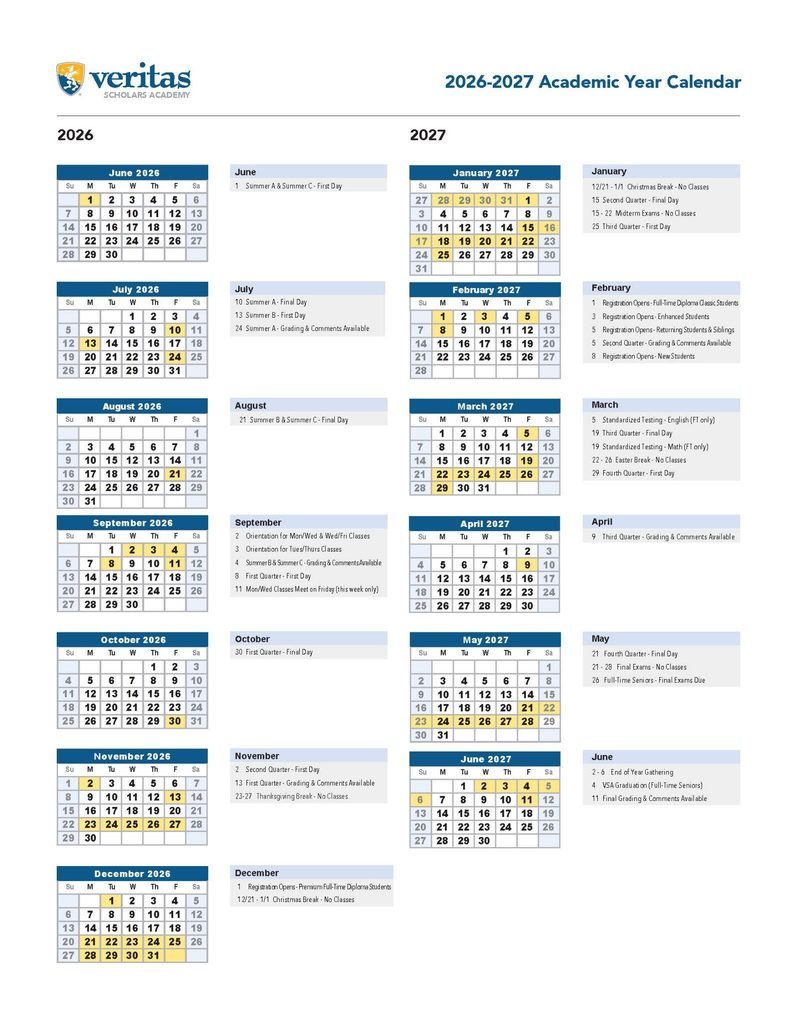
View all key dates as text
| Date | Event |
|---|---|
| June 1, 2026 | Summer A & Summer C: First Day |
| July 10 | Summer A: Final Day |
| July 13 | Summer B: First Day |
| July 24 | Summer A: Grading & Comments Available |
| August 21 | Summer B & Summer C: Final Day |
| September 2 | Orientation for Mon/Wed & Wed/Fri Classes |
| September 3 | Orientation for Tues/Thurs Classes |
| September 4 | Summer B & Summer C: Grading & Comments Available |
| September 8 | First Quarter: First Day |
| September 11 | Mon/Wed Classes Meet on Friday (this week only) |
| October 30 | First Quarter: Final Day |
| November 2 | Second Quarter: First Day |
| November 13 | First Quarter: Grading & Comments Available |
| November 23–27 | Thanksgiving Break: No Classes |
| December 1 | Registration Opens: Premium Full-Time Diploma Students |
| December 21 – January 1 | Christmas Break: No Classes |
| January 15, 2027 | Second Quarter: Final Day |
| January 15–22 | Midterm Exams: No Classes |
| January 25 | Third Quarter: First Day |
| February 1 | Registration Opens: Full-Time Diploma Classic Students |
| February 3 | Registration Opens: Enhanced Students |
| February 5 | Registration Opens: Returning Students & Siblings |
| February 5 | Second Quarter: Grading & Comments Available |
| February 8 | Registration Opens: New Students |
| March 5 | Standardized Testing: English (FT only) |
| March 19 | Third Quarter: Final Day |
| March 19 | Standardized Testing: Math (FT only) |
| March 22–26 | Easter Break: No Classes |
| March 29 | Fourth Quarter: First Day |
| April 9 | Third Quarter: Grading & Comments Available |
| May 21 | Fourth Quarter: Final Day |
| May 21–28 | Final Exams: No Classes |
| May 26 | Full-Time Seniors: Final Exams Due |
| June 2–6 | End of Year Gathering |
| June 4 | VSA Graduation (Full-Time Seniors) |
| June 11 | Final Grading & Comments Available |
Keep the Handbook Handy
Download the full 2026–2027 Parent & Student Handbook to read offline, print, or share with your student.