

Christ College - A New Classical College in Florida | Todd Bates | Veritas Vox
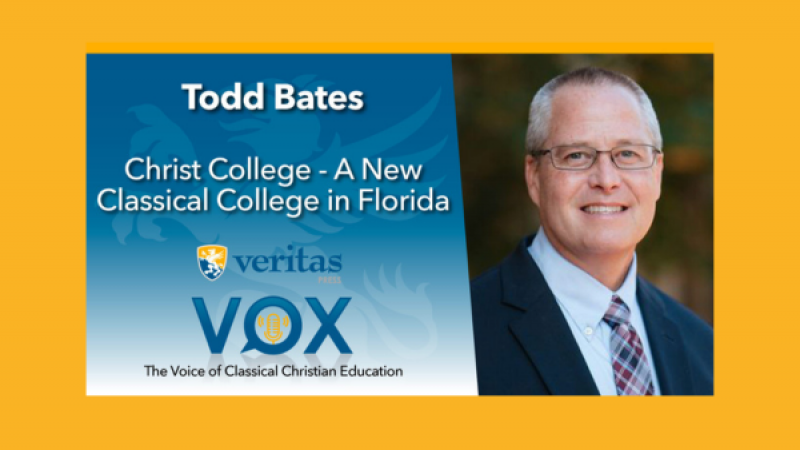
Inspired by the Great Books, Dr. Todd Bates has embarked on a journey to create a classical Christian college with the mission to raise a generation of adults who are well-grounded in classical thought, rhetoric, and entrepreneurship. Christ College in Satellite Beach, FL, just wrapped up its first academic year and will be beginning its second in the ‘26-’27 school season.
If the idea of marrying deep philosophical thoughts with practical life skills sounds appealing to you, you won’t want to miss a moment of the conversation as we explore this new school!
Episode Transcription
Note: This transcription may vary from the words used in the original episode.
Marlin Detweiler:
Hello again and welcome to another episode of Veritas Vox, the voice of classical Christian education. Today we have with us Todd Bates, who is the president of Christ College in Melbourne, Florida. I think it's in Melbourne. Is that correct? I know there are a few little smaller towns there.
Todd Bates:
Yes, that's the big town. Satellite Beach is where we're located.
Marlin Detweiler:
Yeah. Very good. Well, Todd, welcome.
Todd Bates:
Thank you. It's good to be here. Thank you.
Marlin Detweiler:
Good to have you here. Before we get started with what you're doing at Christ's College. Give us a little bit of your background, your family, your education, your career. And don't leave out your college football!
Todd Bates:
Oh, right. Yes. Well, I was born in South Alabama, but we moved to Orlando, Florida very early on. But while we were in Orlando, I was able to meet Bear Bryant, and so only was I born in Alabama, but I met Bear Bryant, which is Alabama royalty. So I have been a diehard Alabama fan my whole life. But in Orlando grew up, I loved athletics, was nominally Christian because we were Southerners, and that's just what Southerners do.
And so I grew up in a very culturally Christian home. And football became really what I centered on, and it's a hard thing. So my goal was to play wide receiver for Dallas Cowboys. I was just like Alabama. Born a Dallas Cowboy fan, I have no idea how, but Drew Pearson was my hero, so I wanted.
Marlin Detweiler:
What was your first coach recollection? Tom Landry.
Todd Bates:
Yeah, yeah, with a hat. Yes. Tony Dorsett, Drew Pearson, all the heyday of the Dallas Cowboys. And so obviously, the dream of playing wide receiver for the Dallas Cowboys didn't work out. But that's all right. But what it did is it allowed me to see in my deep love of football, what things of the earth that serve as our focus point, how when they're taken away, we really are disoriented.
And so we need an eternal reference point. And God used that time in my life to really help me understand that. And for the first time, I was able to see myself in the light of God's holiness. And that radically transformed me. And so my love shifted almost overnight. And I wanted to know the God who loved me. And that has shaped everything I do.
Marlin Detweiler:
What age were you at this point?
Todd Bates:
19, late 19 so I was in my junior year, so, yeah. 19 and 26. Right. During that period, it was a Spurgeon s kind of conversion. So it took a little time and was miserable. But when I saw the cross and what God had done for me, and I could not get there quickly enough, and so that has shaped everything else.
Love football to this day; through the Fellowship of Christian Athletes, actually met my wife. And so we were married in 1991.
Marlin Detweiler:
In high school or college?
Todd Bates:
That was in college. So she went to another local Christian school and was able to connect through FCA. And I was captivated from day one.
Marlin Detweiler:
Did you all ever make it to Black Mountain in the summer?
Todd Bates:
We she did. Yeah. She was regular; usually we had other things going on with football and the like. But yeah, we've been married almost 30, over 35 years, just celebrated our 35th anniversary.
Marlin Detweiler:
Grown children?
Todd Bates:
We do. We have our oldest daughter, which is in Key West. She's 31 and our youngest is 29. And he – excuse me, 27 and he is in San Diego, California, working on his PhD in microbiology.
Marlin Detweiler:
Oh, wow.
Todd Bates:
And then our middle son is 29, and he is a football coach and a faithful dad in Central Texas, the belt in Texas.
Marlin Detweiler:
So you've got the southern perimeter of the United States covered. I was going to say when you just said San Diego and Key West, you have the ends of the earth covered, but Texas doesn't quite qualify for that.
Todd Bates:
Well, we have it a beeline from one student, one child to the other.
Marlin Detweiler:
Yeah. Very good. Well, Christ's College was something that I just discovered this year. How long has it been around?
Todd Bates:
Yeah. So the reason everybody's discovering it now is because we just started. So fall of 2025 was our first year. So we just completed our first academic year and about to start our second academic year.
Marlin Detweiler:
Very good. Why did it start?
Todd Bates:
Yeah. Great question. So I have spent almost 30 years in higher education. So my deep love of God and wanting to know the God who loves me led me into academics. And so I fell in love with the life of the mind. And that led me into higher education. So for 30 years, I plugged away teaching philosophical theology and great books.
But there was always something missing. And so when we were first putting the curriculum for Great Books curriculum together, Great Books College, I thought this would be ideal if we could build not just an honors program, but a whole college around the Great Books. That's what I want to do. And this just still small voice in the back of my mind said, well, why don't you start it?
And I was a junior prof with young kids and got scared to death at that idea, and so put it off and put it off and put it off. But finally my wife and I reached a place in life where it was just time. I'd become a little frustrated with the integration of faith and learning so many Christian universities, and they do so many things well.
But one of my frustrations is that if all things are made by God through Christ for God, then everything we study refers back to him. And so why aren't we studying economics in light of God's creation? Why aren't we studying psychology in light of God's goodness and how he has made humans to be? Literature telling the story of humanity?
So why don't we have that deep integration? And so that's what Christ College was founded for.
Marlin Detweiler:
Very good. Let's focus for a moment on the great books. As people that are listening, almost certainly know. Veritas has been a champion of studying the great books our Omnibus curriculum was a huge investment in presenting means for studying the great books and tools for doing so. What is it that you think Christians get from the great books at a collegiate level that can be traced back to your commitment to start Christ College?
Todd Bates:
Yeah. Again, very good question, very detailed. The sense of the classics is going back to creation. So if indeed God created all things for his glory and reveals himself in all things, then there is no human that writes a truly human story that does not reflect the truth of God in some form or fashion. So I was working through my PhD program and read Nietzsche, and Nietzsche is one of those guys Christians love to hate.
And I'm reading through Wills of Power, and I run across this footnote, and it was such a glaring truth. He sets up this contrast between either truth is real, and if it's going to be real, it has to have a superhuman mind to tell us all, or we create truth. And then his conclusion was, well, of course we create truth, right? But it was.
Marlin Detweiler:
You start with presuppositions sometimes that you don't you can't possibly walk away from.
Todd Bates:
But the very fact that he recognized we needed a superhuman mind to have truth was one of those light bulb moments where I thought, man, Agustin is more right than I ever thought he was. All is God's truth. And so as you read through great works of literature, reading through Billy Budd right now, and so finding the truth of God and these great works of literature just confirms what Scripture tells us and what we should anticipate.
And teaching students to see the glory of God in the world around them opens up their eyes in a way that life becomes worshipful. So they see God everywhere. And it's a beautiful thing.
Marlin Detweiler:
Yeah. Very good. How do you approach the Great Books at Christ College?
Todd Bates:
The right and very similar way that I mentioned. So we have what are called foundational seminars, and they're year-long seminars that teach the students to understand God, to understand creation, to understand human nature, and then human nature and communities. So that's where we get into government, politics, and economics.
Marlin Detweiler:
What about story?
Todd Bates:
From that? Yeah. So all through our composition classes begin with this emphasis on understanding the bigger picture of things. In the biggest picture, again, is scripture. That's the narrative, the overarching arc of human history, where how we began, where we are, and where we're headed. And so inside of that story, we learn to fit all other stories.
And indeed, one of the things we want to help our students see is how their story fits into that story. Because one of the things that I've seen over the 30 years is that Christian students come to us with many of the right answers, but they don't always understand why they're the right answers. So we have to spend time teaching them, okay, this is the right answer, but do you know why?
But then the second thing they understand the Christian story, but are not always clear how their life fits into that story. And man, again, it just ignites them when they find their life is meaningful in the grand scheme of eternity.
Marlin Detweiler:
So Christ College at this point has finished its first year, coming up on its second. Obviously, student population is going to be on the small side, but what is it that you hope to be able to provide in a few years with regard to focused areas of study, majors, as we call them in college?
Todd Bates:
Right. Yeah. So our fundamental commitment is to the humanities. We want our students to understand what it means to be a creature and to worship the creator, to worship God. Then we also want them to see why that matters in life. And so humanities will always be the major. We are in the fall of 2027. Right now we have a B.A. in Humanities and Entrepreneurship.
So we are very big on work, understanding our life in terms of our vocation, our calling. But then also by that calling, we want our students to understand that it's not simply an entrepreneur that honors God, but also it's a classical school teacher. So in the fall of 2027, we're going to develop three different concentrations. So one B.A. in Humanities with a concentration in entrepreneurship and classical education, and then Christian Studies, because we have a lot of our pastors who have pastors and training that they would love to see trained in the classics, so that they have that context of understanding the development of theology.
Marlin Detweiler:
Very good. How are you connecting? Obviously, by virtue of where we met. You're very committed to connecting to the classical Christian education movement in the K-12 world. How do you see yourself working with them? The obvious, of course, is to seek students from them. But I'm looking for more depth than that, I'm sure you've thought through.
Todd Bates:
Right? Yeah. So we would love to have our students. We find our classical education students are well prepared. They have a lot of the nuts and bolts. And so a good way to understand it is the K-12 education gives you all the Legos, teaches you what colors they are, what sizes they are. But it is in the college years where they learn to do something with them, to build something significant with them.
And so the K through 12 is a beautiful preparation, particularly if they have read the great books. But I often get asked, well, how is it different in college? Well, one, you're sitting with professional scholars. And so we have 80%–90% of our professors who have earned PhDs. And so they are genuinely committed to the life of the mind.
And you begin to see that because you're sitting in a room with 4 or 5, six students, we cap our classes at 15. So we are small intentionally, but as they interact with these ideas, they're meeting with others who may or may not agree with them, and so they're having to think through their ideas in ways that are easily challenged.
So we love the classical schools. What we do is reach out to them. We will visit and speak in chapels. We will attend college fairs. We are deeply committed to continuing the great education they get through this classical K through 12 education. And that's part of the reason we started Christ College.
Marlin Detweiler:
Interesting. Yeah.
Todd Bates:
So many of my students come in from the classical schools and some other Christian universities and tend to be bored because when you study Latin, when you study Greek, when you have this knowledge, you've read the great books. Textbooks just don't do it. These brief thin versions, and they just get bored.
Marlin Detweiler:
How do you find the homeschool student fairs in your world?
Todd Bates:
Very good. Yeah, they are very, very bright and well-read. Due dates sometimes get to them. They have to. They have to learn.
Marlin Detweiler:
That's funny because I can relate to it.
Todd Bates:
Yeah, indeed. Well, we do try to help them become adults from day one. So when we send them out with a Christ College degree, we want them to be not simply qualified intellectually, but we want them to be characters that can be counted on. People with character show up on time; they show up ready to do the task. And so we find our homeschool students love to work.
That is one of the beautiful things about it. They love to work. We help them understand how to do it at a high level. And so we love our homeschool students. I would say probably half of our students are homeschooled. Half of them are trained classical K through 12.
Marlin Detweiler:
I would expect that not all of the well are all the students that you're getting coming out of classical education environments in the K-12 space at this point?
Todd Bates:
And most of them are. Yes, because that's our direct constituency. Obviously, when we're starting, we took the shotgun approach. We talked to just any Christian school, and there are definitely different flavors of Christian schools. And we have just found our niche is with those who understand classical education. Now, I would encourage any student to pursue this kind of education, even if they don't have the background.
This factor of being small helps us commit – small and relational. Help us to commit to our students that as long as you are workingm, we will work with you. We will put our shoulders right by you. We will make sure you grow and you learn and you excel. Now, excellence for some students may be a C, but that's all right because this is a challenging education.
Marlin Detweiler:
You're a few years away from this, but what do you think it looks like for a student that's gotten an undergraduate degree at Christ College?
Todd Bates:
We have a lot of young men who come in here and they're not real sure of the idea of work, not sure of the idea of what they want to do. And so what success looks like 20 years down the road is a generation of young men who understand that work isn't just an unfortunate necessity in life, but something God has made us to do, and that as we are working to his glory, it becomes a worshipful experience.
And so when God puts us in the Garden of Eden, he describes the work we’re to do in the Hebrew term “avodah”, which is the same term of the priest's work in the temple. And so one of my favorite Old Testament scholar says there's no gap between work and worship. And so for us, helping our students understand that gives deep meaning to their life and to work.
And I think after a generation of that, we're going to see significant differences in the homes that they have and the children they raise, the impact in the culture and the community. And so that's the goal. And then helping our young ladies understand the same thing, that there is a deep and rich opportunity here, both to shape their husbands with this knowledge, to shape their children, but also shape their neighbors.
And so we really do emphasize that entrepreneurship is a great preparation for anybody. So some of our young ladies just want to be a homeschool mom. And they're not sure. Well, I don't want to be an entrepreneur. I don't want to start a business. And I just ask them to read Proverbs 31.
Marlin Detweiler:
Yes, a great response. That's great. One of the things that I have theorized I watched in the 90s, Drexel University was kind of a leader in this. There were other schools that quickly followed suit. There was a strong emphasis, and it remains. It's kind of come into the main and it's not talked about as much. But there was a strong emphasis on entrepreneurship, even as a degree and as a pursuit.
And I find myself questioning whether or not entrepreneurship isn't first and foremost caught more than it's taught. How do you address that in an academic institution?
Todd Bates:
Yeah, I love that question because it is one of the clearest ways we see the beauty of the humanities in entrepreneurship tied together, and particularly the classical. So we have built a network over the years here. So I was here a year in advance with business owners, those who are entrepreneurs. So we bring them in, and one of our partners is a well-seasoned, I'll say, well-seasoned businessman in the area.
Marlin Detweiler:
I know what that means. I can say it because I'm different than you. That's old.
Todd Bates:
Yes. Well he can get a little crotchety too, because he has been there, done that. And he looked over at me. He said, you know, I'm not sure entrepreneurship could be taught. And I thought, you know, that's great. Because if you understand entrepreneurship in terms of an equation, you do this and you do this and that equals this outcomes an entrepreneur. And it does not work that way.
But I asked him what the key difference is in an entrepreneur and a non-entrepreneur. And he thought for a moment. And he said the ability to see and I went you know that is brilliant. Because what we try to emphasize is what Aristotle calls an his ethics phronesis or practical wisdom. Prudence is the Latin. But the idea is for Aristotle is the ability to see in the circumstances what I most need to see in order to respond according to the goodness that is within me.
So I need to see the good and recognize it in order to respond in the good. So that idea of seeing is a skill that Aristotle believes can be taught through ethics. And it is over time you learn to develop the sense of seeing what you most need to see.
Marlin Detweiler:
Is it seeing? Do you mean by that seeing what can be?
Todd Bates:
Yes. So perceiving what is in order to guide how I respond to what it is and to shape the context. So we take that idea and they're getting it all through the humanities. And then when they get to the entrepreneurship, the same skill applies. We just teach them what they need to be looking for. So what do you need to see in the culture, in the society?
And then how do you understand the problems in order to build a business that meets the needs of your neighbor? So it is really love God and love neighbor all throughout, but it's that ability to see that we really do emphasize.
Marlin Detweiler:
Yeah. Very good. If you can, it would be very hard for me to have done this 1 or 2 years into the Veritas Press experiment, but I'm going to ask you anyway, what does success look like for you looking back 20 years from now?
Todd Bates:
Yeah, yeah, that's very good. I think if I retire, whenever I do, I tell people I'm not going to retire, I'm just going to relocate. I'm going to move from being the president to an adjunct professor. But if I'm out and about and I meet somebody who does a quality of work with a spirit of servanthood in pursuit of excellence to the glory of God and inquire, and he says, yes, I graduated from Christ College. That would be just thrilling to me to see this in practice through the lives of those that I've had the privilege of impacting.
Marlin Detweiler:
What a great answer. Thank you. You've read a couple of books? Yes. Tell us. There are two books. I didn't write the titles down in my notes, so you'll have to help me with those. Let's take one at a time. What was the first book you wrote?
Todd Bates:|
Well, I've co-written several. I worked with a clinical psychologist who was very interested in the deep integration we talked about. So every diagnosis of illness, whether it's mental or physical, presupposes what health looks like.
And so what we wanted to do is put together a series of texts and essays of what that looks like from a Christian vantage point. So it's rooted in Scripture. And so I was privileged to work with this young scholar. That was fantastic. But to write the philosophical, theological part of it. So that was the first series.
Marlin Detweiler:
What was that series called?
Todd Bates:
Yeah, that's a good question. The book itself that came out of that is, and I'm not real pleased with the title, but Rutledge decided to do this. It's Christian Psychotherapy in Context.
Marlin Detweiler:
Okay.
Todd Bates:
And it's by Rutledge.
Marlin Detweiler:
Quite academic, and probably it didn't help its appeal in a broad sense, but I understand the topic right.
Todd Bates:
Well, it did fairly well as a textbook because it was focused on the class. So the young psychotherapist actually took, I call him young. You understand that as a well-seasoned person.
Marlin Detweiler:
Nobody has ever called me well-seasoned before.
Todd Bates:
Well, it’s a good thing. But then the second book, my most recent book that came out, was also by Rutledge, but it was in a series called New Horizons in Leadership, and it was focusing on the humanities and why the leader needs to pay attention to each discipline within the humanities. And so I wrote one, the text on rhetoric, classical rhetoric and the modern leader, the contemporary leader. So why they need to pay attention to classical rhetoric.
Marlin Detweiler:
Rhetoric and the modern leader? With just the couple of minutes, we have less left. Unpack that, because it strikes me that that is a very practical answer to the question, what is rhetoric and why do we need it? Because in classical education, we think of rhetoric as a very important subject discipline that we teach to high school students.
Todd Bates:
Right. So the easiest way to approach is Quintilian's definition of rhetoric is the good man speaking. Well. And so that covers a lot of the waterfront, because the good person sees in the topic, sees in what they want to say, those things that are good and most important, and then they know how to frame it in a way that communicates that and then can actually communicate that in a way that resonates, that is heard, and then people can respond to.
So Socrates is one of my favorite teachers of rhetoric. He doesn't get a lot of attention, but he understood the whole task of rhetoric as philosophy. Learning to live well is what the good rhetorician does. And then he is able to actually use psychological terms in terms of therapy. And so as the wise person is speaking, they have both worked through their own souls and are helping others work through theirs. So it's a really fascinating connection.
Marlin Detweiler:
Very good. What kind of feedback have you gotten from that book?
Todd Bates:
Pretty well. It's still fairly new.
Marlin Detweiler:
Is it? When did it come out?
Todd Bates:
Yeah, 2025 is when it came out. Yeah. It's not a good idea to start a college, write a book, and then get licensed by the state with your college all at the same time. So the due dates literally were the same.
Marlin Detweiler:
I resemble committing to things that would otherwise have been considered being a glutton for punishment in my life. And so I'm sorry that you did that, but congratulations as well.
Todd Bates:
Thank you. And I survived. I keep my hair short for a reason, so I would pull it out otherwise. Yeah. So there's a real quick one last book that is coming out probably a year from now, but under contract to write a book on a Theology of the Humanities. And so much of the humanities is just studied as a separate discipline.
But the deeper you get into theology and particularly doctrines like the Trinity or the simplicity of God, the oneness really begins to come out. And so the beauty of the classical education is that it is whole. It sees truth as one comprehensive thing that cannot be dissected. So the interdisciplinary aspect of the classical education is just what I love.
Marlin Detweiler:
Yeah, I look forward to seeing that. That sounds great, when you expect it to come out?
Todd Bates:
Technically, the due date is next March.
Marlin Detweiler:
It'll be March of 2027.
Todd Bates:
So I will probably say 20. Look for it in 2027, probably by the time the publisher gets finished with it.
Marlin Detweiler:
Very good, very good. Todd, I thank you so much for the work that you're doing. I thank you for telling us about it, and I hope that this brief exposure on our podcast will be attractive to many students that might give Christ's College a good look.
Todd Bates:
We would love to talk with them further about it, and I appreciate the opportunity. I've enjoyed it.
Marlin Detweiler:
Thank you. And folks, thank you for joining us on this. Another episode of Veritas Vox, the voice of Classical Christian Education. We hope to see you next time.
Have questions? Talk to an expert for free!
Our Family Consultants are here to help! Fill out the form below to schedule a quick call for free.