

Trail Life: Raising Boys to Be Men | Mark Hancock | Veritas Vox
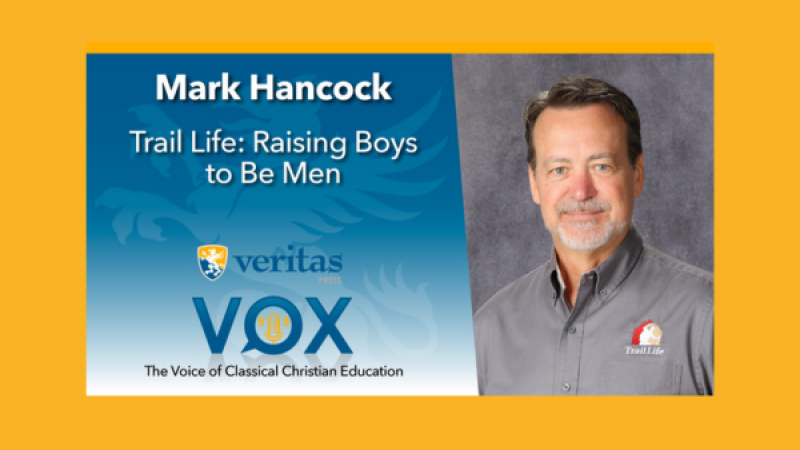
Today’s boys are finding themselves overwhelmingly unguided, ungrounded, unappreciated, and uninspired. With schools, universities, and even Scouting America (formerly Boy Scouts) becoming more feminine in approach and leadership, young men lack the spaces and mentors to learn what healthy masculinity looks like.
Trail Life USA was founded to help change that. By giving boys a place to be challenged, take healthy risks, and grow into godly men, the organization is helping fill this critical gap. Today, we discuss the unique psychology and needs of boys with Trail Life CEO Mark Hancock.
Episode Transcription
Note: This transcription may vary from the words used in the original episode.
Marlin Detweiler:
Hello again and welcome to another episode of Veritas Vox, the voice of classical Christian education. Today we have with us the CEO of Trail Life, Mark Hancock. Mark, welcome.
Mark Hancock:
It's great to be with you today. Thanks for having me on.
Marlin Detweiler:
Before you tell us about Trail Life, tell me. Tell us about yourself, your family, your education, your career, so that we have a little bit of context for the work that you do.
Mark Hancock:
Yeah, I love that. It's my favorite subject talking about me. So I love starting with that.
Marlin Detweiler:
Have you heard the statement, “So enough about what I think about me. What do you think about me?”
Mark Hancock:
That should be the second question. Yeah. Married to my wife, Michelle. Coming up on 38 years. And we have two sons raised, Luke and Logan. They're both classically educated, raised classically, went to Liberty University on full-ride scholarships. So this stuff works; parents, we're going to be okay.
Marlin Detweiler:
For no other reason than to make college cheaper!
Mark Hancock:
It works. And my older son, actually, he graduated with a degree in philosophy at Liberty, and he went to work teaching at a classical academy. And really interesting story, Marlin. And this is testament to the classical education that we're all so familiar with. The position was to teach literature, high school literature. And when he showed up, because of his classical education and the way that it really prepares you, he's a polymath in the pure sense of a classically educated young man. So he shows up and he is teaching high school literature, high school chemistry, and high school algebra.
Marlin Detweiler:
That's a breadth of disciplines.
Mark Hancock:
And another thing, he was the first teacher that they had at that academy in Atlanta that was classically educated. And so he was sort of a rock star because he was able to talk to the other teachers because so many of those folks in that area, you know, they're coming out of more of a traditional education.
Marlin Detweiler:
That's what it's been. That's what it was when we got started 30 years ago. And of course the tides are changing. We're now dealing with second and even, at least in schools, third gens.
Mark Hancock:
I'm so glad to hear that. And so yeah, so he was the first one. So during breaks, the teachers would ask him, so how does this work? Because, you know, it's hard to break some of those habits. So you're by what did you say personal, career, and...
Marlin Detweiler:
Education.
Mark Hancock:
I graduated from Mercer University and years later went back and got a couple of master's degrees in mental health counseling and marriage and family therapy. One of the degrees was through a Christian program and then the other was through the secular program. Got my master's degree from University of Central Florida and but immediately out of college after my undergraduate, I opened an advertising agency. Like I said, I was 22 years old and opened an advertising agency.
Marlin Detweiler:
Wow. What town was that in?
Mark Hancock:
I opened it in South Florida, but almost immediately moved to Central Florida and built it over 15 years to a large agency. We had offices in Florida and in Atlanta, traveling around the country. We had clients all over the country, and I was just this young kid. I look at myself at 22 years old. I said, what was I thinking?
You know? But really, God really blessed it. But I was not a believer. But through the process of that and other things I encountered in my life, I had one of those radical conversions to Christ. About eight years into the ad business, and I started shutting it down because I was like, I can no longer do this business.
And the travel and everything was just a lot. It took me seven years to close it. But then I moved into ministry. Been a pastor, youth pastor, college and career pastor. Traveled around the world for about five years, putting together international crusades. In other countries, we would have 100 to 200,000 people in our meetings.
Marlin Detweiler:
Unbelievable.
Mark Hancock:
I served Doctor T.L. Osborn, who we're not really familiar with in the United States, but he has stood before more people seeing more salvations than any man in the history of the world. He went to the world. He was kind of contemporaries with Billy Graham and Oral Roberts and all those guys. And they were like, okay, we got the United States covered. You go to the world.
And he didn't believe in television, didn't believe that it could be an effective use of the gospel. He believed in books. And so we would go to countries and we would give away tens of thousands of books to pastors. I remember in Ghana, Africa, we had 6,000 pastors. And that meeting, each of them got ten of his books.
He liked giving books. In fact, he was in ministry for a long time. So like for 50 years he traveled around the world doing this. That's why he racked up all those numbers. And I took him on his last tour of the world. He wanted to go around the world one more time, and we would have men come up to me in these meetings for these books that he had given them 50 years ago that were, you know, written in all the pages, folded and say, you know, Doctor Osborn gave me this 50 years ago.
And so that was an incredible experience, influential in my faith and also getting a sense of what the world is like. And Christian, you know, we have an American gospel, as you know, and then we have the real thing, and we see variations on that real thing all over the world.
Marlin Detweiler:
It's amazing. And this is one of the beauties of our online school at Veritas. Because there are so many international students, we get to strip away, in some instances, the cultural layer that is buried- the essence, not the essence, but has disguised elements of the gospel.
Mark Hancock:
Well, I can tell you that we brought that international experience into our home in the way that you're talking about it, where on Saturday mornings when my sons were young, we would have what we called I-Hops, International House of Pancakes, because at the local college where I was teaching, I was also a secular and a Christian college professor, and they had a real good international program.
And so we would invite these international students to our home, usually young men. And it's a crazy statistic. You know, an international student can be in the States for more than just a college degree. And then they continue in their education because they just don't want to go home. And so they utilize that visa for that.
So they can be in the States for years. But something like fewer than 4%, less than 4% of international students are ever in the home of an American during that time.
Marlin Detweiler:
So you changed that with the people you knew.
Mark Hancock:
So around the core group was Ghana, Kazakhstan, Saint Lucia, Great Britain, and Congo, these young people from all over the world that we would, and I would make pancakes for them. Some of them had never had a pancake. And sitting there with them and my two sons every Saturday morning, and we would have a topic, which would be, how do you do birthdays where you're from? Or how does the schooling work where you are? And it was just fascinating conversations.
All of them became believers. And so that was a powerful thing because I was encouraged. Parents, as much as you can expose your kids to those sorts of things. We had a corner in our house. It was called our Little Corner of the World. And on the wall, we just had international pictures of young people from all over the world.
And we had the great, the great Commission posted up there. And our sons understood that we're citizens of the world, we're citizens of the kingdom, but we're ambassadors to the entire world. And so that was a neat part of their upbringing and their understanding.
Marlin Detweiler:
That's really cool. How did your career and its various involvements, college professor, advertising executive, lead you to become the CEO of Trail Life?
Mark Hancock:
That's a great question. Well, for those aren't familiar with Trail Life, let me just grab what is because that'll make my answer will make sense in that trail. Philosophy is a Christ centered, boy focused character, leadership, and venture organization. We utilize troops in churches across the country about 1,500.
Marlin Detweiler:
Is it a Christian version of what we've come to know as the Boy Scouts?
Mark Hancock:
That's the easiest definition. And those are our roots. In 2013, when it was clear that the Boy Scouts were beginning to abandon some of the more traditional family values, about 300 volunteers got together around the country and said, what are we going to do about that? And out of that launch Trail Life USA now we have over 70,000 members, 1500 churches, all 50 states.
And my I was in a Boy Scout troop with my sons and I was never a member. A funny story they asked me, would you like to be in leadership in the troop? I said, I don't think I'm called to leadership in this kind of thing. So but when the Boy Scouts made their decision, that troop and that church said, we can't go along with this.
And the church was shutting down the troop, and I somehow got caught up in this. And this thing started as the 50 of us gathered in Louisville, Kentucky, in June of 2013. We didn't know each other, but we gathered in this room for two days and there were four different factions. Started putting something like it was going to be a Trail Life together, and they all kind of laid down their own thing and said, let's do one thing.
Walk down that meeting with nine men on the steering committee. Somehow I ended up on that. 68 days later, we held a convention in Nashville, Tennessee, had 1,100 men come from 44 states, and we launched Trail Life 68 days later.
Marlin Detweiler:
So this is only 13 years ago.
Mark Hancock:
Yeah, yeah. And we did that. And I did the convention because we're nine men who didn't know each other sitting there. We were tasked by this group of 50 that left and said, you need to take this energy because a lot of energy around this in 2013 when Boy Scouts was making this decision. Sure. And there were a lot of folks who really felt abandoned by that process.
Marlin Detweiler:
And but this Trail Life is a distinctively Christian, substantially, if not entirely Protestant movement to replace in some sense, Boy Scouts with something that honors God and respects our citizenship on earth.
Mark Hancock:
Yeah, absolutely. When people ask me, I had actually had a homeschool mom come up to us at a booth at a homeschool convention, said, all right, I have a Boy Scout troop that meets five minutes away, and I have a Trail Life troop that meets 45 minutes away. Tell me why I should go to Trail Life.
Marlin Detweiler:
Oh, what a great challenge. I'm sure you ate that one up.
Mark Hancock:
Yeah. And I said, well, you know, you homeschool your kids, right?
Isn't there a yellow bus that drives past your house? So it'd be really just easy just to put them on there. But you're already doing the hard thing because you know the difference. We're Christ centered and we're more focused. And so a lot of people say, well, it looks the same. Robust awards program, camping, hiking, handbooks, uniforms, patrols, all that stuff, outdoor adventure, outdoor skills development.
We have values badges that Boy Scouts just can't offer. And so it looks like that. But these two distinct differences don't really make us competitors because if they're important to you, you don't have a choice. You know, if it's important to you that it's Christ-centered. You know, we're not just kind of this outdoor organization having a Christian experience.
We are, at our core, a Christian ministry that uses the outdoors to turn boys into godly men. And the second thing, we're boy-focused, and this is Boy Scouts lost their way around this too. We believe that boys and girls are different.
Marlin Detweiler:
Go figure.
Mark Hancock:
And there's something like 60. My good friend, Doctor Kathy Cook. And if you've had Doctor Cook on before and also Jeff. Jeff Myers from Summit Ministries; they wrote a book.
Marlin Detweiler:
Kathy, I'm not sure I know.
Mark Hancock:
Yeah. Is amazing. You need to have her on your program. They wrote a book together on gender, and they did some studies, I think 6,500 biological differences between boys and girls. And we just know that intuitively. Anybody who has, you know, at least one of each model in their house knows that boys and girls are different.
And so we respect that. We're uniquely male centered organization that's above a certain age. Only men have contact with those boys. Boy Scouts over time has become a very female organization. And now since 2018, they admit girls. And so I believe it's only a matter of time before they become primarily a girls organization. They changed the name and everything.
Marlin Detweiler:
It's not called Boy Scouts?
Mark Hancock:
No, it's called Scouting America. They changed their name to allow this, and they changed the name twice. But they've landed on Scouting America, and it's just really tragic. Marlon. You know, they're at their peak. It's 7 million members now. They're under a million. They celebrated a growth in membership last year. But what they didn't communicate was that all the growth was in girls. So they've been just hemorrhaging boys.
Marlin Detweiler:
Completely.
Mark Hancock:
Yeah. So they replaced they just had more girls join than they had boys leave. Yeah. So they were able to grow. The organization was tragic. Tragic.
Marlin Detweiler:
You might find this a unique experience. When the Boy Scouts were at their heyday, call it the 1960s, I was not permitted by my parents to join the Boy Scouts. Because I was raised a Mennonite. And while I was allowed to do a lot of things that were not traditionally permitted by more conservative in terms of life practice Mennonite families, Mennonite kids, that was the one place where the church and state idea of confusion that was important to the Mennonite community.
Marlin Detweiler:
It was important to keep that apart and to live a life that was wholly other. The Mennonite community would not generally have gotten involved in politics. I may have told this story before on this, but my father decided he should vote for the first time in his life in 1968, voted for Richard Nixon, and everybody knows what happened to him.
Marlin Detweiler:
And maybe it was 72. I forget which time it was. But in any event, with what happened, Nixon, he said, well, I voted once. It wasn't a really good idea. I'm not doing it again. But I was not permitted to.
Mark Hancock:
I could ruin it for you.
Marlin Detweiler:
Yeah. Because of what they perceived to be a confusion of church and state from a very different perspective than the common vernacular and common conversation. And I wouldn't do that with my own children, but it was the experience that I had. But tell us more about what Trail Life's mission and programs are.
Mark Hancock:
Yeah, well, our mission is to guide generations of courageous young men to honor God, lead with integrity, serve others, and experience outdoor adventure. And we, like I said, we're organized through churches. We don't just meet in their basement. We're not just using the building. We're an outreach of that local church. Okay, so the pastor is aware of the program.
Many times. He's active in the program, and he appoints a troop ministry liaison who makes sure that troop stays connected to the church, and the church stays connected to the troop and churches who do this right. And they're seeing growth in their church.
Marlin Detweiler:
Boys will bring boys.
Mark Hancock:
Exactly.
Marlin Detweiler:
They're not part of the church that then draws families in.
Mark Hancock:
Yeah, it happens all the time. You know, that unchurched boy will join the troop, and then the unchurched family joins the church because they're going to that church, you know, on a Tuesday evening or whatever. And they're meeting the folks who are in the trooper part, and they'll say, hey, on Sunday, Sunday morning. Why don't you come? You got invited, boy, for forever to go to Sunday school.
And he may or may not go, but you're invited to go hiking or camping or rock climbing or water rafting or ziplining or something like that. He's all in, and the parents are going to bring him, and they're going to meet some people, and they're going to engage in that community. I can't tell you how many times we've heard the story that we had a man who said, I'll help you and your troop, but don't invite me to church.
And he was so burned by his church experience. And it's not uncommon. He was so hurt and so injured by his church experience growing up. He says, I want my son to have this experience and I'll come help, but don't invite me to church. And he spent time with those men in the outdoors and hiking and camping.
You know, guys don't connect very well face to face, like over a cup of coffee. We do it side by side, turning a wrench or hiking a trail or doing something together, sitting around a fire. The boys bed down and you sit around a fire and guys get real. And so he encountered that environment, and he met a group of men that were actually who they said they were, which wasn't in his experience in the church. And Marlin, his wife said, you know, I think I'd like to go to that church.
Marlin Detweiler:
And now you've got a dilemma. Do you follow his wife's lead and ask him, or do you just let it happen? Yeah.
Mark Hancock:
Well, she was far from being a believer, and she also had her issues, too. Well, both of them. The church fell in love with it. And guess what his title is now? He's a pastor and he pastors a church down the street from the church.
Marlin Detweiler:
Oh that's incredible.
Mark Hancock:
And they I don't know if it's a plant or whatever, but they are still a real close association with the church. So things like that happen all the time.
Marlin Detweiler:
I think God's favorite challenge is when we say I will never.
Mark Hancock:
Yeah, yeah, like what I said in that I'm never going to be a leader in this troop. But I started to explain that journey. I started out on the steering committee around the table. They were like, okay, they charged us with having this conference. Anybody ever done a conference? And I'm like, yeah, you know, in Ghana or Tokyo or Paris or Buenos Aires, you know, I coast, Central America, South America, I could probably do one here. And so I took that on. And of course that got me engaged in it.
Marlin Detweiler:
And what a crazy resource you were, so unanticipated by the group.
Mark Hancock:
Oh, the whole thing's been anticipated. Unanticipated because I was the least likely to be the person because I didn't. All these guys are former executive Scouters steeped in scouting, Eagle Scouts, all that. I've got none of that. And so it's kind of interesting. So they went from that, and I was going to step off after the conference.
See. Okay, you guys, you got this go. But 90 days later we're going to do our formal like start signing members. And I hung on for that. And then eventually that steering committee became the board of directors. And I was vice chair of the board. And eventually I stepped off the board to run the organization as CEO.
And I know you guys need to find a CEO, somebody who's climbed a lot of mountains, who wears backpacks all the time, who knows this stuff back and forth, but instead, Marlin, this is God's preventive. He gave me as my executive team, a 20 year former council president. And listen to this. The former general counsel, the lead attorney for Boy Scouts of America, he wrote their new policy under duress.
A man of faith wrote their policy under duress and said, this is going to gut the organization. Don't do this. And they fired him and we hired him. So for 11 years, he was their internal in-house attorney. And so God provided that level of awareness, but brought me in from the outside, you know, the order of Melchizedek or something.
I don't know how he brought me in from the outside with these men incredible, credible knowledge. But it also gave a perspective that they didn't have. And I think the God used that to make it all happen.
Marlin Detweiler:
The program you've described a bit and the mission you've described a bit. Talk to me about outcomes. As you look at men who were boys in the program, what is that you hope to produce in them?
Mark Hancock:
Yeah, well, I don't know when this airs, but this Sunday I'll be in Valley Forge speaking to 800 trail men who are gathered there for the 250th celebration. And I'll be sharing some of those stories of boys who have come in, talk about Sons of Liberty, the Sons of Legacy, and the young men that we're churning out in Trail Life USA are just incredible young men. And our highest award is called the Freedom Award.
Marlin Detweiler:
Is that the Eagle Scout equivalent?
Mark Hancock:
I would say it's equivalent in that it's the highest award in both organizations. But I also tell you this, my son received his Eagle Scout from Boy Scouts before we left. And then he transferred over to Trail Life. And they're allowed to convert some of those badges because camping is the same. You know, some of those outdoor skills are the same.
But he had to complete the rest of the program, the values portion of it, that's very different from boy scouts. And it took them a year and a half to convert a Boy Scout Eagle, into a Freedom Award, where it's much more difficult. One of the things you have to do. They have to write an essay, a life ambition essay.
And in there they'll talk about the impact that Trail Life has had on them and what it is they're going to do with their lives. And as I read every single one of them, and because I want to see the product, what it is, what comes out at the end of this thing..
Marlin Detweiler:
I know exactly what you mean. Leading an organization has a lot of parallels. I know exactly what you're talking about. Getting to know the product in human form is really valuable.
Mark Hancock:
Yeah. And that's why I do on airplanes is I read Freedom Ambition essays and it's just beautiful. So I'll be talking about a couple of young men this weekend. One was Ricky, 15 years old. Ricky became part of a Corps of Discovery adventure that we did in the Missouri Breaks along the Missouri River, through Montana.
And we traced the path of Lewis and Clark. And there were 15 boys came from all different states, brought them together. They signed up for it. And then, of course, there were the men I kind of went along because I wanted to. But here's Ricky, who was selected to be the first officer over the boys.
He's 15 years old. The 16 year old boys, they're 17 year old boys, 18-year-old boys in there who are Freedom Ranger and they've gone beyond him in the program, advanced than him. But he was the leader. And to see that happen, when you think about the pressure of being a 15 year old and you're telling a 17 year old Freedom Rangeman, a guy who's done more than you, you know, you tell him what to do, or you're giving instruction on that and the challenges that we encounter, of course, the heat and the exhaustion and being away from home and paddling all day.
We did 110 miles of paddling. And camp, setting up camp every night somewhere along some places with a monument saying this is where Lewis and Clark camped. And what an amazing experience. And to see the young man embrace that leadership through the skills and the opportunity to soar. I'm taking Ricky in 2027 to repeat that trip with all adults, taking adult men.
By then Ricky will be 18 and he's going to lead that adventure because I want these men, a lot of them are coming from outside Trail Life. I've to have this experience. And they will be led by an 18 year old because I want them to see what it is we're turning out. And then Avi, a young man in California during the California fires, he acted with just pure adrenaline, but also focused attention to help save his house and keep his family safe, working with his dad, you know, to keep his family home from being burned to the ground.
So we're churning out men like that, just exceptional young men. Marlon, I know you're, you know, the cultural challenges that we face, particularly for men and boys.
Marlin Detweiler:
Well, the whole aspect of this has been going on a long time and Christians have fallen for it. But the way that I say it, the way that I've heard it said and adopted it myself, is that in schools, the best behaved boy is a girl. We expect boys to act like girls and we don’t really understand the nature and character of young men today. We have a fairly effeminate society in that regard.
Mark Hancock:
Well, the schools are designed for girls. And back in the 70s, when girls were behind in the STEM subjects, we changed the way that we teach things. And schools were built for girls. Sit still, be quiet. Pay attention. Which boys are just not wired to do so. That's why they're twice as likely to be in special education, three times more likely to have ADHD.
They've fallen behind girls in every single academic category. Now there's no more women going to college than men. It's just there's more young men living at home. And since we started counting these things.
Marlin Detweiler:
Are these things that Trail Life addresses and really speaks to very clearly?
Mark Hancock:
Straight on.
Marlin Detweiler:
Yeah. Good for you.
Mark Hancock:
We worked with research from Barna in developing what we call our proven process. We identify four challenges that boys are dealing with. They're unguided. 76% of public school teachers are female. 87% of Sunday school teachers are female. 1 in 4 boys now doesn’t have a father. More boys have smartphones than dads, and so they're lacking this male influence.
Now, the girl in that household of that single mom she's seeing what a strong leader, a strong woman looks like as a leader, as a single mom who's leading a family. I mean, that's Herculean task, then that girl's going to school and there's a woman at the front of the classroom, then she's going to Sunday school, and there's a woman at the front of the classroom encountering these mentors, these leaders, these guys.
Boys are lacking these kind of things. So we guide them with these good, strong, character based men. You can't just go online and join Trail Life, there’s an approval process, and you give references, the pastor proves you. He knows your character. So that's the kind of men we put in front of them to guide them.
The boys are largely unguided. They're also grounded in the Word of God. The ground is so shifting in our boys feet today. Now you and I can reach back and remember a time.
When marriage was. I understand what that is. Boys who have been raised since 2013 or so, they have no idea.
Marlin Detweiler:
It doesn’t take long for cultural norms to be forgotten and to shift completely to something else. We need organizations like yours that call us to biblical values and a biblical understanding of male and female.
Mark Hancock:
And that's crucial, particularly with boys, because boys like to know the rules they want to know who's in charge? Who's with me? What is our mission? And in a culture where the rules are changing constantly, we restore that. There's no grounding for them. But we are grounded on the Word of God. That never changes. And so boys discover, you mean there's a right and wrong? You mean there's good and evil? Yes. And that doesn't change with the culture. And so we guide them with good, strong men. We ground them in the Word of God. Boys are also unappreciated. We talked about that, how we have the sense that boys and girls are the same like, but they're not.
They're very, very different. And so we appreciate the differences between boys and girls. Boys aren't some kind of defective girl. They're not a social disease that needs to be eradicated. They're an actual beautiful, wonderful, marvelously created thing that has its own set of challenges but also its own strengths. So you stormed the beaches of Normandy to free the world of tyranny, because you've got something of a boy inside of you.
That says, this could really go really badly, but I've got to do it, and we're taking that out of boys. And that's why they're suffering in so many areas.
Marlin Detweiler:
The social experiment has some real failures.
Mark Hancock:
It really has. And the last thing we talk about is boys are uninspired. So they're unguided, ungrounded, unappreciated, uninspired. Everybody gets a trophy. Don't keep score. So I'm going to hurt somebody feelings. That's horrible for boys.
You know they they're driven to risk and competition. That's why their insurance rates are more but they're driven to that. And when we take them, we put them in a situation where nobody's keeping score, they don't know where they stand or I'm not allowed to be better than somebody else because I may hurt their feelings.
That disengages boys, and it drives them to a world that makes sense to them, which is a video game world. The score is kept; levels are clear. You get a chance to fail and try again and try again and try again until you succeed. So you're given challenges that are beyond you that you don't feel like you can do.
And then you get to do it and you celebrate yourself. So we drive them to a world that makes sense for the way that they're wired. And then we criticize them for playing so many video games. So through Trail Life, we take those things that the video game developers have figured out, and we put risk and competition and opportunity for growth.
And we let boys do hard things and discover you can't learn resilience without encountering something hard and overcoming it. And we shield them from that.
Marlin Detweiler:
Well we've run out of time. But you have done a wonderful job of telling us about Trail Life and the whole opportunity that our listeners are the Veritas family can look at and consider. I hope that our people, because what you're doing really connects and resonates well with what we're doing here at Veritas. Thank you.
Mark Hancock:
Thank you Marlin.
Marlin Detweiler:
Yeah, this is great. Folks, thank you for joining us on this episode of Veritas Vox, the voice of classical Christian Education. Mark, thanks for joining us.
Mark Hancock:
Thank you. God bless.
Marlin Detweiler:
See you next time.
Have questions? Talk to an expert for free!
Our Family Consultants are here to help! Fill out the form below to schedule a quick call for free.