


Free Homeschool Report Card Template (+ Generator)
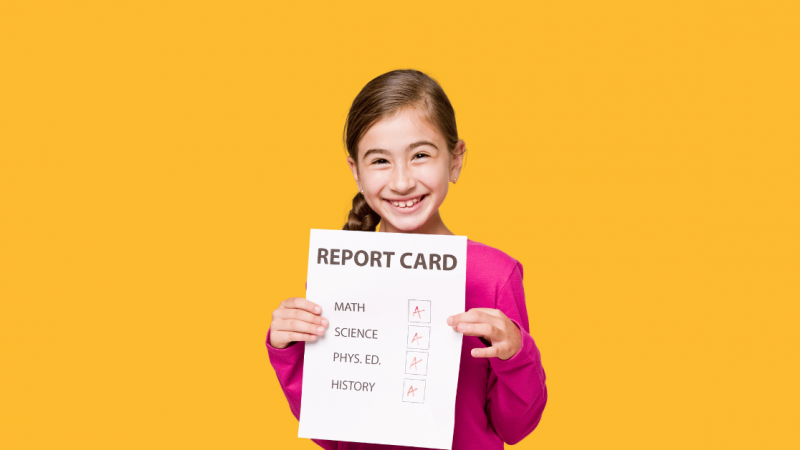
The report card generator below builds a finished report card. Enter your student’s subjects, grades, attendance, and comments, and the tools formats the whole thing and prints it. Free, no sign-up, kindergarten through twelfth grade, and it changes shape depending on the age you pick.
Or click here to open the full screen report card generator: homeschool-report-card-generator.netlify.app.
Below is everything else you might want to know: whether you need a report card at all, what belongs on one, how to grade your own child without it getting strange, and how this year’s record turns into a transcript later.
Templates, or the Generator
Both are here, free, with no email required.
Use the generator if you want the arithmetic done for you and a clean PDF at the end. It calculates GPA, formats the grading scale, and prints on one page.
Take a blank template if you would rather write by hand, or keep a file you fill in each term.
Either way, use Save to a file before you close the tab. It puts everything you entered into a small file on your own computer, and opening it next term fills the form back in. We do not keep a copy, which also means we cannot recover it for you.
A Few Notes on What This Is
This is not an official document, and it does not need to be. A homeschool report card is a record you create as the administrator of your own school. It carries whatever weight your state, your umbrella school, or a receiving institution decides to give it. This tool formats it well. It does not accredit it.
We cannot tell you what your state requires. Nothing here is legal advice. Homeschool law changes, and it varies by state and sometimes by district. Verify your obligations with your state’s department of education or with HSLDA before relying on any document to satisfy a legal requirement.
Your information stays on your computer. The generator runs entirely in your browser. Nothing you type is sent to us or stored anywhere, which is why there is no email form. The file you save is yours alone, and it contains your child’s name, grades, and attendance in plain text, so treat it the way you would any other record about your family.
If you are a VSA family, you already have official records. Your student’s report cards, grades, and transcript are issued by Veritas Scholars Academy, and those are the documents colleges and umbrella schools will want. This generator is not a substitute for them and should not be used to reproduce them. If you have questions about your student’s academic record, your Academic Advisor is the right person to ask.
Whatever you decide, the report card is a small thing next to the year it describes. You already did the hard part.
Do Homeschoolers Need Report Cards?
Sometimes yes, often no, and the reasons vary more than you might expect.
Your state or your umbrella school might require documentation. Homeschool law varies enormously across the fifty states. Some ask for nothing at all. Others require annual assessment, a portfolio review, standardized testing, or a progress report submitted to a district office. A report card sometimes satisfies these requirements and sometimes does not, because several states are specific about what form the documentation takes. If you use an umbrella or cover school, its requirements are separate from your state’s and are usually stricter. The Home School Legal Defense Association maintains current summaries of every state’s law, and that is the right place to check rather than any general article, including this one.
Co-ops and sports leagues often ask. If your student plays in a homeschool athletic league, participates in a co-op with academic prerequisites, or wants to take a class that has one, somebody will eventually ask for grades in writing.
College athletics has its own paperwork. This one catches families late. The NCAA Eligibility Center requires a homeschool transcript that includes the ninth grade start date, course titles, grades, units of credit for each course, the grading scale, and the signature of the homeschool administrator, along with a signed Administrator and Accordance Statement. That is a transcript rather than a report card, but the transcript is built from exactly the information a report card records. Families who kept yearly records find this straightforward. Families reconstructing four years from memory in the fall of senior year do not.
The car insurance reason, which deserves a correction. You will see it written that a homeschool report card gets your teenager a good student discount. Mostly it does not. Because parent-issued grades cannot be verified the way an institutional transcript can, the major carriers ask homeschooled students for standardized test scores instead, typically a score in the top 20% on the PSAT, SAT, or ACT within the last twelve months. Allstate, American Family, State Farm, and USAA all specify some version of this, and Travelers is a notable exception that accepts a signed homeschool certification. Worth knowing before you build a document expecting it to earn a discount it probably will not.
It becomes the transcript later. More on this below, but the short version is that four years of high school report cards is a transcript that assembles itself.
And there is the student. A nine-year-old who receives a real piece of paper saying what she accomplished this year, signed by her mother, tends to treat it as a bigger deal than the adults do. Some children keep them.
When you can skip it
If your state requires a portfolio or a standardized test and nothing else, and your child is seven, you do not need a report card. Keeping a homeschool portfolio will serve you better and will tell you more.
The pressure to produce school-shaped paperwork is worth resisting when nobody has actually asked for it. Make the report card when it does a job. Otherwise, put the hour into something that teaches your child something.
What Goes on a Homeschool Report Card
The generator above walks through these in order, so you can read and fill at the same time.
Identifying information. Student name, grade level, academic year, and the reporting period, whether that is a quarter, a semester, or the full year.
Your school’s name. This one stops people. You get to name it, and most families use their surname: Martin Family Academy, or simply Martin Homeschool. If you report to an umbrella school, use their name instead, since theirs is the entity issuing the record.
Courses and marks. Subject names on the left, marks on the right. High school adds credit values and course level.
Attendance. Days in session, present, and absent. Several states track instructional days, and this is where a report card earns its keep as a record rather than a keepsake.
Comments. Per subject, and one closing comment for the year.
A grading scale legend. Small and easy to forget, and it matters. A mark of S or a 3 means nothing to a reader who does not know your scale. The NCAA explicitly requires a grading scale on homeschool transcripts for this reason.
A signature line. You are the administrator of record. Sign it.
Grading Your Own Child
Here is the part nobody writes about honestly.
Assigning your own daughter a C is uncomfortable in a way that assigning a stranger’s daughter a C is not. If you have felt that, you are not being soft. You are noticing something true, which is that you occupy two roles at once, and the grade you write down affects a relationship you will still be in at dinner.
A few things make it easier.
Below roughly fourth grade, letter grades are usually the wrong instrument. They compress a year of visible growth into a single character, and they compare a child against a standard she does not know exists. Most classical and traditional schools use a mastery scale at this age instead: E for excellent, S for satisfactory, N for needs improvement, or a numeric one through four. The generator offers all of these, and letter grades too, because some families need them for an umbrella school and there is no sense pretending otherwise.
The comment carries more information than the mark. “Reads fluently and has begun choosing longer books on her own” tells you, her, and any future reader something real. An A in reading does not. For younger students, treat the mark as a formality and the comment as the actual report.
Grade the work, not the year. The temptation is to average everything into an impression, and impressions are where a hard week in February quietly becomes a B. Look at what she actually produced.
An honest low mark is a gift, given warmly. A child who is told she is doing fine at something she is not doing fine at will find out eventually, and later is worse. This is easier to write than to do, and it is worth doing anyway.
Habits and Character
Classical schools have always reported on how a student works, and not only on what he produced. Diligence, attentiveness, perseverance, care of work. These sat alongside the academic marks because they were understood to be part of the same education rather than a supplement to it.
That section is built into the generator, and it is optional. If you use it, keep it short. Five or six traits you can genuinely speak to is worth more than twenty checked off quickly. And name them accurately, because a vague word produces a vague request: a child asked to be “good” has been asked for nothing in particular, while a child told “that took patience” has been given a word for something she just did.
If you are stuck on which traits to use, we have written a working list of forty of them, grouped by family, along with what it actually takes for a trait to settle into a habit. The generator lets you pull from that list or add your own.
From Report Cards to a Transcript
Ninth grade is the line that matters.
High school credit applies to work done in ninth through twelfth grade. Coursework completed in seventh or eighth grade generally will not appear on a high school transcript, even when the material is genuinely high school level. That surprises families every year.
From ninth grade forward, the report card stops being a family record and starts being source material. Course titles, credit values, grades, and your grading scale are exactly the fields a transcript needs. Record them once a year and the transcript is a formatting exercise. Reconstruct them in senior year and it is an archaeology project.
This is the part of the process Veritas Scholars Academy handles differently, and it is worth understanding as a comparison rather than a pitch. VSA is accredited, which means its transcripts carry institutional verification that a parent-issued document cannot, and its academic advisors review each student’s transcript with the family before college applications go out. That accreditation is precisely what the insurance carriers above are looking for and not finding in a homeschool record. We have written about how VSA transcripts work and why accreditation matters, and if you would rather build your own, our free transcript generator does that too.
Neither route is the correct one for every family. A well-kept parent transcript, backed by test scores and a clear grading scale, has sent a great many students to good colleges.
Have questions? Talk to an expert for free!
Our Family Consultants are here to help! Fill out the form below to schedule a quick call for free.